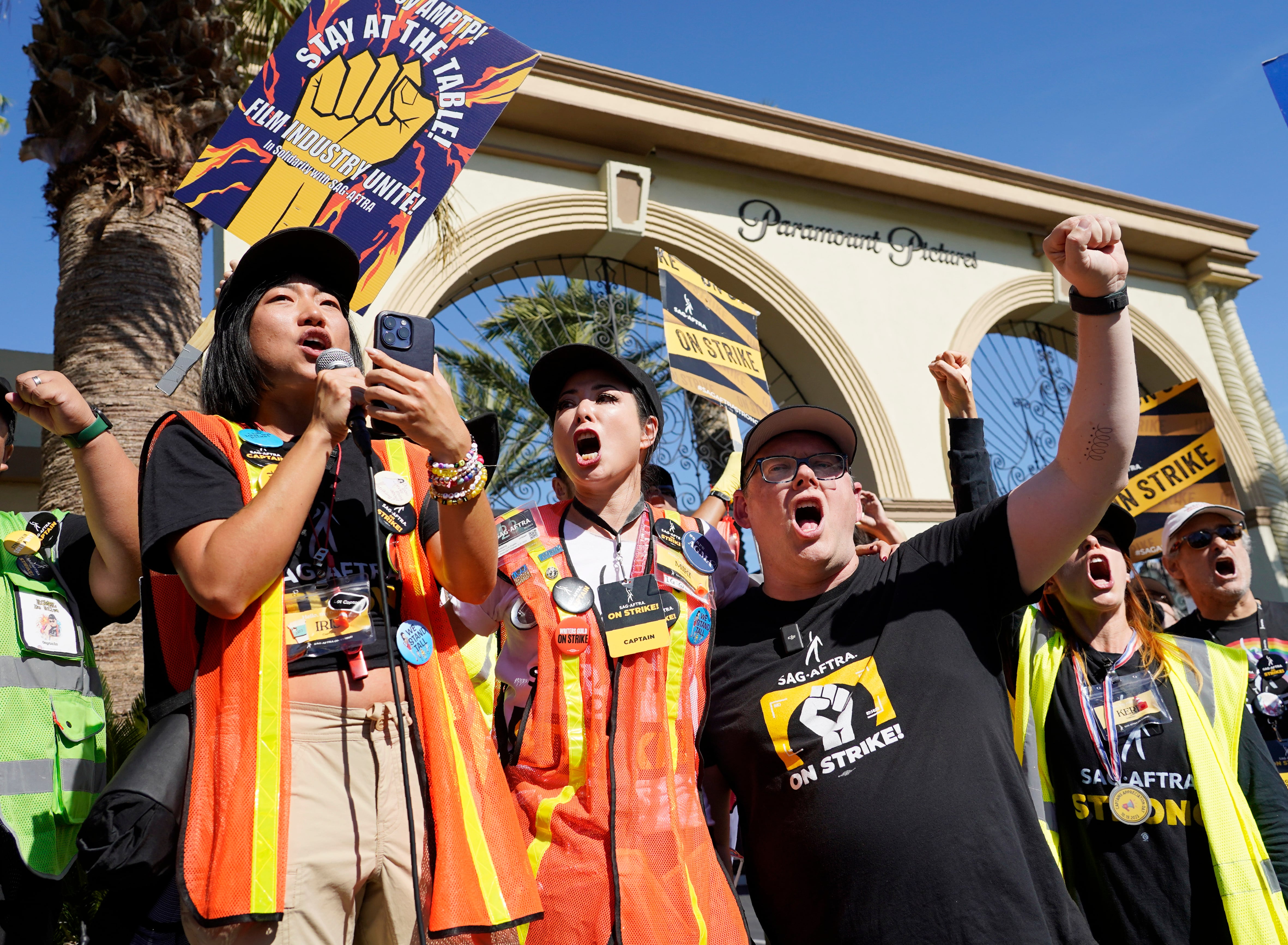
LOS ANGELES (AP) — Hollywood’s video game performers announced they would go on strike Thursday, throwing part of the entertainment industry into another work stoppage after talks for a new contract with major game studios broke down over artificial intelligence protections.
The strike — the second for video game voice actors and motion capture performers under the Screen Actors Guild-American Federation of Television and Radio Artists — will begin at 12:01 a.m. Friday. The move comes after nearly two years of negotiations with gaming giants, including divisions of Activision, Warner Bros. and Walt Disney Co., over a new interactive media agreement.
SAG-AFTRA negotiators say gains have been made over wages and job safety in the video game contract, but that the two sides remained split over the regulation of generative AI. A spokesperson for the video game producers, Audrey Cooling, said the studios offered AI protections, but SAG-AFTRA’s negotiating committee said that the studios’ definition of who constitutes a “performer” is key to understanding the issue of who would be protected.
“The industry has told us point blank that they do not necessarily consider everyone who is rendering movement performance to be a performer that is covered by the collective bargaining agreement,” SAG-AFTRA Chief Contracts Officer Ray Rodriguez said at a news conference Thursday afternoon. He said some physical performances are being treated as “data.”
Without guardrails, game companies could train AI to replicate an actor’s voice, or create a digital replica of their likeness without consent or fair compensation, the union said.
“We strike as a matter of last resort. We have given this process absolutely as much time as we responsibly can,” Rodriguez told reporters. "We have exhausted the other possibilities, and that is why we’re doing it now."
Cooling said the companies' offer “extends meaningful AI protections.”
“We are disappointed the union has chosen to walk away when we are so close to a deal, and we remain prepared to resume negotiations," she said.
Andi Norris, an actor and member of the union's negotiating committee, said that those who do stunt work or creature performances would still be at risk under the game companies' offer.
“The performers who bring their body of work to these games create a whole variety of characters, and all of that work must be covered. Their proposal would carve out anything that doesn’t look and sound identical to me as I sit here, when, in truth, on any given week I am a zombie, I am a soldier, I am a zombie soldier,” Norris said. “We cannot and will not accept that a stunt or movement performer giving a full performance on stage next to a voice actor isn’t a performer.”
The global video game industry generates well over $100 billion dollars in profit annually, according to game market forecaster Newzoo. The people who design and bring those games to life are the driving force behind that success, SAG-AFTRA said.
Members voted overwhelmingly last year to give leadership the authority to strike. Concerns about how movie studios will use AI helped fuel last year’s film and television strikes by the union, which lasted four months.
The last interactive contract, which expired in November 2022, did not provide protections around AI but secured a bonus compensation structure for voice actors and performance capture artists after an 11-month strike that began in October 2016. That work stoppage marked the first major labor action from SAG-AFTRA following the merger of Hollywood’s two largest actors unions in 2012.
The video game agreement covers more than 2,500 “off-camera (voiceover) performers, on-camera (motion capture, stunt) performers, stunt coordinators, singers, dancers, puppeteers, and background performers,” according to the union.
Amid the tense interactive negotiations, SAG-AFTRA created a separate contract in February that covered independent and lower-budget video game projects. The tiered-budget independent interactive media agreement contains some of the protections on AI that video game industry titans have rejected. Games signed to an interim interactive media agreement, tiered-budget independent interactive agreement or interim interactive localization agreement are not part of the strike, the union said.




