By Aaron Morrison and Ayanna Alexander
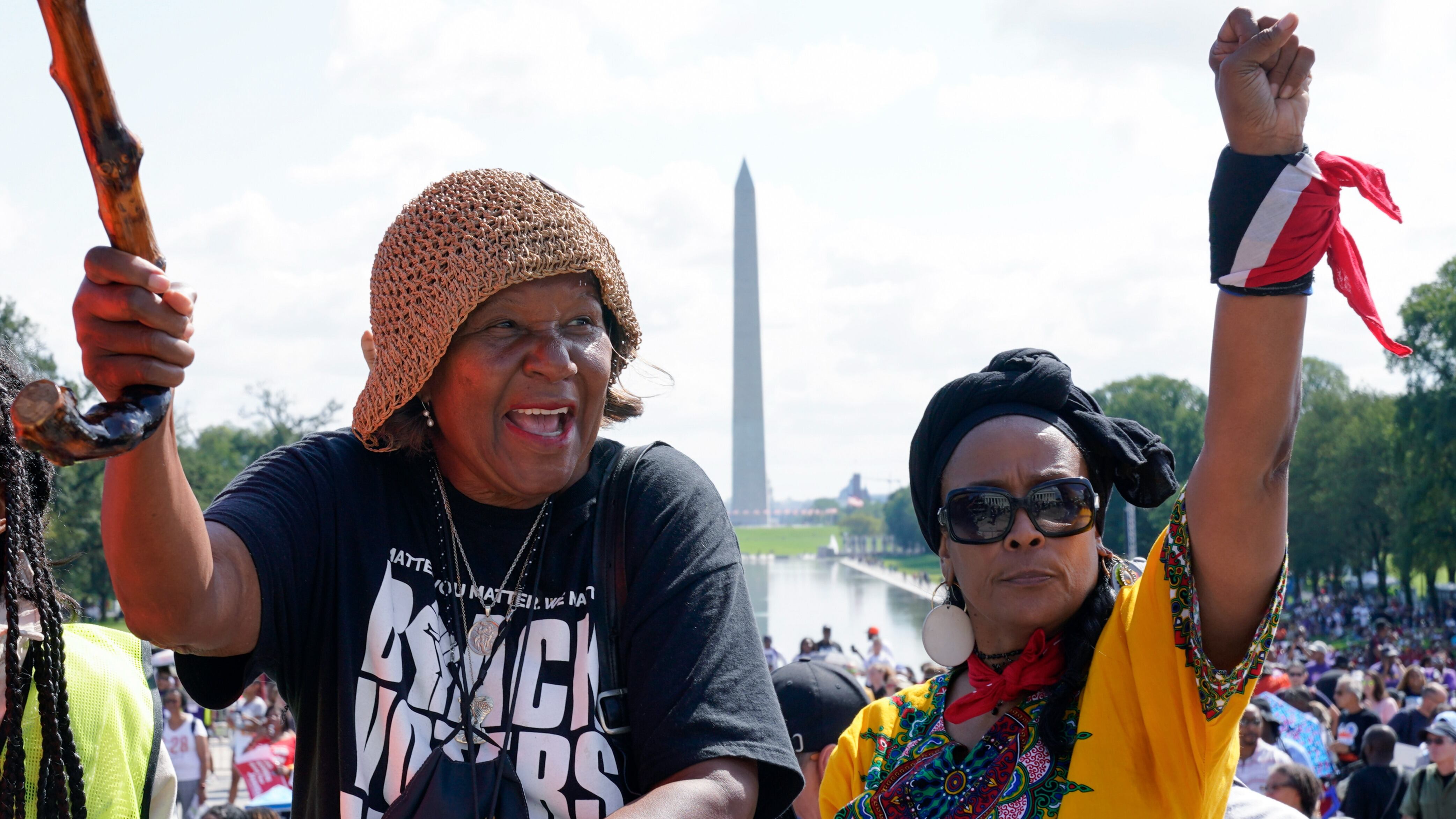
Thousands converged Saturday on the National Mall for the 60th anniversary of Rev. Martin Luther King Jr.'s March on Washington, saying a country that remains riven by racial inequality has yet to fulfill his dream.
“We have made progress, over the last 60 years, since Dr. King led the March on Washington," said Alphonso David, president and CEO of the Global Black Economic Forum. “Have we reached the mountaintop? Not by a long shot."
The event was convened by the Kings’ Drum Major Institute and the Rev. Al Sharpton 's National Action Network. A host of Black civil rights leaders and a multiracial, interfaith coalition of allies rallied attendees on the same spot where as many as 250,000 gathered in 1963 for what is still considered one of the greatest and most consequential racial justice and equality demonstrations in U.S. history.
Inevitably, Saturday's event was shot through with contrasts to the initial, historic demonstration. Speakers and banners talked about the importance of LGBTQ and Asian American rights. Many who addressed the crowd were women after only one was given the microphone in 1963.
Pamela Mays McDonald of Philadelphia attended the initial march as a child. “I was 8 years old at the original March and only one woman was allowed to speak — she was from Arkansas where I’m from — now look at how many women are on the podium today,” she said.
For some, the contrasts between the size of the original demonstration and the more modest turnout Saturday were bittersweet. “I often look back and look over to the reflection pool and the Washington Monument and I see a quarter of a million people 60 years ago and just a trickling now," said Marsha Dean Phelts of Amelia Island, Florida. “It was more fired up then. But the things we were asking for and needing, we still need them today.”
As speakers delivered messages, they were overshadowed by the sounds of passenger planes taking off from Ronald Reagan National Airport. Rugby games were underway along the Mall in close proximity to the Lincoln Memorial while joggers and bikers went about their routines.
Yolanda King, the 15-year-old granddaughter of the Rev. Martin Luther King, Jr., roused marchers with remarks delivered from the same spot her grandfather gave the “I Have A Dream” speech sixty years ago.
“If I could speak to my grandfather today, I would say I’m sorry we still have to be here to rededicate ourselves to finishing your work and ultimately realizing your dream,” she said. “Today, racism is still with us. Poverty is still with us. And now, gun violence has come for places of worship, our schools and our shopping centers.”
From the podium, Sharpton promised more demonstrations to push back against injustices, new and old.
“Sixty years ago Martin Luther King talked about a dream. Sixty years later we’re the dreamers. The problem is we’re facing the schemers,” Sharpton said. “The dreamers are fighting for voting rights. The schemers are changing voter regulations in states. The dreamers are standing up for women’s right to choose. The schemers are arguing whether they are going to make you stop at six weeks or 15 weeks."
After the speeches, the crowd marched to the Martin Luther King Jr. Memorial.
Several leaders from groups organizing the march met Friday with Attorney General Merrick Garland and Assistant Attorney General Kristen Clarke of the civil rights division, to discuss a range of issues, including voting rights, policing and redlining.
Saturday's gathering was a precursor to the actual anniversary of the Aug. 28, 1963 March on Washington. President Joe Biden and Vice President Kamala Harris will observe the march anniversary on Monday by meeting with organizers of the 1963 gathering. All of King’s children have been invited to meet with Biden, White House officials said.
Martin Luther King Jr.'s Washington remarks have resounded through decades of push and pull toward progress in civil and human rights. But dark moments followed his speech, too.
Two weeks later in 1963, four Black girls were killed in the 16th Street Baptist Church bombing in Birmingham, Alabama, followed by the kidnapping and murder of three civil rights workers in Neshoba County, Mississippi the following year. The tragedies spurred passage of the Civil Rights Act of 1964.
The voting rights marches from Montgomery to Selma, Alabama, in which marchers were brutally beaten while crossing the Edmund Pettus Bridge in what became known as “Bloody Sunday,” forced Congress to adopt the Voting Rights Act of 1965.
Speakers warned that King's unfinished dream was in danger of being further whittled away. “I’m very concerned about the direction our country is going in," Martin Luther King III said. "And it is because instead of moving forward, it feels as if we’re moving back. The question is, what are we going to do?”
Rosetta Manns-Baugh knew the answer: Keep fighting.
“I think we have accomplished a lot, but I also think we lost." said Manns-Baugh, who was a Trailways bus counter worker in 1963 when she left her seven children and husband at home in Virginia to come to D.C. Now she's so disillusioned she's stopped singing “We Shall Overcome,” the anthem of the civil rights movement.
But even at age 92, she returned to Washington for the 60th anniversary, bringing three generations of her family, all the way down to her 18-month-old grandchild. “I think that’s why we all are here because we do expect the world to get better," Manns-Baugh said. "We can’t stop working at it that’s for sure.”
Associated Press journalists Gary Fields, Jacquelyn Martin, Julie Walker and Nicholas Riccardi in Denver contributed to this report.