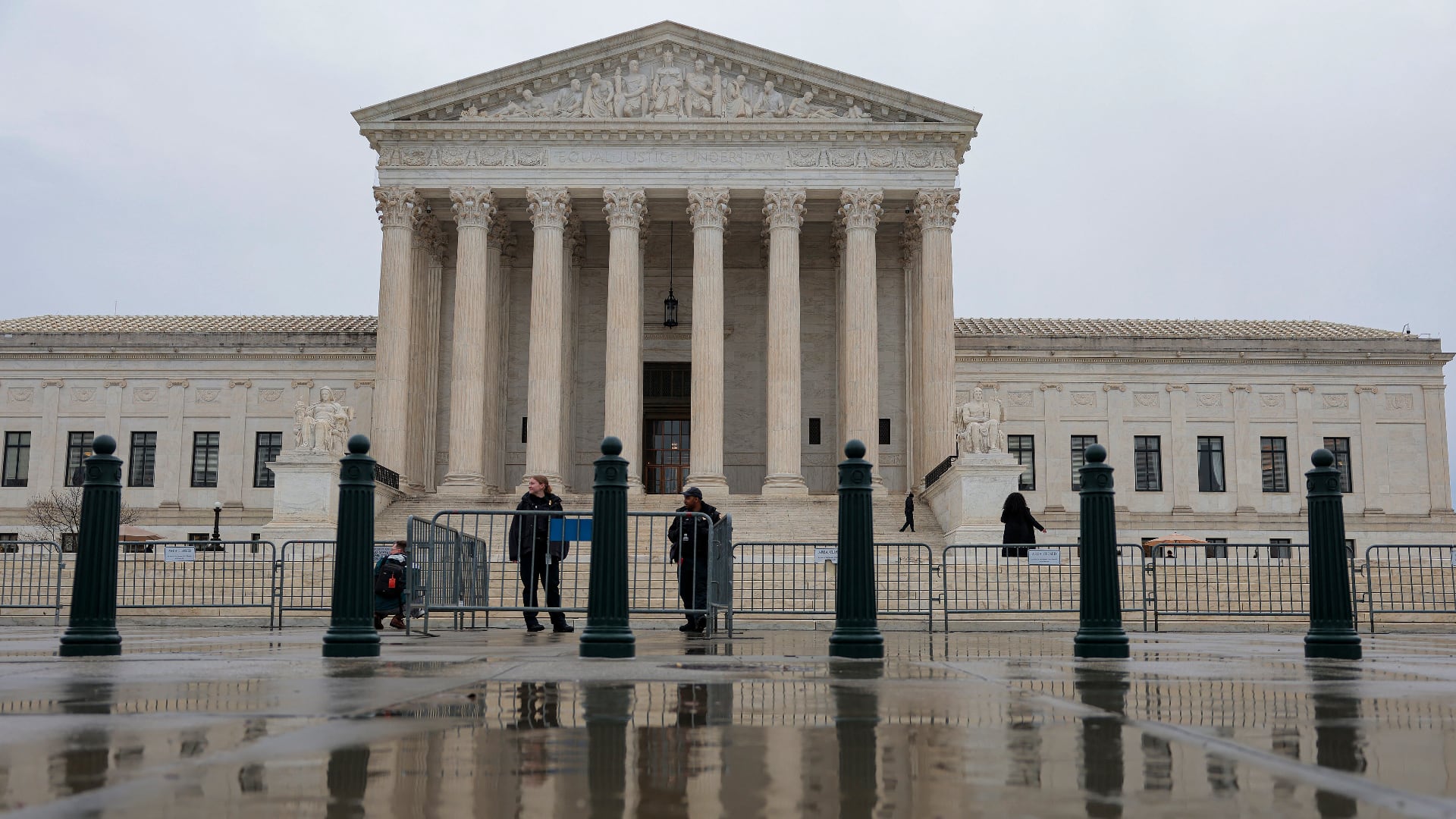
The Supreme Court on Thursday allowed construction to resume on a contested natural-gas pipeline that is being built through Virginia and West Virginia.

Work on the Mountain Valley Pipeline had been blocked by the 4th U.S. Circuit Court of Appeals in Richmond, Virginia, even after Congress ordered the project's approval as part of the bipartisan bill to increase the debt ceiling. President Joe Biden signed the bill into law in June.

The high court's order came as a three-judge panel of the appeals court was hearing arguments in the case.

The Biden administration backed the company in calling for the Supreme Court’s intervention.

“All necessary permits have been issued and approved, we passed bipartisan legislation in Congress, the president signed that legislation into law, and now the Supreme Court has spoken: construction on the Mountain Valley Pipeline can finally resume, which is a major win for American energy and American jobs,” West Virginia Republican Sen. Shelley Moore Capito said in a statement.

Sen. Joe Manchin, a West Virginia Democrat who was a key vote for last year’s sweeping legislation, said on X, the social media platform formerly known as Twitter, that the Supreme Court’s decision “is the correct one.”

Lawyers for the company said they needed quick Supreme Court action to keep plans on track to finish building the 300-mile (500-kilometer) pipeline and put it into service by the winter, when the need for natural gas for heating grows.

Environmental groups have opposed the the $6.6 billion project, designed to meet growing energy demands in the South and Mid-Atlantic by transporting gas from the Marcellus and Utica fields in Pennsylvania and Ohio.

The 4th Circuit panel did not immediately rule on Mountain Valley Pipeline’s motion to dismiss challenges to the project over concerns about the pipeline’s impact on endangered species, erosion and stream sedimentation.

Opponents said they will continue to try to stop construction on the project and are eager to see how the 4th Circuit rules.

“All The Supreme Court did today was weigh in on a preliminary stay. The 4th Circuit still has the meat of the case and they can still grant final relief," said DJ Gerken, executive director of the Southern Environmental Law Center.

“We still believe it’s unconstitutional," he said.

Any ruling by the 4th Circuit would be subject to potential review by the Supreme Court.

In court papers, lawyers for the pipeline argued that Congress was within its rights to strip the 4th Circuit from jurisdiction over the case. They also said that any debate over the law’s constitutionality should be heard not by the 4th Circuit but by an appellate court in Washington, because the law passed by Congress last month spells out that precise scenario.

Mountain Valley Pipeline said the work is largely complete, except for a 3-mile (5-kilometer) section that cuts through the Jefferson National Forest.

“In accordance with the project’s strict safety standards and environmental requirements of the issued permits, we look forward to completing this important infrastructure project,” spokesperson Natalie Cox said in a statement.

West Virginia Attorney General Patrick Morrisey, who had asked the Supreme Court to take up the case, said after the ruling that there was an “urgent need” for the pipeline to be completed without delay.

Jamie Williams, president of The Wilderness Society, said in a statement that allowing the pipeline to proceed “puts the profits of a few corporations ahead of the health and safety of Appalachian communities."

“The Mountain Valley Pipeline is a threat to our water, our air, and our climate,” Williams said.

Derek Teaney, an attorney for Appalachian Mountain Advocates, told the 4th Circuit that Congress’ action last month requiring that all necessary permits be issued for the pipeline's construction “crosses the fence between the judicial power and the legislative power.”

At the end of the hearing, 4th Circuit Judge James A. Wynn commended attorneys on both sides for the work they've done.

”If we grant the motion, this is probably the last time we’re going to see you," he said. “We don’t know where we’ll go from here.”

Associated Press writers John Raby in Charleston, West Virginia, and Denise Lavoie in Richmond, Virginia, contributed to this report.

Share:
More In Politics
US tariffs are having an uneven effect on holiday prices and purchases
Many U.S. consumers say they’ve noticed higher than usual prices for holiday gifts in recent months, according to a a December poll from The Associated Press-NORC Center for Public Affairs Research. A contributing factor is the unusually high import taxes the Trump administration put on foreign goods. While the worst-case consumer impact that many economists foresaw from the administration’s trade policies hasn’t materialized, some popular gift items have been affected more than others. Most toys and electronics sold in the U.S. come from China. So do most holiday decorations. Jewelry prices have risen due to the cost of gold.
Serbia organized crime prosecutors charge minister, others in connection with Kushner-linked project
Serbia’s prosecutor for organized crime has charged a government minister and three others with abuse of position and falsifying of documents related to a luxury real estate project linked to U.S. President Donald Trump’s son-in-law Jared Kushner. The charges came on Monday. The investigation centers on a controversy over a a bombed-out military complex in central Belgrade that was a protected cultural heritage zone but that is facing redevelopment as a luxury compound by a company linked to Kushner. The $500 million proposal to build a high-rise hotel, offices and shops at the site has met fierce opposition from experts at home and abroad. Selakovic and others allegedly illegally lifted the protection status for the site by falsifying documentation.
Trump signs executive order to block state AI regulations
President Donald Trump has signed an executive order to block states from regulating artificial intelligence. He argues that heavy regulations could stifle the industry, especially given competition from China. Trump says the U.S. needs a unified approach to AI regulation to avoid complications from state-by-state rules. The order directs the administration to draw up a list of problematic regulations for the Attorney General to challenge. States with laws could lose access to broadband funding, according to the text of the order. Some states have already passed AI laws focusing on transparency and limiting data collection.
New York Times, after Trump post, says it won’t be deterred from writing about his health
The New York Times and President Donald Trump are fighting again. The news outlet said Wednesday it won't be deterred by Trump's “false and inflammatory language” from writing about the 79-year-old president's health. The Times has done a handful of stories on that topic recently, including an opinion column that said Trump is “starting to give President Joe Biden vibes.” In a Truth Social post, Trump said it might be treasonous for outlets like the Times to do “FAKE” reports about his health and "we should do something about it.” The Republican president already has a pending lawsuit against the newspaper for its past reports on his finances.
Trump approves sale of more advanced Nvidia computer chips used in AI to China
President Donald Trump says he will allow Nvidia to sell its H200 computer chip used in the development of artificial intelligence to “approved customers” in China. Trump said Monday on his social media site that he had informed China’s leader Xi Jinping and “President Xi responded positively!” There had been concerns about allowing advanced computer chips into China as it could help them to compete against the U.S. in building out AI capabilities. But there has also been a desire to develop the AI ecosystem with American companies such as chipmaker Nvidia.
Swing district Republicans brace for political fallout if health care subsidies expire
House Republicans in key battleground districts are working to contain the political fallout expected when thousands of their constituents face higher bills for health insurance coverage obtained through the Affordable Care Act. For a critical sliver of the GOP majority, the impending expiration of the enhanced premium tax credits after Dec. 31 could be a major political liability as they potentially face midterm headwinds in a 2026 election critical to President Donald Trump’s agenda. For Democrats, the party’s strategy for capturing the House majority revolves around pinning higher bills for groceries, health insurance and utilities on Republicans.
Load More