By Michael Phillis
As the Biden administration makes billions of dollars available to remove millions of dangerous lead pipes that can contaminate drinking water and damage brain development in children, some states are turning down funds.
Washington, Oregon, Maine and Alaska declined all or most of their federal funds in the first of five years that the mix of grants and loans is available, The Associated Press found. Some states are less prepared to pay for lead removal projects because, in many cases, the lead must first be found, experts said. And communities are hesitant to take out loans to search for their lead pipes.
States shouldn't “shrug their shoulders” and pass up funds, said Erik Olson, a health and food expert at the environmental group Natural Resources Defense Council.
“It's troubling that a state would decide to take a complete pass on the funding because part of the reason for the funding is to figure out whether you even have lead," Olson said.
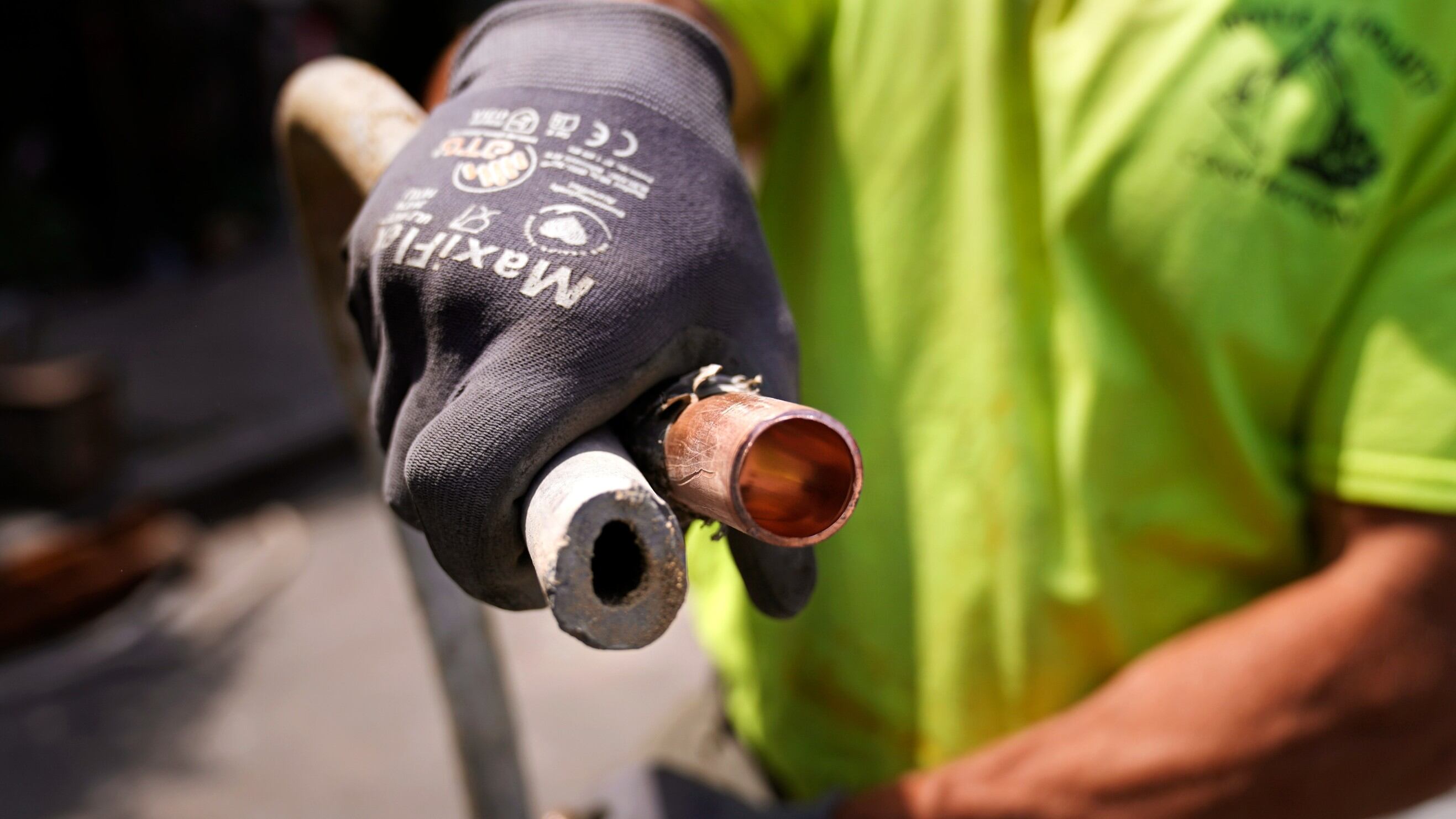
The Biden administration wants to remove all 9.2 million lead pipes carrying water to U.S. homes. Lead can lower IQ and create behavioral problems in children. The 2021 infrastructure law provides $15 billion to find and replace them. That money will help a lot, but it isn’t enough to get all the toxic pipes out of the ground. State programs distribute the federal funds to utilities.
The Environmental Protection Agency said it is reviewing state requests to decline funds but did not provide a full list of states that have said no so far. That information will be available in October, officials said. States that declined first-year funds can still accept them during the remaining four years.
“EPA has been working closely with our state partners on utilizing Bipartisan Infrastructure Law funding that is available,” the agency said.
Lead pipes are far more common in some states such as Michigan and Illinois, which each have hundreds of thousands. The harm there is clear. Flint’s lead crisis elevated lead in tap water to a national health issue. Residents of Benton Harbor, Michigan, drank water with too much lead for years until all their lead pipes were replaced. In response, however, Michigan is clamoring for as much money as it can get to remove lead.
The states that declined funds have fewer problematic pipes, but that doesn’t mean lead isn’t an issue. There’s concern about lead in some Maine schools. Portland, Oregon, has struggled with high lead levels for years, although recent tests have been better and officials say the issue isn’t lead pipes, but household plumbing.
Washington accepted $85,000 of $63 million it could have taken and said the decision was based on the limited number of water systems that wanted loans. The EPA estimates the state has 22,000 lead pipes. Oregon, which could have accepted $37 million, said inventories are going to be done with existing staff and resources, adding that utilities have no known lead lines. The EPA projected that the state has 3,530 lead pipes — a relatively small number — based in part on information collected from utilities.
The location of many lead pipes is a mystery. The EPA is requiring communities to provide initial inventories of their lead pipes by October 2024. Maine, which banned lead pipes far earlier than most states, said other funds would be used for inventories and they didn’t have lead replacement projects ready to fund. Most states that rejected funding initially indicated they would probably ask for money in later years.
To access the grants, there also needs to be demand for loans but utilities are hesitant to seek them out, according to Deirdre Finn, executive director of the Council of Infrastructure Financing Authorities, a group that represents the federally funded state programs that distribute infrastructure funds.
“This is a great opportunity,” Finn said. “But it would be helpful if states and utilities had access to 100% grant funding to move these projects along.”
Federal funds can only go to replacement projects that remove the entire lead pipe. Lead pipes run from the water main in the street to homes, but the ownership of the pipe is often split between the utility and homeowner. Some cities replace just the portion they own — a harmful practice that spikes lead levels — and paying to replace the homeowner's side is often a problem. Grants can help utilities pay to replace the homeowner's side, Finn said.
The EPA offered early funds based on a state's general drinking water infrastructure needs — not the number of lead pipes. The EPA later developed estimates of each state's lead pipes to inform how future years of funding should be distributed. Therefore, some states were offered more early money than they can spend.
In May, for example, Alaska told the EPA it wanted just $6.8 million of the $28 million it was entitled to receive. Carrie Bohan, facilities program manager in the division of water at the Alaska Department of Environmental Conservation, said utilities' demand for loans to inventory their systems for lead pipes is “very, very small.” But over five years, there will be plenty of federal funds available to find the small number of lead pipes in Alaska and replace them.
Money that’s not used will be redistributed to other states that need it.
“I think it’s a potential disservice to other states if we were to apply for the full amount knowing that we couldn’t make use of it,” Bohan said.
But just figuring out how to distribute the money based on need is difficult. In April, the EPA's lead pipe estimate surprised some experts by predicting that Florida had 1.16 million, the most of any state.
The higher estimate meant Florida would get more funds, but the state objected, arguing its utilities would find far more lead in the tap water if it really had that many lead pipes.
“Once these lead line surveys are completed, it is expected that the actual extent of facilities with lead service lines documented in Florida will be significantly less than what was estimated by the EPA,” said Brian Miller, a spokesperson with the Florida Department of Environmental Protection.
The Associated Press receives support from the Walton Family Foundation for coverage of water and environmental policy. The AP is solely responsible for all content. For all of AP’s environmental coverage, visit https://apnews.com/hub/climate-and-environment