Former President Donald Trump’s new proposal to exclude tips from federal taxes is getting strong reviews from some Republican lawmakers, though major questions remain about the impact of the policy and how it would work.
What's certain is that a change in the taxation of tips would affect millions. The U.S. Bureau of Labor Statistics estimates there are 2.24 million waiters and waitresses across the country, with tips making up a large percentage of their income.
A look at what Trump's proposing and the possible political and economic ramifications:
TRUMP'S ELECTION-YEAR PITCH IN NEVADA
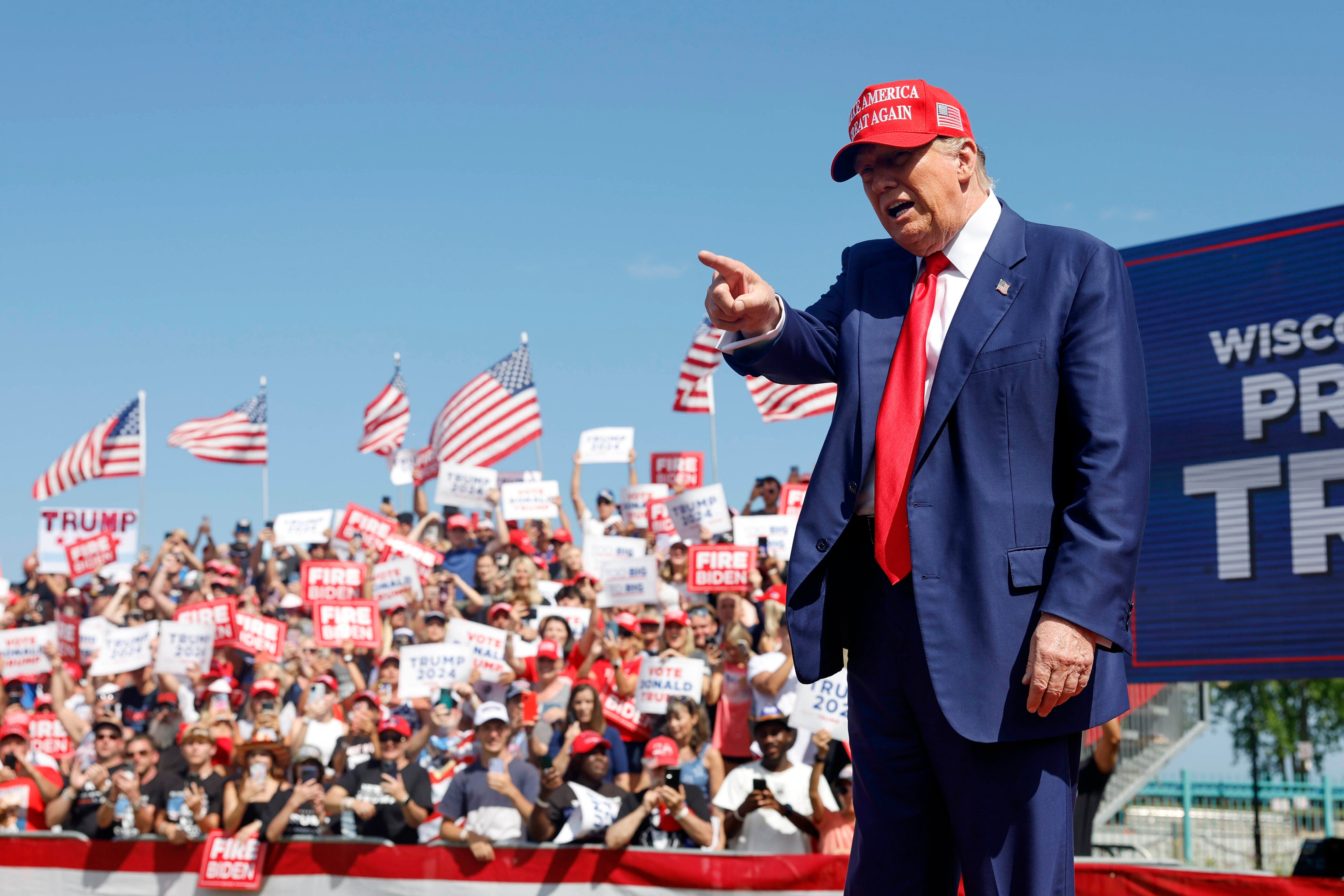
Trump announced his tax-free-tips plan at a June 9 rally in Nevada, a key battleground state with six electoral votes in the race for the White House. President Joe Biden won the state in 2020, but the Trump campaign hopes to put the state in play this fall.
Nevada has the highest concentration of tipped workers in the country, with about 25.8 waiters and waitresses per 1,000 jobs, followed by Hawaii and Florida.
“To those hotel workers and people who get tips, you are going to be very happy, because when I get to office we are going to not charge taxes on tips, people making tips,” Trump said at the rally. “... We’re going to do that right away, first thing in office.”
The pitch sets up a sharp political contrast between Democrats and Republicans. While Trump assumes that a tax cut would help workers, Democrats have generally endorsed efforts to increase hourly wages — and it’s an open question which approach resonates more with voters.
The Culinary Union, which represents 60,000 workers in Las Vegas and Reno and is backing Biden, dismissed Trump’s plan as a stunt.
“Relief is definitely needed for tip earners, but Nevada workers are smart enough to know the difference between real solutions and wild campaign promises from a convicted felon.” Culinary Union Secretary-Treasurer Ted Pappageorge said in a statement.
Lael Brainard, director of the White House National Economic Council, declined to speak to the idea floated by Trump because, as a federal employee, she’s not supposed to talk campaign politics.
“What I can say is that President Biden has fought for real solutions that actually address workers’ legitimate need for fair wages, we think, much more effectively,” she said, adding that tipped workers in Nevada would get a $6,000 income boost from a higher minimum wage and the elimination of the tipped minimum wage.
HOW WOULD THE TAX EXEMPTION WORK?
Trump has not specified whether he wants to exempt tips from just income taxes or from the payroll tax as well. The payroll tax funds Medicare and Social Security.
For workers, a blanket exemption would mean more take-home pay. And for the federal government, it could mean larger budget deficits.
The Committee for a Responsible Federal Budget, a nonpartisan fiscal watchdog group, has estimated that exempting tips from both income and payroll taxes would reduce federal revenues by $150 billion to $250 billion over the next decade.
The committee said exempting tips from taxation would also lead employers and workers to reclassify wages as tips where possible. The more that happens, the more that federal deficits would increase. A 10% increase in tips, for example, would bump up the committee’s projection for lost federal revenue to a range of $165 billion to $275 billion over the next decade.
Congress undoubtedly would examine Trump’s proposal on tips as it considers which portions of the 2017 Tax Cuts and Jobs Act are allowed to expire after next year, including the lower individual tax rates. Lawmakers are already prepping for the task, though Trump’s proposal is something that many had not thought about until recently.
Rep. Vern Buchanan, R-Fla., a senior House Ways and Means Committee member, said lawmakers will have to consider the overall cost of the tips proposal and how to pay for it.
“I want to be sensitive because they work hard, you can’t find enough waiters, and obviously a big part of their earnings is tips,” Buchanan said. “All these programs sound good. Everybody would like to pay less taxes, but we’ve got to pay the bills.”
“I know he’s trying to make sure the people at that income level have relief as much as possible. We might be able to do the same thing in making his tax cuts more permanent and more likely to address lower-income people,” said Rep. Kevin Hern, R-Okla., who also serves on the Ways and Means Committee, which has jurisdiction over tax policy.
TRADE-OFFS OF NOT TAXING TIPS
Like many tax proposals, Trump’s push to exempt tips could have unintended consequences.
Howard Gleckman, a senior fellow at the Tax Policy Center, a joint venture of the Urban Institute and Brookings Institution, argues that Trump’s proposal could actually backfire for many tipped workers.
For example, some customers may respond to tax-free tips by reducing their gratuity. Secondly, it could take the steam out of efforts in some states to gradually increase the minimum wage for tipped workers so that their base pay is in line with the minimum wage for other workers.
“The lure of tax-free income could turn many workers against the shift from tips to wages,” Gleckman wrote in a blog post.
Gleckman also questioned why a service worker should avoid paying taxes on tips as opposed to a warehouse worker earning the same amount. He noted that while Trump promised to repeal the tax on tips right away, only Congress can repeal federal taxes, and “for reasons of efficiency, fairness, and sound tax administration, let’s hope it doesn’t.”
LOOKING AHEAD
Democrats have largely dismissed Trump's proposal as a gimmick to win over voters.
Sen. Debbie Stabenow, a senior member of the Senate Finance Committee, noted she was a waitress in college, calling it “really hard work.” She prefers increasing the minimum wage for tipped workers to match the minimum wage for other workers.
“From my perspective, I don’t think (Trump’s) proposal is serious and I don’t think it does enough to address low-wage working people,” Stabenow said.
Sen. Ron Wyden, the chairman of the Senate Finance Committee, said Trump was “throwing out lots of ideas as he goes,” but his record as president reflects an emphasis on tax breaks for the wealthy and corporations.
“All these things he throws out every day, I’ll believe it when I see it,” Wyden said.
But Trump's enthusiasm for the idea seems to be growing. The tax promise has since become a staple of Trump’s rallies and meetings, and he raised his proposal while meeting with GOP lawmakers and business leaders in Washington last week.
“I think it’s actually a very smart idea. The men and women who rely on tips for their earnings, they are working their tails off,” said Sen. Ron Johnson, R-Wis. “That’s very good, targeted tax reform right there.”
Some lawmakers and allies have begun tweeting photos of their restaurant bills with handwritten messages designed to spread the word about Trump’s promise. Rep. Derrick Van Orden, R-Wis., wrote “Vote Trump!” and “No Tax on tips!” on his bill from a Milwaukee restaurant.
The musician Kid Rock, a prominent Trump supporter, shared a photo on X.
“A vote for Trump is a vote for no tax on tips!!” he wrote on his receipt. He tipped $400 on a $1,143 bill at a pricey steakhouse, according to the photo.