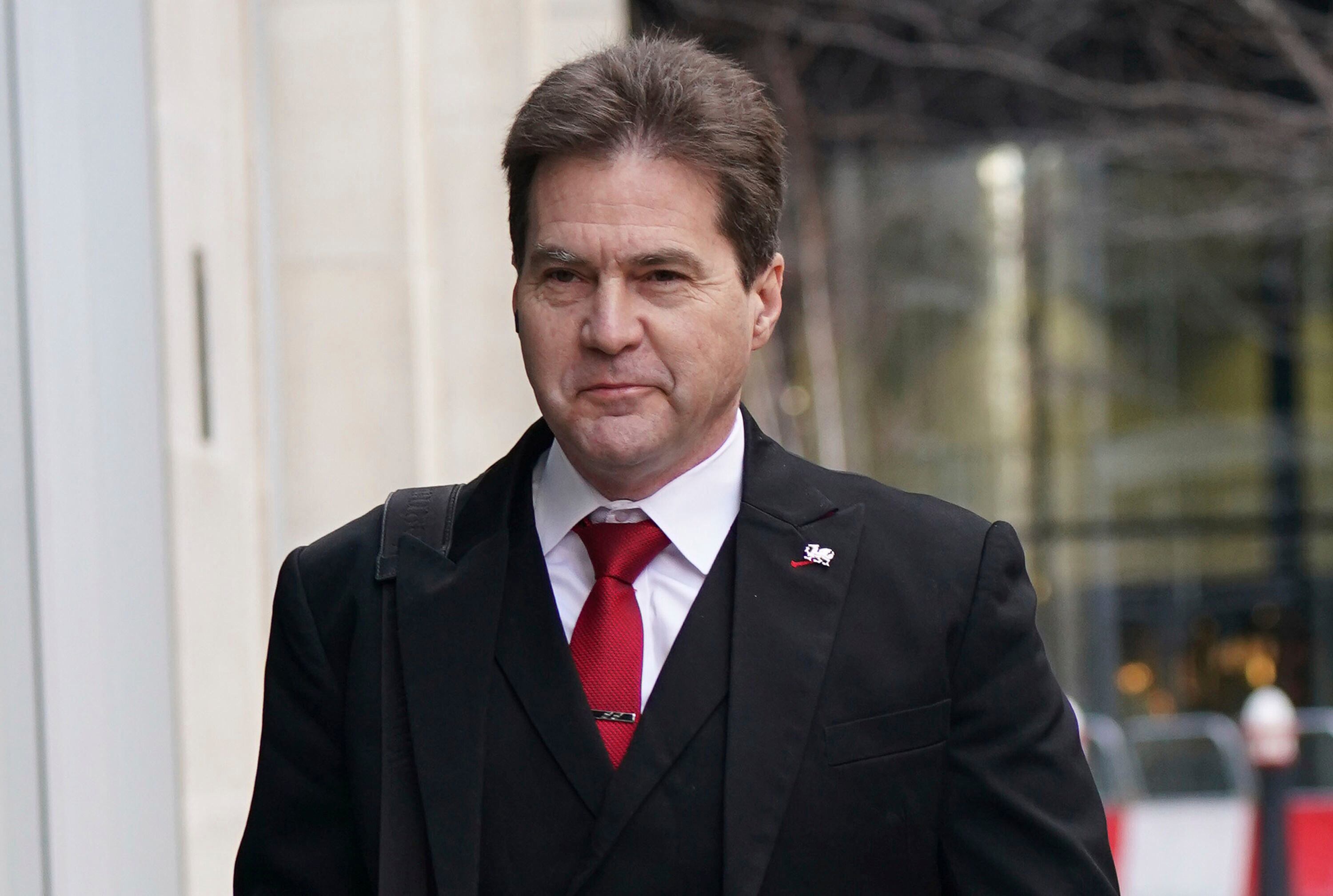
LONDON (AP) — An Australian computer scientist found to have falsely claimed to be the mysterious creator of the bitcoin cryptocurrency will be referred to British prosecutors for “wholescale perjury and forgery of documents,” a London judge said Tuesday.

Judge James Mellor, who ruled after a civil trial in March that Craig Wright was not the man behind “Satoshi Nakamoto,” the pseudonym that has masked the creator of bitcoin's identity, said he will refer evidence from the case to the Crown Prosecution Service to consider whether to bring charges.

“In advancing his false claim to be Satoshi through multiple legal actions, Dr. Wright committed ‘a most serious abuse’ of the process of the courts of the U.K., Norway and the U.S.A.," Mellor said. "If what happened in this case does not warrant referral to the CPS, it is difficult to envisage a case which would.”

Mellor had ruled at trial that Wright did not invent bitcoin, was not the man behind Nakamoto, or creator of the bitcoin software.

The murky origins of bitcoin date to the height of the financial crisis in 2008, when a person or group using the Nakamoto pen name issued a paper explaining how digital currency could be sent around the world anonymously, without banks or national currencies.

Speculation on the identity of Nakamoto swirled for years and several candidates had emerged when Wright emerged to claim the identity in 2016, only to quickly return to the shadows, saying he didn’t “have the courage” to provide more proof.

In what was considered a major victory for open source developers, a nonprofit group of technology and crypto companies successfully sued in the High Court to prove Wright is not Nakamoto.

The Crypto Open Patent Alliance (COPA) had argued that Wright had committed “forgery on an industrial scale” to support a “brazen lie” he was Nakamoto. The alliance said he used his claim as bitcoin’s inventor to “terrorize” developers by filing litigation to prevent them from further developing the open-source technology.

Wright, who testified over several days of the five-week trial, denied the allegations. In May, he said on the social media platform X that he plans to appeal the decision “on the matter of the identity issue.”

The trial had implications for control of the intellectual property rights of the world’s most popular virtual currency. The ruling affected three pending lawsuits Wright filed based on his claim to having the intellectual property rights to bitcoin.

Mellor granted two injunctions Tuesday preventing Wright from threatening to sue or filing lawsuits aimed at developers.

He also ordered Wright to publish details of the ruling against him to "dispel residual uncertainty” that he's not Nakamoto and post notices to that effect on his website and his profile on X, the social media platform, and his Slack channels.

Messages seeking comment from Wright’s attorneys were not immediately returned.

Bitcoin is the world’s most high-profile digital currency, and like others is not tied to any bank or government. Like cash, it allows users to spend and receive money anonymously, or mostly so. It can be converted to cash when deposited into accounts at prices set in online trading.

Share:
More In Technology
Spain fines Airbnb $75 million for unlicensed tourist rentals
Spain's government has fined Airbnb 64 million euros or $75 million for advertising unlicensed tourist rentals. The consumer rights ministry announced the fine on Monday. The ministry stated that many listings lacked proper license numbers or included incorrect information. The move is part of Spain's ongoing efforts to regulate short-term rental companies amid a housing affordability crisis especially in popular urban areas. The ministry ordered Airbnb in May to remove around 65,000 listings for similar violations. The government's consumer rights minister emphasized the impact on families struggling with housing. Airbnb said it plans to challenge the fine in court.
Militant groups are experimenting with AI, and the risks are expected to grow
The Islamic State group and other militant organizations are experimenting with artificial intelligence as a tool to boost recruitment and refine their operations. National security experts say that just as businesses, governments and individuals have embraced AI, extremist groups also will look to harness the power of AI. That means aiming to improve their cyberattacks, breaking into sensitive networks and creating deepfakes that spread confusion and fear. Leaders in Washington have responded with calls to investigate how militant groups are using AI and seek ways to encourage tech companies to share more about how their products are being potentially misused.
Trump signs executive order to block state AI regulations
President Donald Trump has signed an executive order to block states from regulating artificial intelligence. He argues that heavy regulations could stifle the industry, especially given competition from China. Trump says the U.S. needs a unified approach to AI regulation to avoid complications from state-by-state rules. The order directs the administration to draw up a list of problematic regulations for the Attorney General to challenge. States with laws could lose access to broadband funding, according to the text of the order. Some states have already passed AI laws focusing on transparency and limiting data collection.
San Francisco woman gives birth in a Waymo self-driving taxi
Waymo's self-driving taxis have been in the spotlight for both negative and positive reasons. This week, the automated ride-hailing taxis went viral after a San Francisco woman gave birth inside a Waymo taxi while on her way to the hospital. A Waymo spokesperson on Wednesday confirmed the unusual delivery. It said the company's rider support team detected unusual activity inside the vehicle and alerted 911. The taxi arrived safely at the hospital before emergency services. Waymo's popularity is growing despite heightened scrutiny following an illegal U-turn and the death of a San Francisco cat. The company, owned by Alphabet, says it is proud to serve riders of all ages.
OpenAI names Slack CEO Dresser as first chief of revenue
OpenAI has appointed Slack CEO Denise Dresser as its first chief of revenue. Dresser will oversee global revenue strategy and help businesses integrate AI into daily operations. OpenAI CEO Sam Altman recently emphasized improving ChatGPT, which now has over 800 million weekly users. Despite its success, OpenAI faces competition from companies like Google and concerns about profitability. The company earns money from premium ChatGPT subscriptions but hasn't ventured into advertising. Altman had recently announced delays in developing new products like AI agents and a personal assistant.
Trump approves sale of more advanced Nvidia computer chips used in AI to China
President Donald Trump says he will allow Nvidia to sell its H200 computer chip used in the development of artificial intelligence to “approved customers” in China. Trump said Monday on his social media site that he had informed China’s leader Xi Jinping and “President Xi responded positively!” There had been concerns about allowing advanced computer chips into China as it could help them to compete against the U.S. in building out AI capabilities. But there has also been a desire to develop the AI ecosystem with American companies such as chipmaker Nvidia.
Load More