A Moscow court on Thursday ruled that Wall Street Journal reporter Evan Gershkovich must remain in jail on espionage charges until at least late August, rejecting the American journalist’s appeal to be released.
The 31-year-old U.S. citizen was arrested in late March while on a reporting trip. A Moscow court ruled last month to keep him in custody until Aug. 30, but his lawyers had challenged the decision.
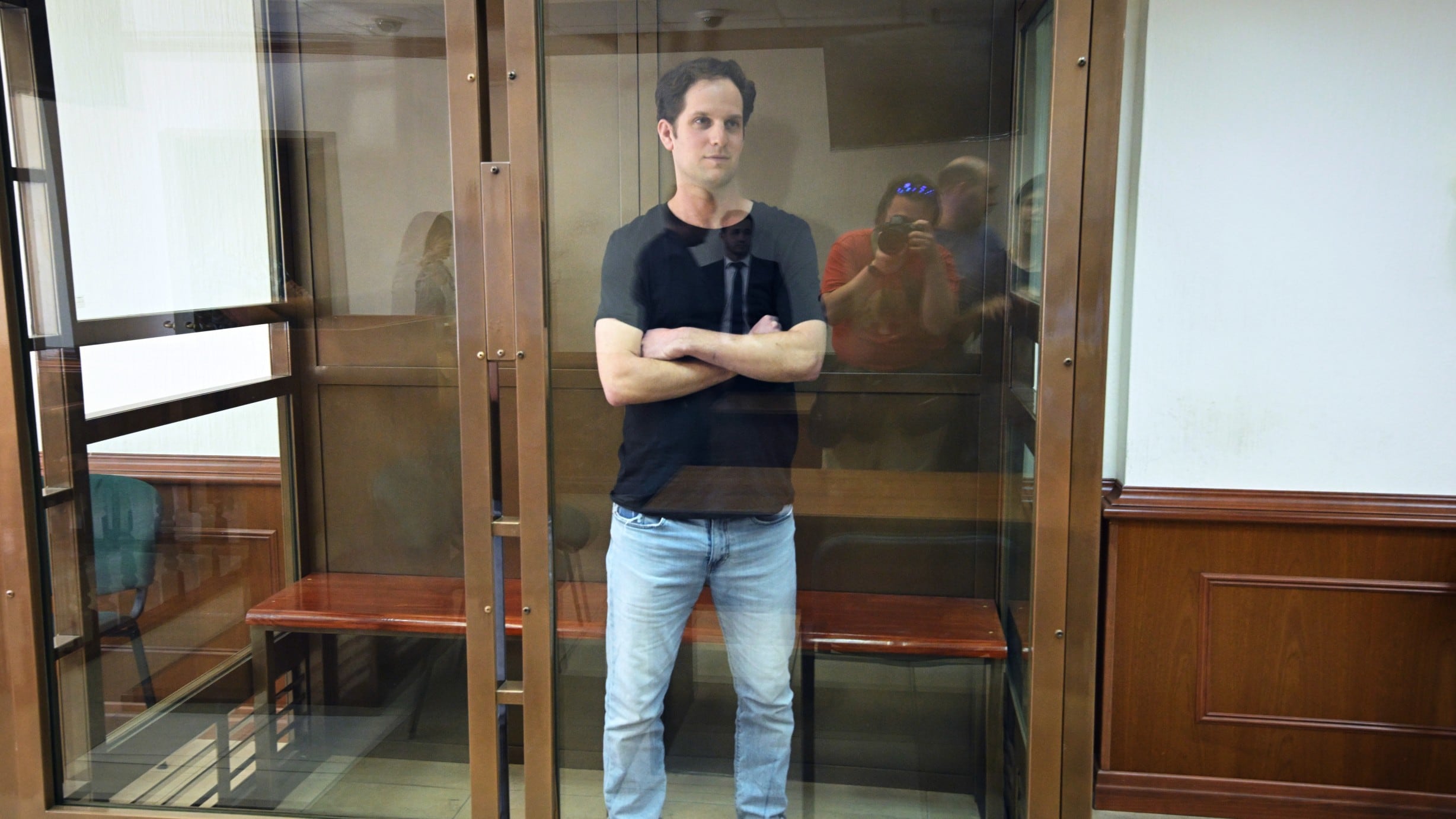
Gershkovich, wearing a black T-shirt and light blue jeans, looked tense and paced inside a glass defendant’s cage while waiting for the hearing to begin at the Moscow City Court. Then other journalists in the courtroom were asked to leave and the proceedings took place behind closed doors.
The ruling was broadcast to reporters, who watched it on two large TV screens in a separate room in the courthouse.
While waiting for the judge, Gershkovich smiled and chatted with his parents, who were present. U.S. Ambassador Lynne Tracy also attended.
“Evan continued to show remarkable strength and resiliency in these very difficult circumstances,” she told reporters afterward.
Tracy said she was “extremely disappointed” by the ruling, reiterating that Gershkovich was “an innocent journalist” and Russia’s charges against him were baseless.
“Such hostage diplomacy is unacceptable, and we call on the Russian Federation to release him,” she said.
The Wall Street Journal said in a statement after the hearing that Gershkovich “has been wrongfully detained for more than 12 weeks for nothing more than doing his job as a journalist," and it again called for his immediate release.
Gershkovich and his employer have denied the allegations, and the U.S. government has declared him to be wrongfully detained.
His arrest in the city of Yekaterinburg rattled journalists in Russia, where authorities have not detailed what, if any, evidence they have to support the espionage charges.
Gershkovich is being held at Moscow’s Lefortovo prison, which is notorious for its harsh conditions. Tracy said the U.S. Embassy was denied consular access to Gershkovich on three occasions since she last visited him in jail in April.
Russian Deputy Foreign Minister Sergei Ryabkov told reporters the ministry is considering another visit request from the embassy.
Analysts have pointed out that Moscow may be using jailed Americans as bargaining chips in soaring U.S.-Russian tensions over the Kremlin’s military operation in Ukraine. At least two U.S. citizens arrested in Russia in recent years — including WNBA star Brittney Griner — have been exchanged for Russians jailed in the U.S.
Ryabkov has cautioned, however, that the possibility of a swap in Gershkovich's case “could only be considered after a court delivers its verdict.” Prominent lawyers who worked on espionage cases told The Associated Press that the investigation alone could take up to 18 months.
Gershkovich is the first American reporter to be arrested on espionage charges in Russia since September 1986, when Nicholas Daniloff, a Moscow correspondent for U.S. News and World Report, was arrested by the KGB. Daniloff was released without charge 20 days later in a swap for an employee of the Soviet Union’s U.N. mission who was arrested by the FBI, also on spying charges.

Many U.S. consumers say they’ve noticed higher than usual prices for holiday gifts in recent months, according to a a December poll from The Associated Press-NORC Center for Public Affairs Research. A contributing factor is the unusually high import taxes the Trump administration put on foreign goods. While the worst-case consumer impact that many economists foresaw from the administration’s trade policies hasn’t materialized, some popular gift items have been affected more than others. Most toys and electronics sold in the U.S. come from China. So do most holiday decorations. Jewelry prices have risen due to the cost of gold.
Serbia’s prosecutor for organized crime has charged a government minister and three others with abuse of position and falsifying of documents related to a luxury real estate project linked to U.S. President Donald Trump’s son-in-law Jared Kushner. The charges came on Monday. The investigation centers on a controversy over a a bombed-out military complex in central Belgrade that was a protected cultural heritage zone but that is facing redevelopment as a luxury compound by a company linked to Kushner. The $500 million proposal to build a high-rise hotel, offices and shops at the site has met fierce opposition from experts at home and abroad. Selakovic and others allegedly illegally lifted the protection status for the site by falsifying documentation.
President Donald Trump has signed an executive order to block states from regulating artificial intelligence. He argues that heavy regulations could stifle the industry, especially given competition from China. Trump says the U.S. needs a unified approach to AI regulation to avoid complications from state-by-state rules. The order directs the administration to draw up a list of problematic regulations for the Attorney General to challenge. States with laws could lose access to broadband funding, according to the text of the order. Some states have already passed AI laws focusing on transparency and limiting data collection.
The New York Times and President Donald Trump are fighting again. The news outlet said Wednesday it won't be deterred by Trump's “false and inflammatory language” from writing about the 79-year-old president's health. The Times has done a handful of stories on that topic recently, including an opinion column that said Trump is “starting to give President Joe Biden vibes.” In a Truth Social post, Trump said it might be treasonous for outlets like the Times to do “FAKE” reports about his health and "we should do something about it.” The Republican president already has a pending lawsuit against the newspaper for its past reports on his finances.
President Donald Trump says he will allow Nvidia to sell its H200 computer chip used in the development of artificial intelligence to “approved customers” in China. Trump said Monday on his social media site that he had informed China’s leader Xi Jinping and “President Xi responded positively!” There had been concerns about allowing advanced computer chips into China as it could help them to compete against the U.S. in building out AI capabilities. But there has also been a desire to develop the AI ecosystem with American companies such as chipmaker Nvidia.
House Republicans in key battleground districts are working to contain the political fallout expected when thousands of their constituents face higher bills for health insurance coverage obtained through the Affordable Care Act. For a critical sliver of the GOP majority, the impending expiration of the enhanced premium tax credits after Dec. 31 could be a major political liability as they potentially face midterm headwinds in a 2026 election critical to President Donald Trump’s agenda. For Democrats, the party’s strategy for capturing the House majority revolves around pinning higher bills for groceries, health insurance and utilities on Republicans.
Load More