By Jeff McMillan, Kavish Harjai and Kimberlee Kruesi
Aaron and Lacey Jennen's roots in Arkansas run deep. They've spent their entire lives there, attended the flagship state university, and are raising a family. So they're heartbroken at the prospect of perhaps having to move to one of an ever-dwindling number of states where gender-affirming health care for their transgender teenage daughter, Sabrina, is not threatened.
“We were like, ‘OK, if we can just get Sabrina to 18 ... we can put all this horrible stuff behind us,’” Aaron Jennen said, “and unfortunately that’s not been the case, as you’ve seen a proliferation of anti-trans legislation here in Arkansas and across the country.”
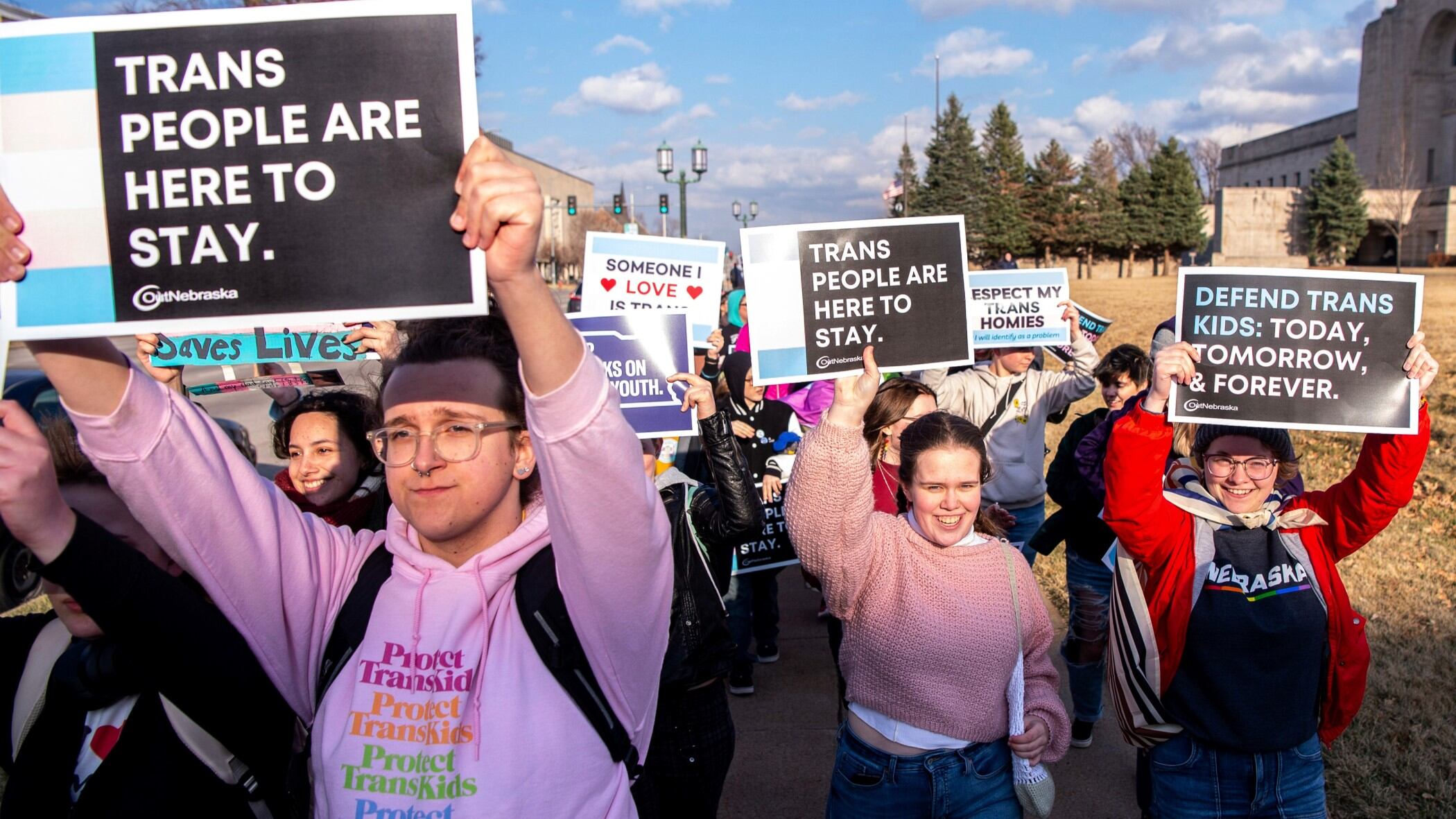
At least 17 states have enacted laws restricting or banning gender-affirming care for transgender minors, though judges have temporarily blocked their enforcement in some, including Arkansas. An Associated Press analysis found that often those bills sprang not from grassroots or constituent demand, but from the pens of a handful of conservative interest groups.
Many of the proposals, as introduced or passed, are identical or very similar to some model legislation, the AP found. Those ready-made bills have been used in statehouses for decades, often with criticisms of carpetbagging by out-of-state interests. In the case of restrictions on gender-affirming care for youths, they allow a handful of far-right groups to spread a false narrative based on distorted science, critics say.
“These are solutions from outside our state looking to solve nonexistent problems inside our state,” said Aaron Jennen. “For whatever reason, they have the ear of legislatures in states like Arkansas, and the legislators will generally defer to and only listen to those individuals.”
The AP obtained the texts of more than 130 bills in 40 state legislatures from Plural, a public policy software company, and analyzed them for similarities to model bills peddled by the conservative groups Do No Harm, which also criticizes efforts to diversify staffing in medicine, and the Family Research Council, which has long been involved in abortion restrictions.
One of the clearest examples is in Montana, where nearly all the language in at least one bill can be found in Do No Harm’s model. Publicly available emails from December show the Republican sponsor, Sen. John Fuller, tweaked the model before introducing it weeks later. Democrats criticized his efforts.
“This is not a Montana issue; it is an issue pushed by well-funded national groups,” Democratic Sen. Janet Ellis said during debate in February.
Republicans pushed back.
“Someone mentioned this is not a Montana solution. And I can tell you that I won my election on this issue,” said Republican Sen. Barry Usher, who ran unopposed in the general election after winning his contested primary.
The Montana bill passed in March with much of Do No Harm’s model language intact and has been signed into law.
Do No Harm’s model and the 2021 Arkansas bill endorsed as a model by the Family Research Council also have many similarities, including the assertion — rebutted by major medical organizations — that the risks of gender-affirming care outweigh its benefits.
Republicans' recent focus on legislation to restrict aspects of transgender life is largely a strategy of using social “wedge issues” — in the past, abortion or same-sex marriage — to motivate their voting base, political observers say. And it does appear to resonate; a Pew Research Center survey a year ago found broad support among Republicans, but not Democrats, for restrictions on medical care for gender transitions.
“These organizations are not introducing this model legislation to make legislators’ jobs easier, to support kids in their constituencies. They’re introducing this model legislation to gain wealth, to gain eyes, to gain power, and to gain access,” said Heron Greenesmith, a senior research analyst who monitors anti-LGBTQ+ rhetoric for Political Research Associates, a liberal think tank.
Such bills often distort valid science that supports gender-affirming care for youths, said Dr. Jack Drescher, a psychiatry professor at Columbia University who edited the section about gender dysphoria in the American Psychiatric Association's diagnostic manual. Do No Harm cites the manual in its model bill.
“These bills are not at all interested in patient care,” Drescher said. “These bills are designed to inflame.”
It's problematic “any time policymakers are cherry-picking isolated studies or scientific research that arrives upon a different conclusion than the rest of the community or that relies upon studies without having that expertise," said Marty P. Jordan, an assistant professor of political science at Michigan State University. "It’s problematic for the individuals that the legislation could impact. It’s problematic for the larger public, and problematic for democracy writ large.”
Kent Syler, a political science professor at Middle Tennessee State University, said: “If it’s a good bill, no one should be shy about where they got it because that’s the federal system working correctly.”
Do No Harm launched last year with an initial critical focus on the role of race in medical education and hiring, and the Virginia-based nonprofit has registered lobbyists in at least four states. People associated with it have testified in statehouses around the U.S.
When asked about Do No Harm’s legislative activity, founder and chair Dr. Stanley Goldfarb responded in an email: “Do No Harm works to protect children from extreme gender ideology through original research, coalition-building, testimonials from parents and patients who’ve lived through deeply troubling experiences, and advocacy for the rigorous, apolitical study of gender dysphoria.”
The Family Research Council, an advocacy group that opposes abortion and LGBTQ+ rights, has been behind what it calls the Save Adolescents from Experimentation Act, or SAFE Act. Among other things, it falsely asserts that “‘gender transition’ is an experiment.”
A leader of the Family Research Council declined to directly answer several questions about its model bill, including where it had been used and which legislators it had worked with, but said, “What should be an issue debated in the scientific community now has to be dealt with through legislation.”
“The SAFE Act gives minors a chance to experience development before imposing lifelong chemical and surgical procedures that increasingly show evidence of psychological and physiological harm and completed suicide after the transition,” Jennifer Bauwens, the organization's director of family studies, said in an email.
In Arkansas, Sabrina Jennen — who will turn 18 in July — continues to receive gender-affirming health care while her family's suit winds through the courts.
“For these outside groups to carry more weight than the people these legislators were elected to represent is very upsetting,” Aaron Jennen said. “They didn’t listen to us before, but now they have to listen to us because we filed a lawsuit and went to court.”
Contributing to this report were Associated Press journalists around the country, including Andrew DeMillo in Little Rock, Arkansas; Amy Beth Hanson in Helena, Montana; and Michael Goldberg and Emily Wagster Pettus in Jackson, Mississippi.
Harjai is a corps member of the Associated Press/Report for America Statehouse News Initiative. Report for America is a nonprofit national service program that places journalists in local newsrooms to report on undercovered issues.