By Rebecca Boone
Lawmakers probing the cause of last month’s deadly Maui wildfire did not get many answers during Thursday's congressional hearing on the role the electrical grid played in the disaster.
Still, the president of Hawaiian Electric — Maui's sole electricity provider — promised to gather and provide more details about exactly what happened Aug. 8, including when the power stopped flowing through downed power lines in Lahaina and exactly when the decision was made to trigger a procedure designed to ensure broken lines were not re-energized.
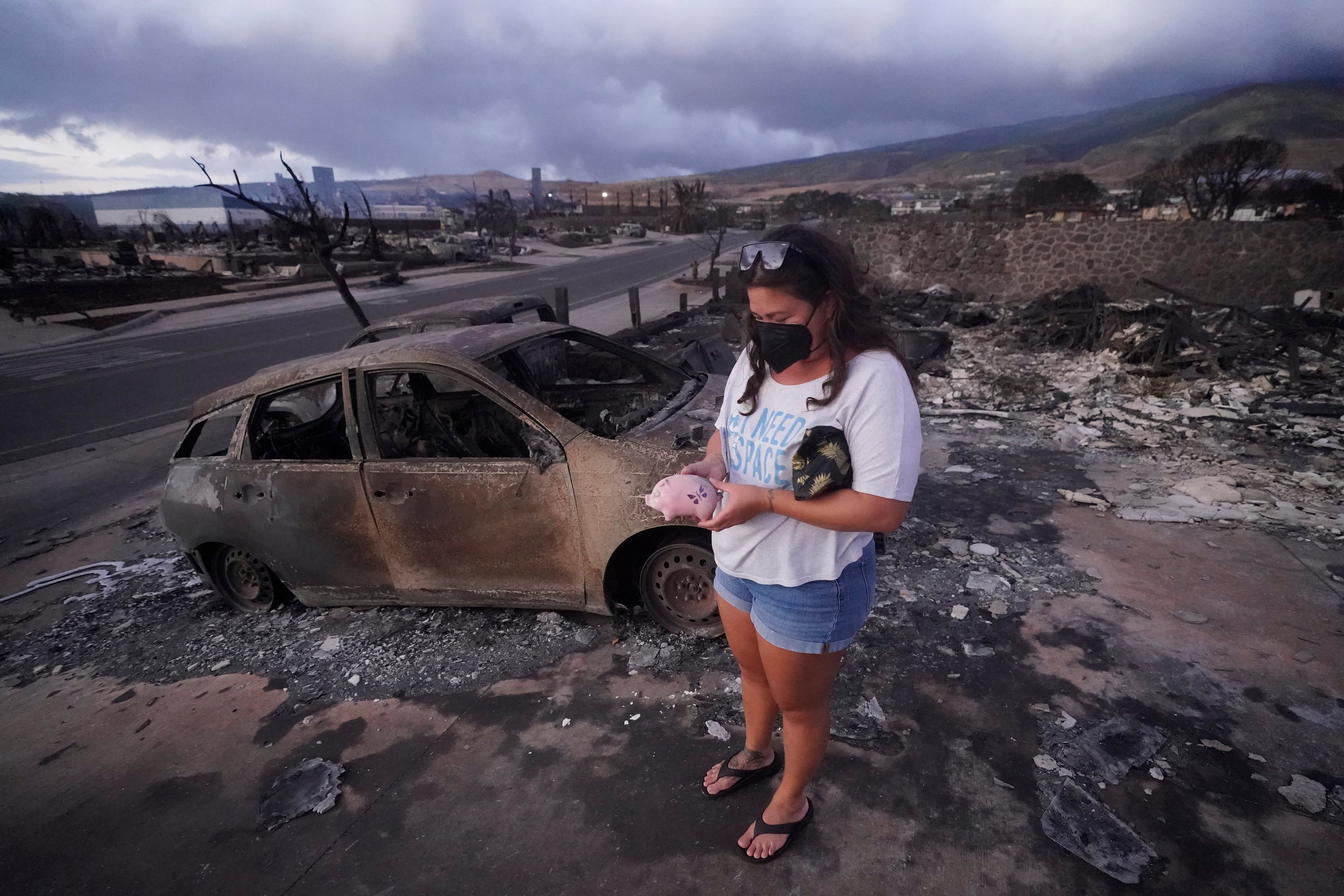
The fire in the historic town of Lahaina killed at least 97 people and destroyed more than 2,000 buildings, mostly homes. It first erupted at 6:30 a.m. when strong winds appeared to cause a Hawaiian Electric power line to fall, igniting dry brush and grass near a large subdivision. The fire was initially declared contained, but it flared up again around 3 p.m. and spread through the town.
The Associated Press reported Wednesday that aerial and satellite imagery shows the gully where the fire reignited that afternoon has long been choked with plants and trash, which a severe summer drought turned into tinder-dry fuel for fires. Photos taken after the blaze show charred foliage in the utility’s right-of-way still more than 10 feet (three meters) high, and a resident who lives next to the gully said it had not been mowed in the 20 years he’s lived there.
Asked about the issue Thursday during the U.S. House Energy and Commerce subcommittee hearing, Shelee Kimura, president of Hawaiian Electric, reiterated the company’s position that it is only responsible for trimming trees that are high enough to contact electric lines.
“Our vegetation management is around our lines. It is not a stated right to take care of the grass under our lines on private property,” Kimura said, adding that it is an issue that the state should consider in the aftermath of the fire.
Lawmakers questioned Kimura and other utility officials about how the deadliest U.S. wildfire in more than a century began — and whether the electrical grid in Lahaina was safe and properly maintained.
There is still much to sort out about the fire, Rep. Morgan Griffith, R-Virginia, said at the hearing’s start. Among questions that need to be answered are how the fires spread and what efforts to reduce fire risk have been made in recent years.
“It is extremely important that we ... ask the hard questions,” he said.
Those testifying were Kimura, Hawaii Public Utilities Commission Chair Leodoloff Asuncion Jr. and Hawaii Chief Energy Officer Mark Glick.
Asked to address whether the electrical grid in Lahaina was safe and properly maintained, Kimura told the committee that 2,000 of the company’s wooden power poles had not been tested for possible termites, rot or other problems since 2013. The other 29,000 poles on the island had been assessed under Hawaiian Electric’s “test and treat” program, she said.
Kimura said she didn’t know exactly where those 2,000 remaining untested poles were located. But at least one near where the fire started was tested and treated in 2022, she said.
The factors that led to the fire are complex and involve several organizations, Kimura said.
“There’s a system here that was in play for all of these conditions to happen all at one time that resulted in the devastation in Lahaina,” she said.
Both Kimura and Asuncion addressed the possibility of burying power lines to reduce wildfire risk, especially in high-wind conditions. About 50% of Hawaii's power lines are now underground, Kimura said. However, Asuncion said burying can be cost-prohibitive and has a big impact on rate-payers.
“I get that,” Rep. Michael Burgess, R-Texas, responded. “But sometimes the cost of doing nothing gets to be prohibitive too.”
Downed power lines hindered some residents’ efforts to flee Lahaina during the fires, and several survivors told The Associated Press that they were turned away from exit routes by closed roads, utility crews and police who were trying to keep people from driving over potentially live wires.
Some fiew victims also attended the hearing, submitting written testimony because they were not included among those asked to speak.
Kathleen Hennricks wrote that her family spent 10 days searching for her 57-year-old sister Rebecca Ann Rans, only to learn that she had died in the arms of her longtime partner, Doug Gleoge, just a few blocks from their home.
“The biggest tragedy is that my sister’s death and the losses to our family were completely preventable,” Hennricks wrote. “My sister’s death was unnecessary, but please do not let it be meaningless. Steps must be taken now to prevent yet another fire on Maui.”
The FBI agents who informed her of Rans’ death said the only items that remained of her sister were a bracelet with the word “Kuuipo,” which means “sweetheart” in Hawaiian, and one burnt slipper.
Gleoge’s son and daughter, Jon Gleoge and Andrea Wheeler, also submitted testimony, saying the details of their father and Rans’ attempt to flee the fire “remain shrouded in uncertainty.”
“Perhaps the most excruciating aspect of this ordeal has been the condition of our dad’s remains,” the two wrote. “The fire’s ferocity left his body unrecognizable, rendering viewing impossible. The weight of this reality is one that we both continue to grapple with daily.”
They wrote that they are angry the committee did not allow even one victim to testify.
“Caring would be giving time to hear at least one or two stories,” they said.
Griffith, Energy and Commerce Committee chair Rep. Cathy McMorris Rodgers and Energy, Climate and Grid Security Subcommittee chair Rep. Jeff Duncan — all Republicans — also questioned Kimura, Asuncion and Glick about the cause of the fire in a letter sent Aug. 30.
The letter included 10 questions about the sequence of events on the day of the fire, efforts to mitigate fire risks posed by the electrical grid, the fire investigation and other matters.
Kimura acknowledged Hawaiian Electric's downed lines caused the initial fire, but said the lines had been de-energized for more than six hours when it flared up in the same area again. She called the 3 p.m. blaze the “Afternoon Fire,” implying it was separate from the morning blaze — and emphasized that its cause has not been determined.
Whether the lines were fully de-energized might still be in question. At least one Lahaina resident told AP their power came back on around 2 p.m., and Maui Police Chief John Pelletier has said his officers were trying to keep people from driving over live power lines later that afternoon as they fled.
Rep. Frank Pallone, a Democrat from New Jersey, warned that if Congress does not act before a looming federal government shutdown, residents could be left without the financial assistance needed to cope with the crisis. Scores of people were have lost homes and jobs.
A “reckless government shutdown, which we know is imminent,” would dramatically slow Maui’s recovery effort, Pallone said.
Associated Press reporter Michael Biesecker contributed from New York.