Huawei’s Tri-Foldable Phone Hits Global Markets in a Show of Defiance
By Eileen Ng
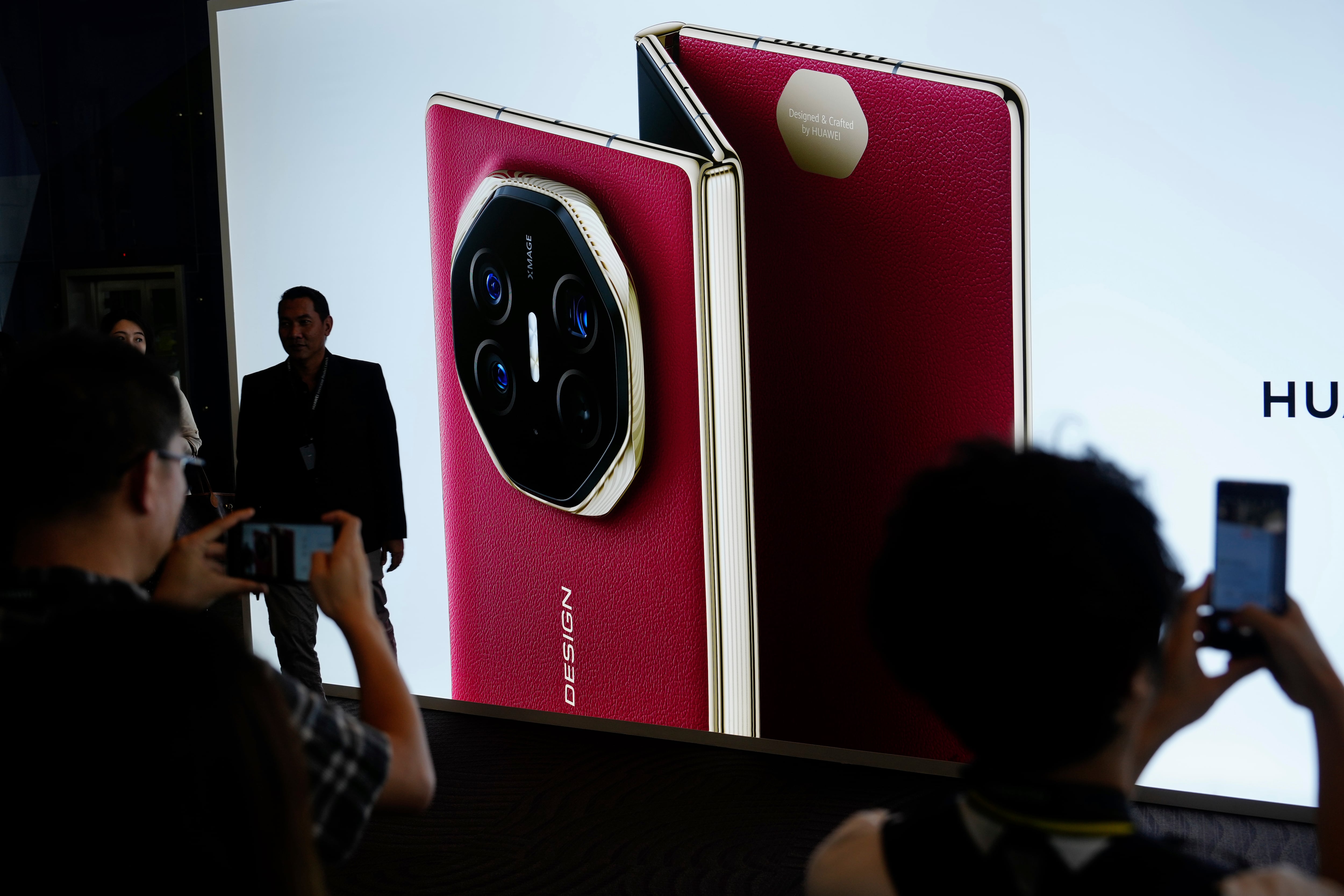
Visitors take pictures in-front of a giant billboard display of Huawei's industry's first tri-foldable phone during the opening of its global sales in Kuala Lumpur, Malaysia, Tuesday, Feb. 18, 2025. (AP Photo/Vincent Thian)
KUALA LUMPUR, Malaysia (AP) — Huawei on Tuesday held a global launch for the industry’s first tri-foldable phone, which analysts said marked a symbolic victory for the Chinese tech giant amid U.S. technology curbs. But challenges over pricing, longevity, supply and app constraints may limit its success.
Huawei said at a launch event in Kuala Lumpur that the Huawei Mate XT, first unveiled in China five months ago, will be priced at 3,499 euros ($3,662). Although dubbed a trifold, the phone has three mini-panels and folds only twice. The company says it's the thinnest foldable phone at 3.6 millimeters (0.14 inches), with a 10.2-inch screen similar to an Apple iPad.
“Right now, Huawei kind of stands alone as an innovator" with the trifold design, said Bryan Ma, vice president of device research with the market intelligence firm International Data Corporation.
Huawei reached the position despite “not getting access to chips, to Google services. All these things basically have been huge roadblocks in front of Huawei,” Ma said, adding that the “resurgence we're seeing from them over the past year has been quite a bit of a victory."
Huawei, China’s first global tech brand, is at the center of a U.S.-China battle over trade and technology. Washington in 2019 severed Huawei’s access to U.S. components and technology, including Google’s music and other smartphone services, making Huawei's phone less appealing to users. It has also barred global vendors from using U.S. technology to produce components for Huawei.
American officials say Huawei is a security risk, which the company denies. China’s government has accused Washington of misusing security warnings to contain a rising competitor to U.S. technology companies.
Huawei launched the Mate XT in China on Sept. 20 last year, the same day Apple launched its iPhone 16 series in global markets. But with its steep price tag, the Mate XT “is not a mainstream product that people are going to jump for,” Ma said.
At the Kuala Lumpur event, Huawei also unveiled its MatePad Pro tablet and Free Arc, its first open-ear earbuds with ear hooks and other wearable devices.
While Huawei’s cutting-edge devices showcase its technological prowess, its long-term success remains uncertain given ongoing challenges over global supply chain constraints, chip availability and limitations on the software ecosystem, said Ruby Lu, an analyst with the research firm TrendForce.
"System limitations, particularly the lack of Google Mobile Services, means its international market potential remains constrained,” Lu said.
IDC's Ma said Huawei dominated the foldable phone market in China with 49% market share last year. In the global market, it had 23% market share, trailing behind Samsung's 33% share in 2024, he said. IDC predicted that total foldable phone shipments worldwide could surge to 45.7 million units by 2028, from over 20 million last year.
While most major brands have entered the foldable segments, Lu said Apple has yet to release a competing product.
“Once Apple enters the market, it is expected to significantly influence and stimulate further growth in the foldable phone sector,” Lu added.
President Donald Trump has signed an executive order to block states from regulating artificial intelligence. He argues that heavy regulations could stifle the industry, especially given competition from China. Trump says the U.S. needs a unified approach to AI regulation to avoid complications from state-by-state rules. The order directs the administration to draw up a list of problematic regulations for the Attorney General to challenge. States with laws could lose access to broadband funding, according to the text of the order. Some states have already passed AI laws focusing on transparency and limiting data collection.
Waymo's self-driving taxis have been in the spotlight for both negative and positive reasons. This week, the automated ride-hailing taxis went viral after a San Francisco woman gave birth inside a Waymo taxi while on her way to the hospital. A Waymo spokesperson on Wednesday confirmed the unusual delivery. It said the company's rider support team detected unusual activity inside the vehicle and alerted 911. The taxi arrived safely at the hospital before emergency services. Waymo's popularity is growing despite heightened scrutiny following an illegal U-turn and the death of a San Francisco cat. The company, owned by Alphabet, says it is proud to serve riders of all ages.
OpenAI has appointed Slack CEO Denise Dresser as its first chief of revenue. Dresser will oversee global revenue strategy and help businesses integrate AI into daily operations. OpenAI CEO Sam Altman recently emphasized improving ChatGPT, which now has over 800 million weekly users. Despite its success, OpenAI faces competition from companies like Google and concerns about profitability. The company earns money from premium ChatGPT subscriptions but hasn't ventured into advertising. Altman had recently announced delays in developing new products like AI agents and a personal assistant.
President Donald Trump says he will allow Nvidia to sell its H200 computer chip used in the development of artificial intelligence to “approved customers” in China. Trump said Monday on his social media site that he had informed China’s leader Xi Jinping and “President Xi responded positively!” There had been concerns about allowing advanced computer chips into China as it could help them to compete against the U.S. in building out AI capabilities. But there has also been a desire to develop the AI ecosystem with American companies such as chipmaker Nvidia.
The end of 2025 is almost upon us. And it’s time to unpack Spotify Wrapped. On Wednesday, the music streaming giant delivered its annual recap — giving its hundreds of millions of users worldwide a look at the top songs, artists, podcasts and other audio they listened to over the past year. Spotify isn’t the only platform to roll out a yearly glimpse of data collected from consumers’ online lives. But since its launch about a decade ago, Wrapped has become one of the most anticipated. And Spotify is billing the 2025 edition to be the biggest yet, with a host of new features it hopes may also address some disappointments users had last year.