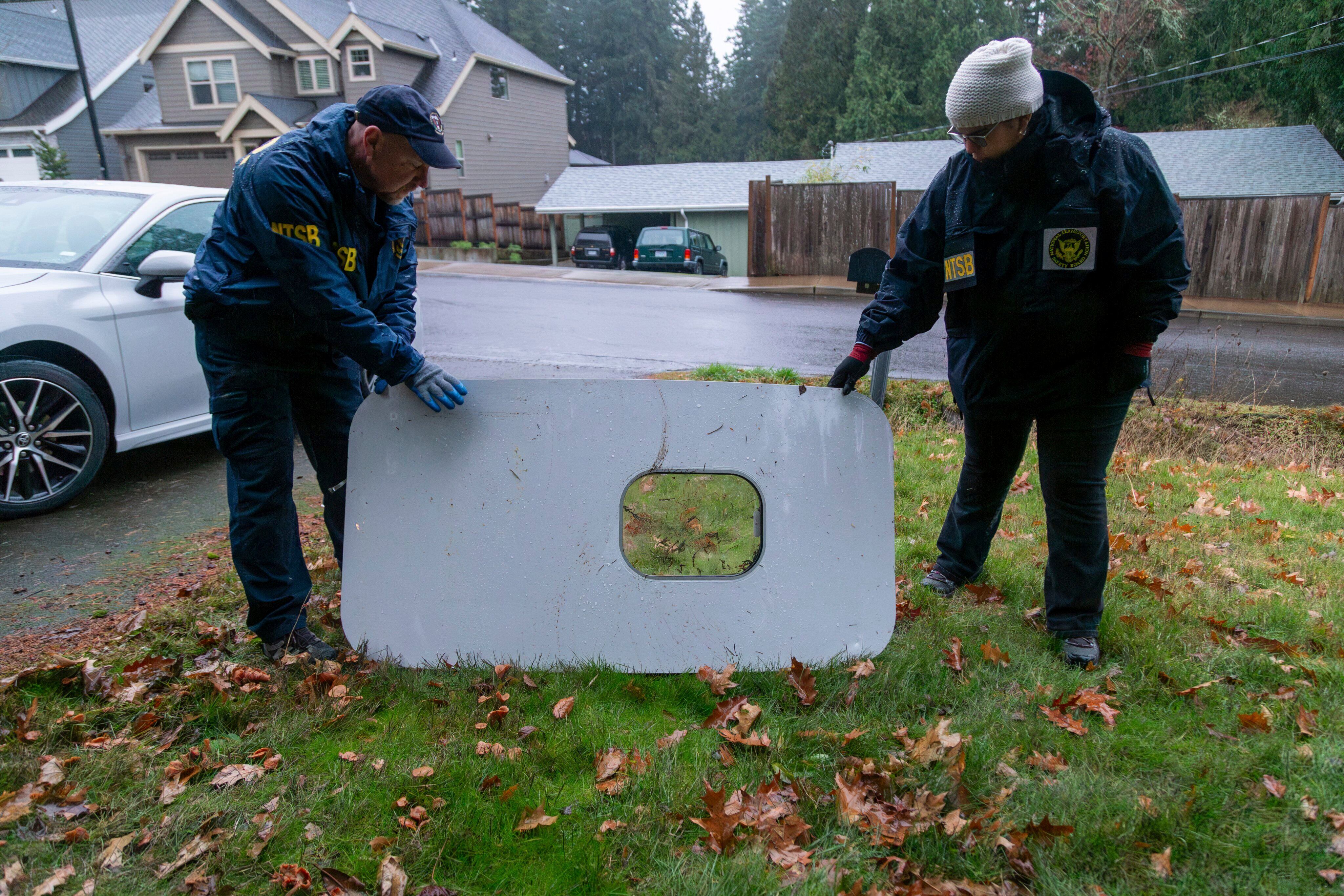
This photo released by the National Transportation Safety Board shows the door plug from Alaska Airlines Flight 1282 on Monday, Jan. 8, 2024, in Portland, Ore. A panel used to plug an area reserved for an exit door on the Boeing 737 Max 9 jetliner blew out Jan. 5, shortly after the flight took off from Portland, forcing the plane to return to Portland International Airport. (National Transportation Safety Board via AP)
Federal officials are investigating whether Boeing failed to make sure a panel that blew off a jetliner in midflight last week was safe and manufactured to meet the design that regulators approved.
The Federal Aviation Administration said Thursday that the investigation is focusing on plugs used to fill spots for extra exits when those doors are not required on Boeing 737 Max 9 jetliners.
The plug that blew off an Alaska Airlines Max 9 was found near Portland, Oregon, and will be be examined in a government laboratory.
“This incident should have never happened and it cannot happen again,” the FAA said in a statement. “Boeing’s manufacturing practices need to comply with the high safety standards they’re legally accountable to meet.”
The FAA notified Boeing of the investigation in a letter dated Wednesday and asked it to respond within 10 business days.
The agency said Boeing's response should include “the root cause of the encountered condition(s)" and steps the company is taking to prevent a recurrence.
The FAA has grounded Max 9 jets, including all 65 operated by Alaska and 79 used by United Airlines until Boeing can develop inspection guidelines and planes can be examined. Alaska has canceled all flights by Max 9s through Saturday.
Investigators with the National Transportation Safety Board said this week they have not been able to find four bolts that are used to help secure the 63-pound door plug. They are not sure whether the bolts were there before the plane took off.
Despite a hole in the side of the plane, pilots were able to return to Portland and make an emergency landing. No serious injuries were reported.
It's a tough time for the job market. Amid wider economic uncertainty, some analysts have said that businesses are at a “no-hire, no fire” standstill. At the same time, some sizeable layoffs have continued to pile up — raising worker anxieties across sectors. Some companies have pointed to rising operational costs due to U.S.'s new tariffs, while others have redirected money to artificial intelligence investments. Workers in the public sector have also been hit hard. Federal jobs were cut by the thousands earlier this year. And many workers are now going without pay as the U.S. government shutdown has now dragged on for more than a month.
Nvidia smashes earnings with record-breaking revenue and soaring Blackwell demand as shares slip this morning, Barron’s senior writer Adam Levine unpacks it all
Jeff Wagoner, CEO of Outrigger Hospitality Group, discusses the company’s coral preservation initiatives and sustainable practices at their hotels and resorts.
Dena Jalbert, Head of M&A at Align Advisory, discusses the state of mergers and acquisitions in 2025 and beyond, highlighting key trends and opportunities.
Kim Perell, author and entrepreneur, shares actionable tips and tricks to help current and aspiring entrepreneurs kick off 2026 with confidence and momentum.
Computer chipmaker Nvidia is poised to release a quarterly earnings report that is expected to either deepen a recent downturn in the stock market or prompt an ebullient sigh of relief among investors increasingly worried the world’s most valuable company is perched upon an artificial intelligence bubble about to burst.
Emera CEO Scott Balfour discusses soaring energy demand, AI-driven grid challenges, clean-power investments, and how the company is building a resilient future.
JB Mackenzie discusses Robinhood’s new entertainment prediction markets, letting users engage with pop culture, award shows, and more through low-stakes bets.