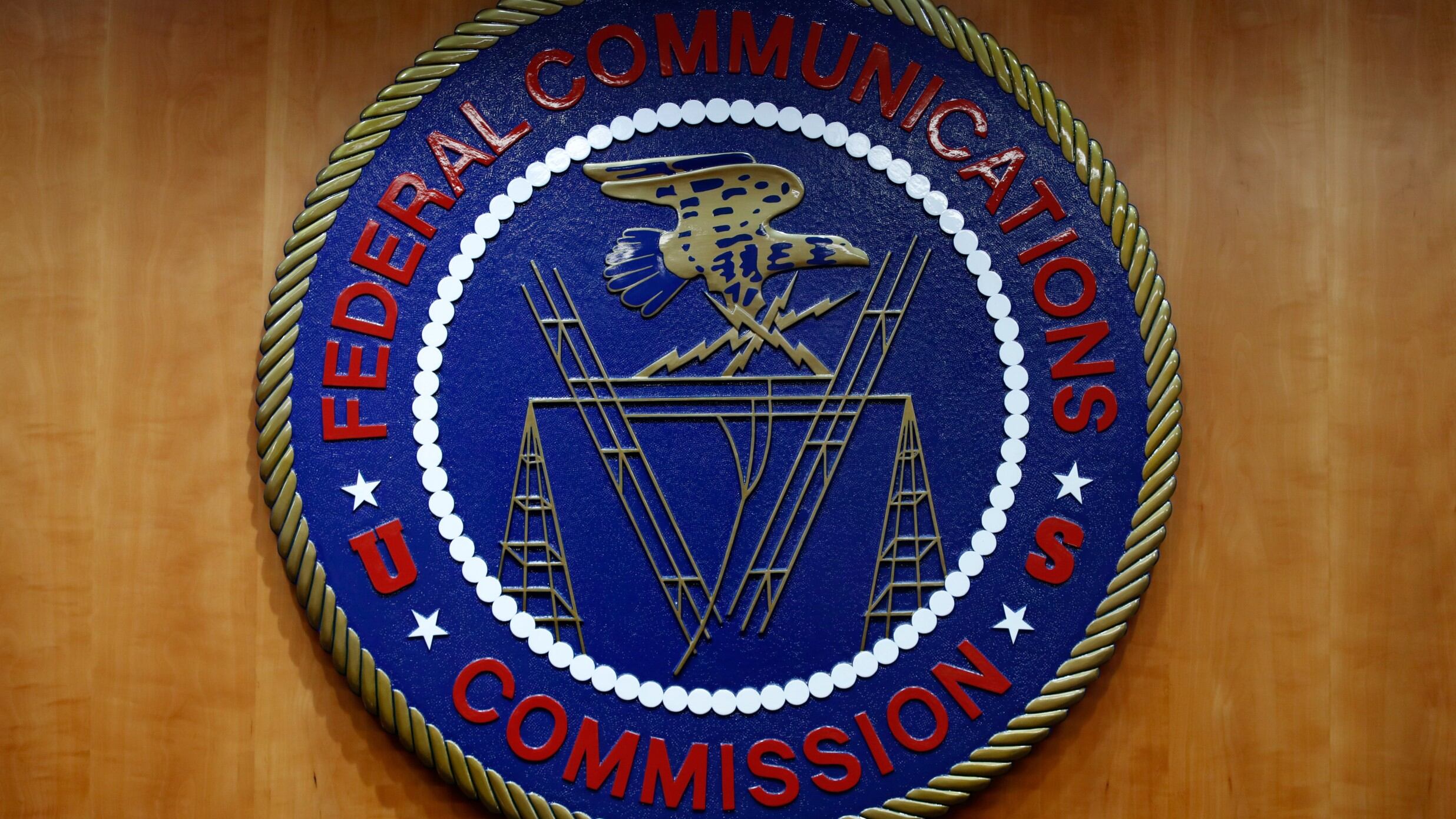
The seal of the Federal Communications Commission (FCC) is seen before an FCC meeting to vote on net neutrality in Washington, Dec. 14, 2017. The Biden administration and major consumer tech players are launching an effort to put a nationwide cybersecurity certification and labeling program in place to help consumers choose smart devices that are less vulnerable to hacking. Officials liken the new "U.S. Cyber Trust Mark" initiative to the Energy Star program that rates appliances' energy efficiency. It will be overseen by the Federal Communications Commission. (AP Photo/Jacquelyn Martin, File)
The Biden administration and major consumer technology players on Tuesday launched an effort to put a nationwide cybersecurity certification and labeling program in place to help consumers choose smart devices that are less vulnerable to hacking.
Officials likened the new U.S. Cyber Trust Mark initiative — to be overseen by the Federal Communications Commission, with industry participation voluntary — to the Energy Star program, which rates appliances’ energy efficiency.
“It will allow Americans to confidently identify which internet- and Bluetooth-connected devices are cybersecure,” deputy national security adviser Anne Neuberger told reporters in a pre-announcement briefing.
Amazon, Best Buy, Google, LG Electronics USA, Logitech and Samsung as among industry participants.
Devices including baby monitors, home security cameras, fitness trackers, TVs, refrigerators and smart climate control systems that meet the U.S. government’s cybersecurity requirements will bear the “Cyber Trust” label, a shield logo, as early as next year, officials said.
FCC Chairwoman Jessica Rosenworcel said the mark will give consumers “peace of mind” and benefit manufacturers, whose products would need to adhere to criteria set by the National Institute of Standards and Technology to qualify.
The FCC was launching a rule-making process to set the standards and seek public comment. Besides carrying logos, participating devices would have QR codes that could be scanned for updated security information.
In a statement, the Consumer Technology Association said consumers could expect to see certification-ready products at the industry’s annual January show, CES 2024, once the FCC adopts final rules. A senior Biden administration official said it was expected that products that qualify for the logo would undergo an annual re-certification.
The Cyber Trust initiative was first announced in October following a meeting between White House and tech industry representatives.
The proliferation of so-called smart devices has coincided with growing cybercrime in which one insecure device can often give a cyberintruder a dangerous foothold on a home network.
An April report from the cybersecurity firm Bitdefender and networking equipment company NetGear, based on their monitoring of smart homes, found that the most vulnerable devices in 2022 were, far and away, smart TVs, followed by smart plugs, routers and digital video recorders.
Providers of numerous smart home devices often don’t update and patch software fast enough to thwart newly emerging malware threats. The Cyber Mark standards are expected to make clear which devices patch vulnerable software in a timely fashion and secure their communications to preserve privacy, officials said. Also important will be informing consumers which devices are equipped to detect intrusions.
For the first time since September, Bitcoin fell below $40,000 early Monday. The currency's average short-term price has now dipped below its average long-term price, which is known by a rather dramatic term, a death cross. According to analysts, the indicator appears to be a result of mounting concerns of faster liquidity withdrawal by the US Federal Reserve. The crypto slump also follows a week of rough trading for equities overall. CEO Snickerdoodle Labs and Co-Founder of the Stanford Future of Digital Currency Initiative, Jonathan Padilla, joined Cheddar to discuss more.
With the record highs in pet ownership in recent months, there is a huge emerging market in pet technology. The new halo collar isn't just a smart collar; it's the next-generation dog safety system. Cheddar News sits down with the co-founders of Halo, Cesar Milan and Ken Ehrman, to discuss.
With no end in sight to supply chain snarls, some companies are reconsidering the way they manufacture goods. Harry Moser, founder and president of Reshoring Initiative and Jennifer Smith, logistics and supply chain reporter for the Wall Street Journal, joined Cheddar News' Closing Bell to discuss some of the ways companies are trying to solve their supply chain problems in the long term.
Bitcoin dipped below $40,000 this week amid a broader slump to begin the year. Some speculate that as cryptocurrencies correlate closer to traditional assets that factors like the Federal Reserve tightening monetary policy will weigh on digital coins. Jalak Jobanputra, managing partner at Future Perfect Ventures, joins Cheddar News' Closing Bell to discuss why crypto markets are feeling pressure from the Fed's potential 2022 rate hikes, broader crypto market predictions, and more.
A.I. startup Fractal has raised $360 million in funding, officially entering the unicorn club. Pranay Agrawal, CEO and Co-Founder of Fractal, joined Cheddar News' Closing Bell to discuss what the company plans to do with the fresh capital.
Electric vehicles are quickly becoming an accessible way for consumers to slash emissions as legacy automakers begin to electrify their fleets and world leaders including President Joe Biden push for broad EV adoption. But consumers have concerns about EV range, the availability of charging stations, and more. What if it were both helpful to consumers — and feasible from a climate change standpoint — to keep hybrid models that run on gas on the market? Gill Pratt, CEO of the Toyota Research Institute & Toyota Motor Corporation's Chief Scientist joins Cheddar Climate to discuss his team's research about 'carbon return on investment,' how Toyota is electrifying its fleet, and more.
Fresh off of a $42 million Series B Fundraise, co-founder and CEO of Chapter, Cobi Blumenfeld-Gantz, joined Cheddar to discuss the company's business model and how it will use the capital going forward. He explained that Chapter is a Medicare advisor that searches savings on medical options in order to help users find the right plan for them. "We want to make sure we can help all of our existing members and as many new Americans find the right Medicare coverage, so we're hiring aggressively for the best talent we can," Blumenfeld-Gantz said.