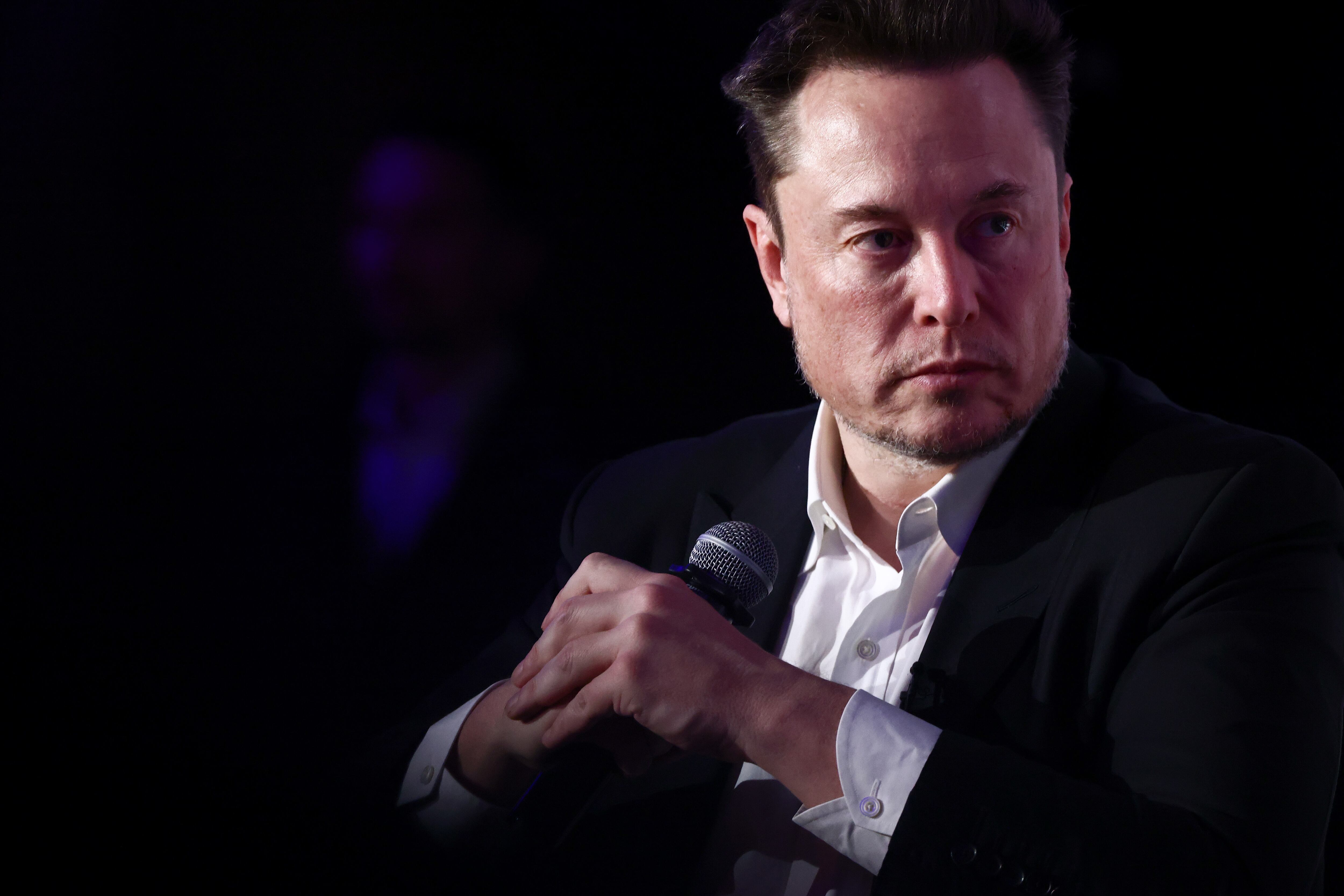
“My guess is that we’ll have AI that is smarter than any one human probably around the end of next year,” Elon Musk said in an interview Monday with Nicolai Tangen, CEO of Norges Bank Investment Management, and one of the largest investors in Tesla.
The billionaire then went on to predict that AI will exceed all human intelligence within the next five years.
Musk is notoriously inaccurate on the timelines he gives — just see his predictions for full self-driving — but has remained bullish on the progress of artificial general intelligence (AGI), last year saying it would be achieved by 2029.
Many AI experts have brought their predictions for AGI forward in the past 2 years after the release of highly capable chatbots and image and video generation tools. Demis Hassabis, co-founder of Google’s Deepmind, said in February that he believes AGI could be reached by 2030.
Geoffrey Hinton, a world leading computer scientist and a man known as the “godfather of AI,” now believes AGI will arrive sometime in the next 5-20 years. He said he had thought it would take between 30-50 years before the release of ChatGPT.
“Think the printing press, the steam engine, electricity, computing and the Internet, among others,” Jamie Dimon, chief executive of JPMorgan Chase, wrote in his annual letter to shareholders Monday. Dimon went on to claim that AI might lead future generations to only work 3½ days a week.
Somewhat scarily given how quick it has improved, the pace of AI development has actually been constrained by the supply of microchips available to power the models. These constraints are easing but Musk believes that the next impediment to AI development will be electricity and transformers for the grid.
The release of GPT-5 and OpenAI’s Sora video generation tool some time this year, and with so many companies competing in the AI space, the rapid improvement of the technology is virtually certain. OpenAI and Meta have both said that the next version of their models will be capable of reasoning and planning, both seen as crucial steps on the path to AGI.
Despite his concerns over AI safety, xAI, Musk’s own company, is training a second version of its AI model, Grok, which he says will be better than GPT-4. The new model, Grok 2 will be finished by May and, according to Musk, “should exceed current AI on all metrics.” He also says this model will be followed by a new model several times more powerful, although failed to say when this model would be released (and again, it’s worth noting his timetables are less than accurate).
Although scary, with all the developments in the AI space since the release of ChatGPT at the end of 2022, it’s easy to see how AGI could arrive some time this decade. In an effort to improve testing for AI safety, the US and UK recently signed a landmark agreement to assess and regulate the risks of AI. It’s the world’s first bilateral deal and hopes to assess and regulate the risks emerging from this new and rapidly improving technology.
Japan’s largest telecommunications company, Nippon Telegraph and Telephone, and the country’s biggest newspaper, Yomiuri, issued a manifesto earlier this week, urging restraint.
While the manifesto did point out potential benefits to generative AI, it cautioned that “in the worst-case scenario, democracy and social order could collapse, resulting in wars.”
Others, like Angel Vossough, the co-founder and chief executive of BetterAI, isn’t fully convinced.
AI systems are good at analyzing large data sets, and can make predictions or speed up productivity, Vossough tells the Wall Street Journal. But AI is nowhere near being as intelligent as humans, she says as technology lacks emotional intelligence.
“It needs to connect, understand and respond to human emotions in a way that actually feels authentic and meaningful,” she said. “I don’t think we’re anywhere close.”