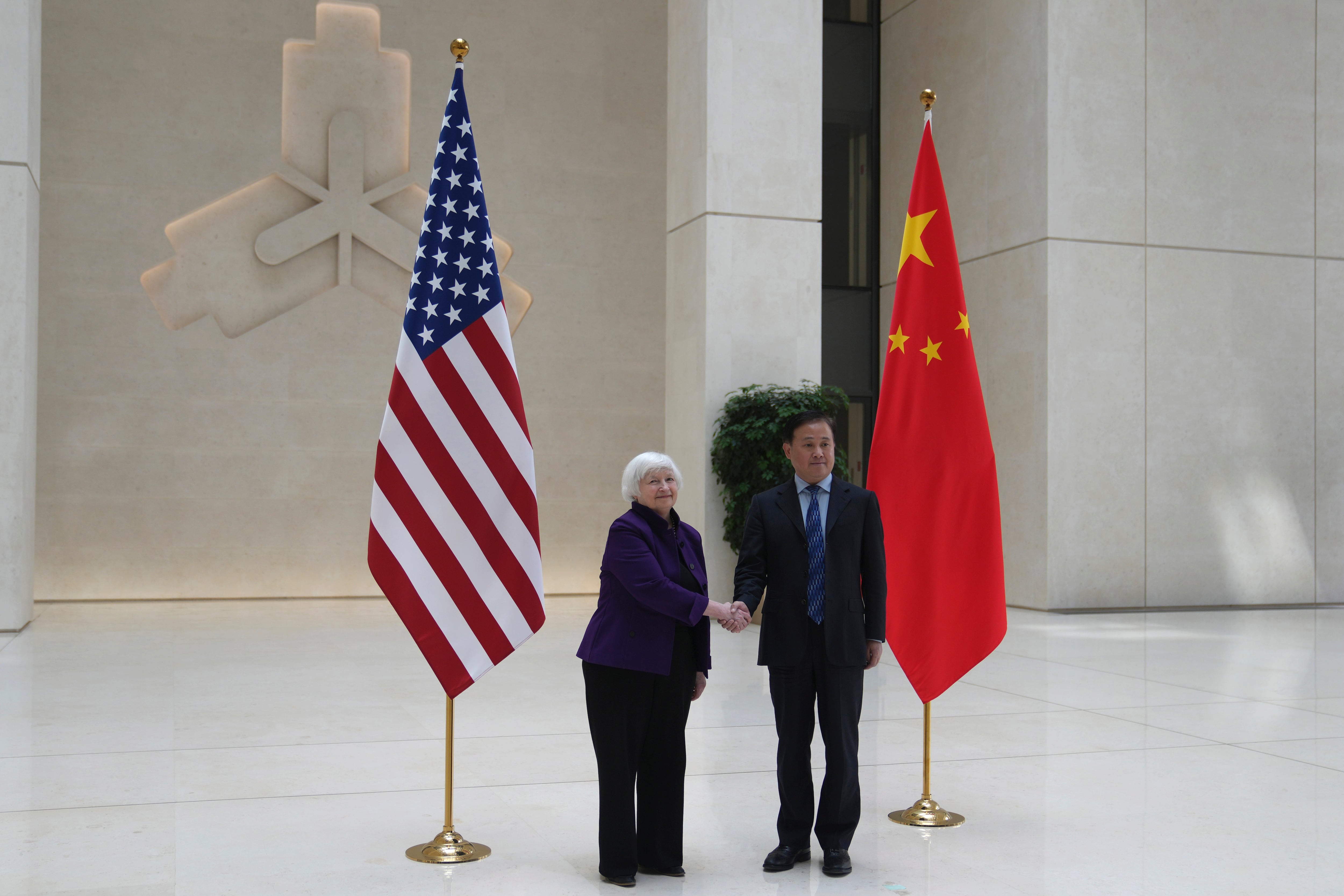
China's burgeoning production of electric cars and other green technologies has become a flashpoint in a new U.S.-China trade fight, highlighted by Treasury Secretary Janet Yellen during her five-day visit to China and seized on by former President Donald Trump in incendiary remarks on the campaign trail.
China has sharply ramped up its production of cheap electric vehicles, solar panels, and batteries just as the Biden administration has pushed through legislation supporting many of those same industries in the United States. Concerns are growing not just in the U.S. but also in Europe and Mexico that China will seek to bolster its own struggling economy with a wave of exports that could undercut factories overseas.
A U.S. trade group, the Alliance for American Manufacturing, noted in a February report that leading Chinese automaker BYD had recently introduced an electric SUV at the “astonishingly low” price of $14,000. China's auto industry poses an “existential threat” to U.S. carmakers, the report argued.
Trump, at a rally late last month in Ohio, charged that China would seek to export cars into the United States through Mexico. The U.S. currently has a 25% tariffs on cars from China that has largely blocked vehicles from that country, but Mexico has a free trade agreement with the U.S.
Trump promised to block such imports with new tariffs, but suggested if Biden were reelected it would be a “bloodbath” for the auto industry.
So what's behind this new trade fight between the U.S. and China? Here are some questions and answers on the issue:
WHAT IS THE THREAT FROM CHINA?
After more than a decade of subsidizing its automakers, China has built a substantial car industry that accounts for 60% of global electric vehicle sales, according to the Paris-based International Energy Agency.
Yet by some estimates, Chinese companies are producing as many as 10 million more electric vehicles annually than they can sell domestically, according to the AAM. That is driving them to sell more cars overseas. Similar dynamics exist in other industries, such as solar panels, batteries, and more traditional areas such as steel.
“The concern is that the Chinese are building up a lot of capacity in many industries across the board, including these new technology sectors and if domestic demand does not pick up, they are going to be looking for markets outside the country,” said Eswar Prasad, an economist at Cornell University.
HOW IS THIS DIFFERENT FROM PREVIOUS TRADE FIGHTS WITH CHINA?
It's pretty similar. American officials say they have seen this movie before.
In remarks on Saturday in Guangzhou, China, Yellen highlighted the Biden administration’s concerns by recalling a visit a week earlier to Suniva, a solar cell manufacturer in Norcross, Georgia.
The company “was once forced to close down, like other companies across a number of industries, because it could not compete against large quantities of goods that China was exporting at artificially depressed prices,” Yellen said. “It’s important that this doesn’t happen again.”
China is now the world's largest producer of solar cells. Suniva closed in 2017, but is restarting production with the help of subsides from the Biden administration's Inflation Reduction Act.
Steel and aluminum imports surged into the United States roughly a decade ago, after China's government supported increased production after the 2008-2009 global financial crisis. Those imports were hit with tariffs in 2017 during the Trump administration. Biden has kept the tariffs.
“What's new is that the concerns around overcapacity in some cutting edge sectors have become acute,” said Brad Setser, a senior fellow at the Council on Foreign Relations and former Treasury Department official in the Obama administration. “China’s clearly built an insane amount of capacity to produce solar cells, and similarly large amounts of battery production. And now it’s starting to export autos.”
ISN'T THE UNITED STATES ALSO SUBSIDIZING THESE INDUSTRIES?
Yes, the Biden administration pushed through several pieces of legislation that have provided financial support to clean energy and semiconductor producers. China has even filed a complaint before the World Trade Organization charging that some of Biden's subsidies for electric car purchases violate trade rules.
But a report in 2022 by the Center for Strategic and International Studies found that China's industrial subsidies in 2019 were double, in dollar terms, the size of U.S. supports.
And both Prasad and Setser added that China subsidizes the production of goods, but does little to spur consumption by its own citizens. During the COVID-19 pandemic, the U.S. supported much higher consumption with several rounds of stimulus checks, for example.
WHAT'S NEXT?
For now, the two sides have mainly agreed to hold talks on the issue. China hasn't committed to any steps to address American concerns, arguing that its cheap solar panels and other green products are helping the world wage the costly battle against climate change.
But the government in Beijing has also acknowledged that manufacturing overcapacity and weak consumer spending are challenges it needs to confront to achieve sustainable growth for its own economy.
The rapid expansion of EV production has sparked fierce price wars that are expected to drive some makers out of business. Huang Hanquan, an expert on industrial policy, said that China needs better policy coordination so that it can encourage the development of new technologies without prompting every province to promote the same industry, and companies to overinvest.
“I think the Chinese realize how concerned we are about the implications of their industrial strategy for the United States, for the potential to flood our markets with exports that make it difficult for American firms to compete,” Yellen told reporters on Saturday.
“It’s not going to be solved in an afternoon or a month, but I think they have heard that this is an important issue to us,” she said.