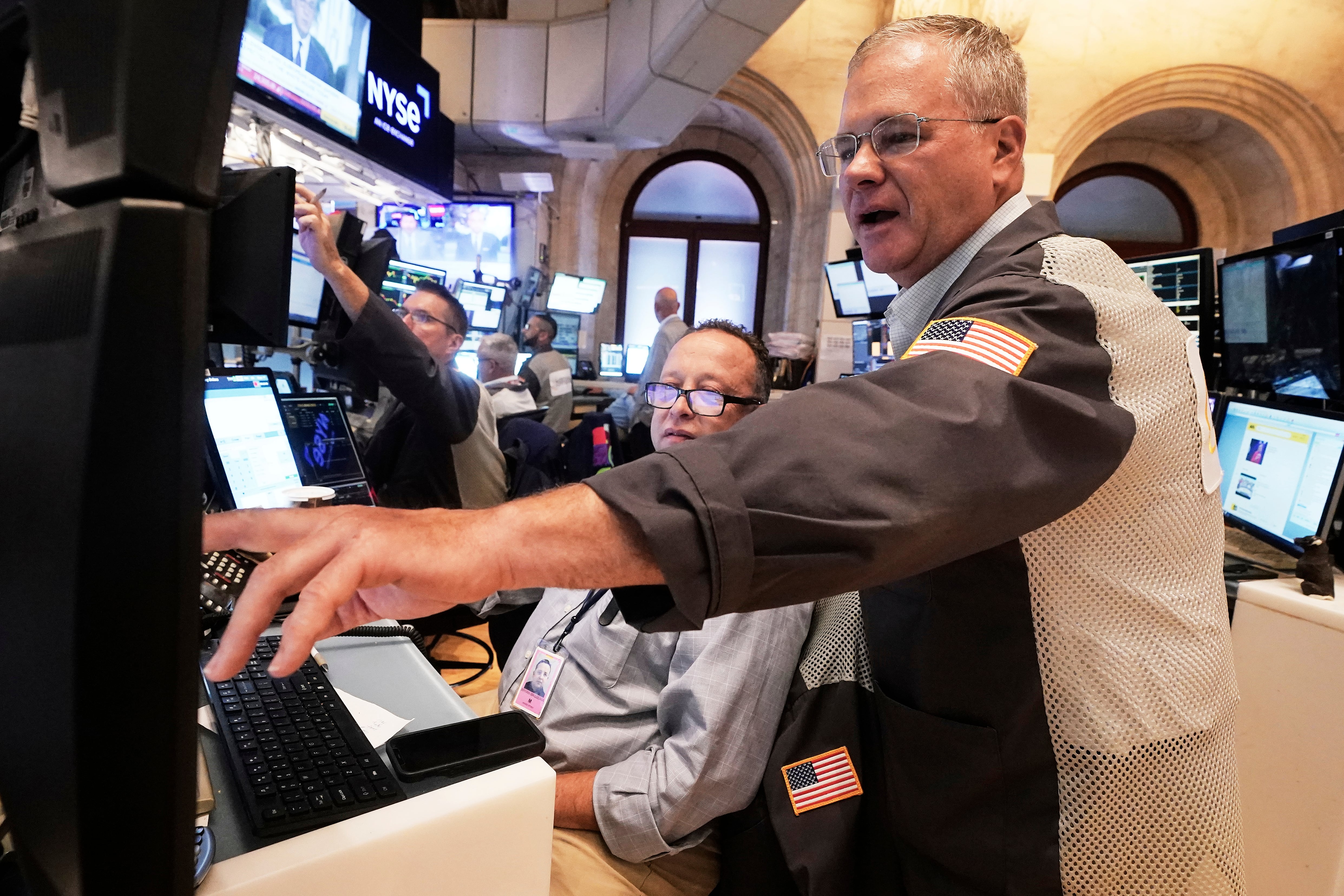
NEW YORK (AP) — Wall Street is rallying on Friday toward its best day in months after the head of the Federal Reserve hinted the cuts to interest rates that investors and President Donald Trump crave so much may be on the way.
The S&P 500 leaped 1.6%, and its first gain in six days has it on track to top its all-time high set last week.
The Dow Jones Industrial Average soared 916 points, or 2.1%, and was above its last all-time high, which was set in December. The Nasdaq composite was up 2%, as of 1:25 p.m. Eastern time.
“Ka-Powell” is how Brian Jacobsen, chief economist at Annex Wealth Management, described the reaction to Jerome Powell’s highly anticipated speech in Jackson Hole, Wyoming. “The Fed isn’t going to be the party-pooper.”
The hope among investors had been that Powell would hint that the Fed’s first cut to interest rates of the year may be imminent. Wall Street loves lower rates because they can give a boost to the economy and to investment prices, even if they risk worsening inflation at the same time.
Trump has angrily been calling for lower rates, often insulting Powell while doing so. And a surprisingly weak report on job growth this month pushed many on Wall Street to assume cuts may come as soon as the Fed’s next meeting in September.
Powell encouraged them on Friday after saying he’s seen risks rise for the job market. The Fed’s two jobs are to keep the job market healthy and to keep a lid on inflation, and it often has to prioritize one because it has just one tool to fix either.
But Powell also would not commit to any kind of timing. He said the job market looks OK at the moment, even if “it is a curious kind of balance” where fewer new workers are chasing after fewer new jobs. Inflation, meanwhile, still has the potential to push higher because of Trump’s tariffs.
In sum, Powell said that “the stability of the unemployment rate and other labor market measures allows us to proceed carefully as we consider changes to our policy stance.”
Treasury yields tumbled in the bond market as bets nevertheless built that the Fed would cut its main interest rate in September. Traders see an 87% chance of that, up from 75% a day earlier, according to data from CME Group.
The yield on the 10-year Treasury fell to 4.26% from 4.33% late Thursday. The two-year Treasury yield, which more closely tracks expectations for Fed action, sank to 3.68% from 3.79% in a notable move for the bond market.
On Wall Street, stocks of smaller companies led the way. They can benefit more from lower interest rates because of their need to borrow money to grow. The smaller stocks in the Russell 2000 index surged 3.9% toward its best day since April.
Homebuilders jumped on hopes that easier interest rates could encourage more people to buy homes. Lennar, PulteGroup and D.R. Horton all rose at least 5%.
Travel companies, meanwhile, climbed amid hopes that easier interest rates could help U.S. households spend more. Norwegian Cruise Line rallied 6.3%, Delta Air Lines flew 6.6% higher and Caesars Entertainment rose 6.3%.
Shares of Nio, a Chinese electric-vehicle maker, that trade in the United States leaped 16.8% after it began pre-sales of its flagship premium SUV model, the ES8.
Nvidia rose 1.8% to trim its loss for the week. The company, whose chips are powering much of the world’s move in to artificial-intelligence technology, has seen its stock struggle recently amid criticism that it and other AI superstars shot too high, too fast and became too expensive.
Nvidia’s CEO, Jensen Huang, said Friday that the company is discussing a potential new computer chip designed for China with the Trump administration. The chips are graphics processing units, or GPUs, a type of device used to build and update a range of AI systems. But they are less powerful than Nvidia’s top semiconductors today, which cannot be sold to China due to U.S. national security restrictions.
In stock markets abroad, Germany’s DAX returned 0.3% after government data showed that its economy shrank by 0.3% in the second quarter compared with the previous three-month period.
Indexes rose across much of Asia, with stocks climbing 1.4% in Shanghai and 0.9% in South Korea.
___
AP Writers Teresa Cerojano and Matt Ott contributed.