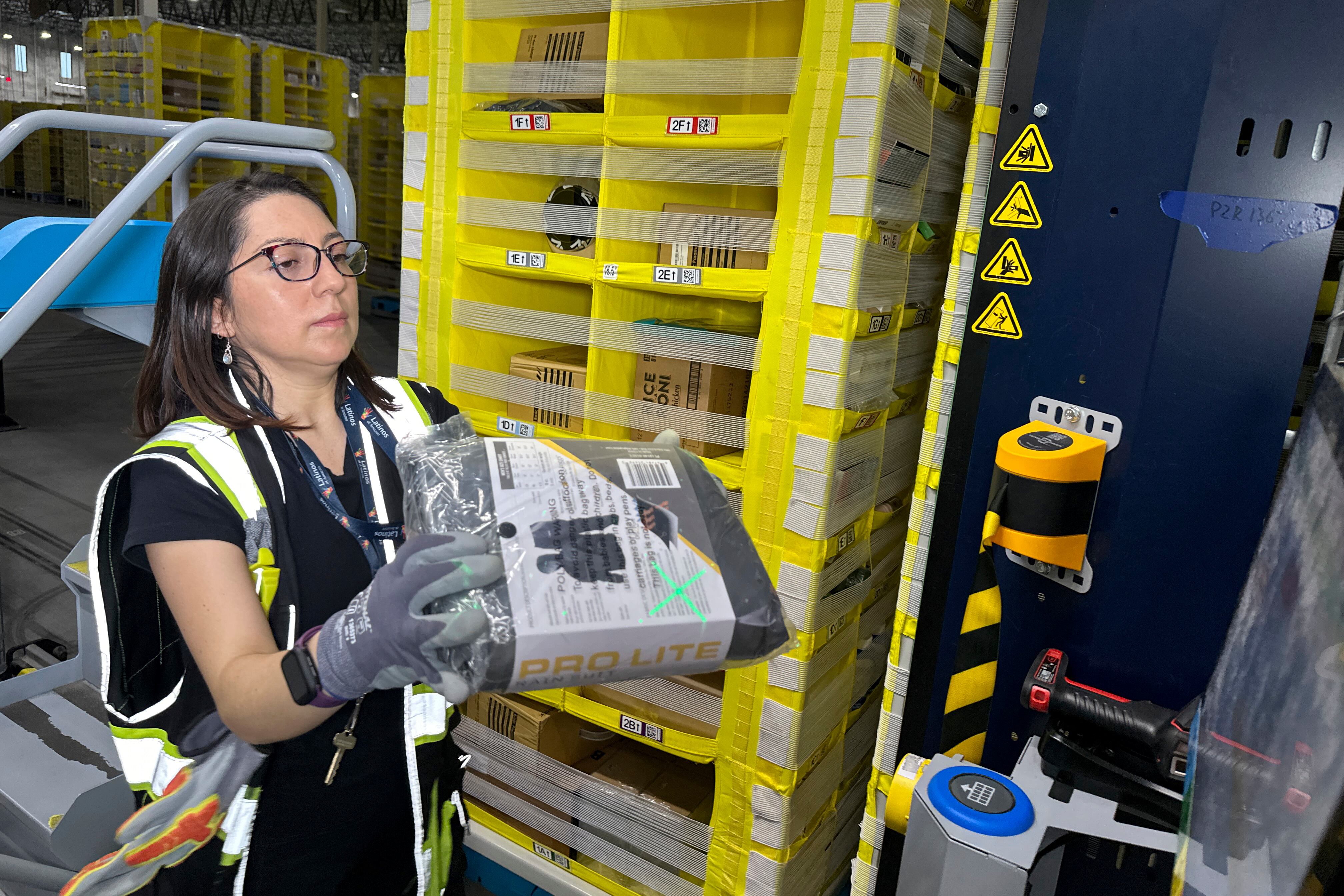
A worker moves a package at an Amazon same-day delivery shipping center in Woodland Park, New Jersey, on Monday, December 18, 2023. On Friday, the U.S. government issues its December jobs report.(AP Photo/Ted Shaffrey)
The nation’s employers added a robust 216,000 jobs last month, the latest sign that the American job market remains resilient even in the face of sharply higher interest rates.
Friday’s report from the Labor Department showed that December’s job gain exceeded the 173,000 that were added in November. The unemployment rate was unchanged at 3.7% — the 23rd straight month that joblessness has remained below 4%.
Despite the low unemployment and cooling inflation, polls show that many Americans are dissatisfied with the economy. That disconnect, which will likely be an issue in the 2024 elections, has puzzled economists and political analysts.
A key factor, though, is the public’s exasperation with higher prices. Though inflation has been falling more or less steadily for a year and a half, prices are still 17% higher than they were before the inflation surge began.
Fed Chair Jerome Powell warned of hard times ahead after the central bank began jacking up interest rates in the spring of 2022 to attack high inflation. Most economists predicted that the much higher borrowing costs that resulted would cause a recession, with layoffs and rising unemployment, in 2023.
Yet the recession never arrived, and none appears to be on the horizon. The nation’s labor market, though cooler than in the sizzling-hot years of 2022 and 2023, is still cranking out enough jobs to keep the unemployment rate near historic lows.
The resilience of the job market has been matched by the durability of the overall economy. Far from collapsing into a recession, the U.S. gross domestic product — the total output of goods and services — grew at a vigorous 4.9% annual pace from July through September. Strong consumer spending and business investment drove much of the expansion.
Since March 2022, the Fed has raised its benchmark interest rate 11 times, lifting it to a 22-year high of about 5.4%. Those higher rates have made borrowing costlier for companies and households, but they are on their way toward achieving their goal: Conquering inflation.
Consumer prices were up 3.1% in November from a year earlier, down drastically from a four-decade high 9.1% in June 2022. The Fed is so satisfied with the progress so far that it hasn’t raised rates since July and has signaled that it expects to make three rate cuts this year.
Beyond a hard hit to the housing market, higher rates haven’t exerted much damage across the broader economy. Many industry sectors, including healthcare and government, have proved relatively resistant to higher interest rates.
The labor market’s cool-down has been nowhere near enough to signal that a recession is on the way. Normally, slowing job growth might be a cause for concern. But under the current circumstances, with inflation still above the Fed’s 2% annual target, a more moderate pace of hiring is seen as just what the economy needs.
Lower demand for workers tends to ease the pressure on employers to raise pay to keep or attract workers and to pass on their higher labor costs to customers by raising prices.
The New York Times and President Donald Trump are fighting again. The news outlet said Wednesday it won't be deterred by Trump's “false and inflammatory language” from writing about the 79-year-old president's health. The Times has done a handful of stories on that topic recently, including an opinion column that said Trump is “starting to give President Joe Biden vibes.” In a Truth Social post, Trump said it might be treasonous for outlets like the Times to do “FAKE” reports about his health and "we should do something about it.” The Republican president already has a pending lawsuit against the newspaper for its past reports on his finances.
OpenAI has appointed Slack CEO Denise Dresser as its first chief of revenue. Dresser will oversee global revenue strategy and help businesses integrate AI into daily operations. OpenAI CEO Sam Altman recently emphasized improving ChatGPT, which now has over 800 million weekly users. Despite its success, OpenAI faces competition from companies like Google and concerns about profitability. The company earns money from premium ChatGPT subscriptions but hasn't ventured into advertising. Altman had recently announced delays in developing new products like AI agents and a personal assistant.
President Donald Trump says he will allow Nvidia to sell its H200 computer chip used in the development of artificial intelligence to “approved customers” in China. Trump said Monday on his social media site that he had informed China’s leader Xi Jinping and “President Xi responded positively!” There had been concerns about allowing advanced computer chips into China as it could help them to compete against the U.S. in building out AI capabilities. But there has also been a desire to develop the AI ecosystem with American companies such as chipmaker Nvidia.
U.S. sports betting is booming as NFL and college football fuel massive activity. BetMGM CEO Adam Greenblatt breaks down trends, growth, and what’s next.
President Donald Trump says a deal struck by Netflix last week to buy Warner Bros. Discovery “could be a problem” because of the size of the combined market share. The Republican president says he will be involved in the decision about whether federal regulators should approve the deal. Trump commented Sunday when he was asked about the deal as he walked the red carpet at the Kennedy Center Honors. The $72 billion deal would bring together two of the biggest players in television and film and potentially reshape the entertainment industry.
Disney's changes to a program for disabled visitors are facing challenges in federal court and through a shareholder proposal. The Disability Access Service program, which allows disabled visitors to skip long lines, was overhauled last year. Disney now mostly limits the program to those with developmental disabilities like autism who have difficulty waiting in lines. The changes have sparked criticism from some disability advocates. A shareholder proposal submitted by disability advocates calls for an independent review of Disney's disability policies. Disney plans to block this proposal, claiming it's misleading. It's the latest struggle by Disney to accommodate disabled visitors while stopping past abuses by some theme park guests.
With a merger this big, creators, studios, and theaters all face uncertain futures. Here’s what experts are worried about and what good could come from it.
With disengagement rising and hybrid work shifting, 'Everybody Matters' author Bob Chapman explains why treating people well could define the future of work.
We sat down with Ali Furman, U.S. Consumer Markets Industry Leader at consulting firm PwC to ask what trends she garnered from the initial data this year.