BETHLEHEM, Pa. (AP) — Love them or hate them, those marshmallow Peeps that come in blindingly bright colors and an array of flavors are inescapable around the Easter holiday.

Millions are made daily in Bethlehem, Pennsylvania, by Just Born Quality Confections, a family-owned candy manufacturer that also churns out Hot Tamales, Mike and Ike fruit chews and Goldenberg’s Peanut Chews.

Peeps is Just Born’s most recognizable brand and one of a handful of candies that evoke strong reactions — good and bad. Some say an Easter basket isn't complete without Peeps while others deride them as being indestructible. Some use them in recipes or even artwork.

“Even if you’re not usually one to gravitate to eating the Peeps, there’s always so many other fun ways to include them in your celebrations,” said Caitlin Servian, brand manager for Peeps.

How many Peeps are made each year?

On average, about 5.5 million are made each day.

That adds up to 2 billion a year — or roughly 6 Peeps for every man, woman and child across the U.S.

How many different varieties and colors are there?

First hatched in yellow, the sugary chicks and bunnies come in nine colors for this Easter season, including pink, blue and lavender. And there are even more flavors — 14 for Easter — from cookies and cream, to fruit punch and sour watermelon. The varieties and colors vary throughout the year with different holiday seasons.

How long does it take to make a Peep?

Before the early 1950s, making the candies by hand took 27 hours.

Bob Born, who became known as the “Father of Peeps,” came up with a way to speed up the process. He and a company engineer designed a machine to make them in less than six minutes. The same process is used today.

How are they made?

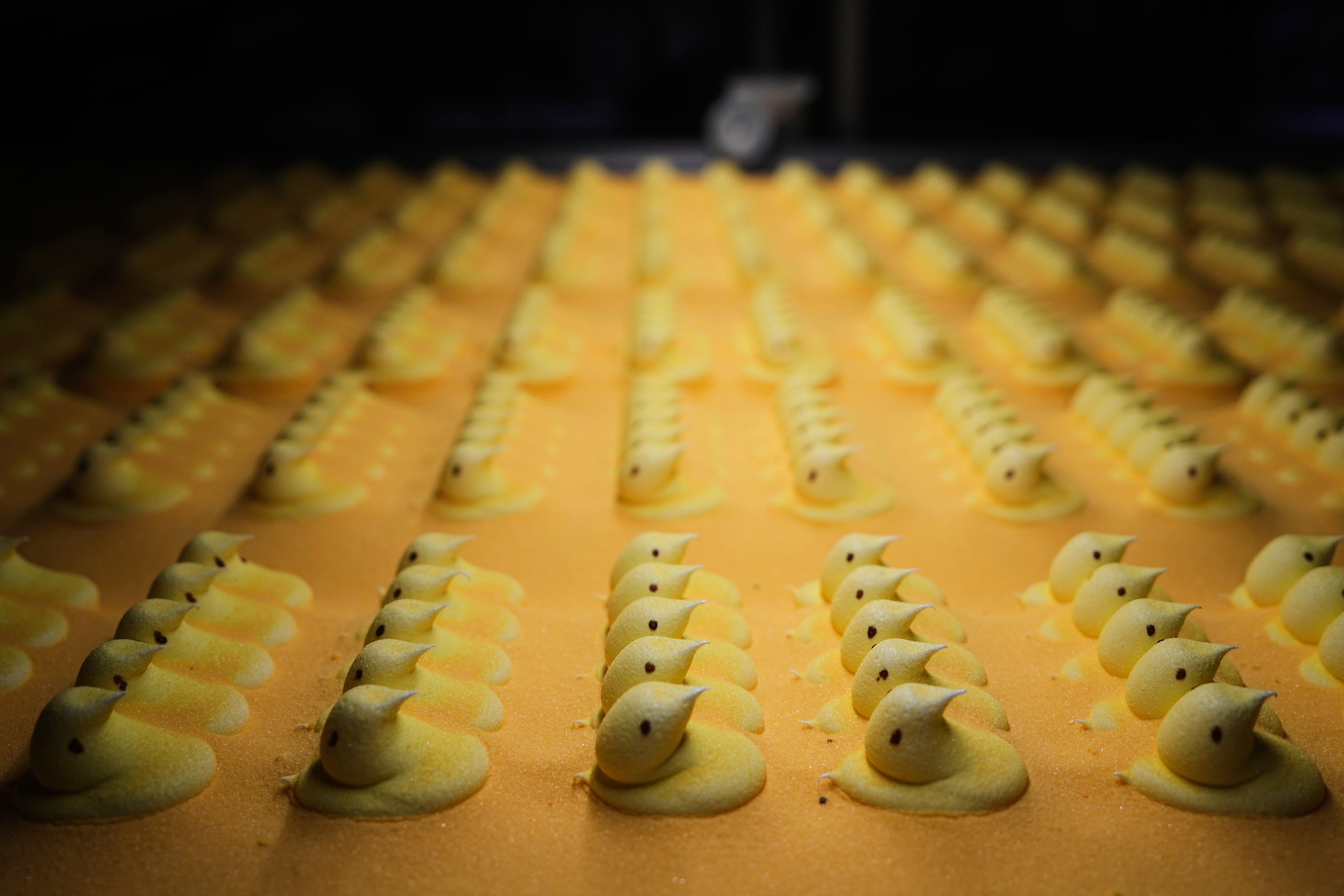
The main ingredients — sugar, corn syrup and gelatin — are cooked and combined to create marshmallows, which are then shaped and sent through a “sugar shower.”

A whopping 400 pounds (181 kilograms) of sugar is used per batch for Peeps' colored sugars.

Freshly made Peeps — each chick weighs one-third of an ounce — then move along a conveyor so that they can cool before being packaged.

___

Seewer reported from Toledo, Ohio.

Share:
More In Business
Spain fines Airbnb $75 million for unlicensed tourist rentals
Spain's government has fined Airbnb 64 million euros or $75 million for advertising unlicensed tourist rentals. The consumer rights ministry announced the fine on Monday. The ministry stated that many listings lacked proper license numbers or included incorrect information. The move is part of Spain's ongoing efforts to regulate short-term rental companies amid a housing affordability crisis especially in popular urban areas. The ministry ordered Airbnb in May to remove around 65,000 listings for similar violations. The government's consumer rights minister emphasized the impact on families struggling with housing. Airbnb said it plans to challenge the fine in court.
Roomba maker iRobot files for bankruptcy protection; will be taken private under restructuring
Roomba maker iRobot has filed for Chapter 11 bankruptcy protection, but says that it doesn’t expect any disruptions to devices as the more than 30-year-old company is taken private under a restructuring process. iRobot said that it is being acquired by Picea through a court-supervised process. Picea is the company's primary contract manufacturer. The Bedford, Massachusetts-based anticipates completing the prepackaged chapter 11 process by February.
Serbia organized crime prosecutors charge minister, others in connection with Kushner-linked project
Serbia’s prosecutor for organized crime has charged a government minister and three others with abuse of position and falsifying of documents related to a luxury real estate project linked to U.S. President Donald Trump’s son-in-law Jared Kushner. The charges came on Monday. The investigation centers on a controversy over a a bombed-out military complex in central Belgrade that was a protected cultural heritage zone but that is facing redevelopment as a luxury compound by a company linked to Kushner. The $500 million proposal to build a high-rise hotel, offices and shops at the site has met fierce opposition from experts at home and abroad. Selakovic and others allegedly illegally lifted the protection status for the site by falsifying documentation.
Load More