The nation’s economy grew at an unexpectedly brisk 3.3% annual pace from October through December as Americans showed a continued willingness to spend freely despite high interest rates and price levels that have frustrated many households.
Thursday’s report from the Commerce Department said the gross domestic product — the economy’s total output of goods and services — decelerated from its sizzling 4.9% growth rate the previous quarter. But the latest figures still reflected the surprising durability of the world’s largest economy, marking the sixth straight quarter in which GDP has grown at an annual pace of 2% or more.
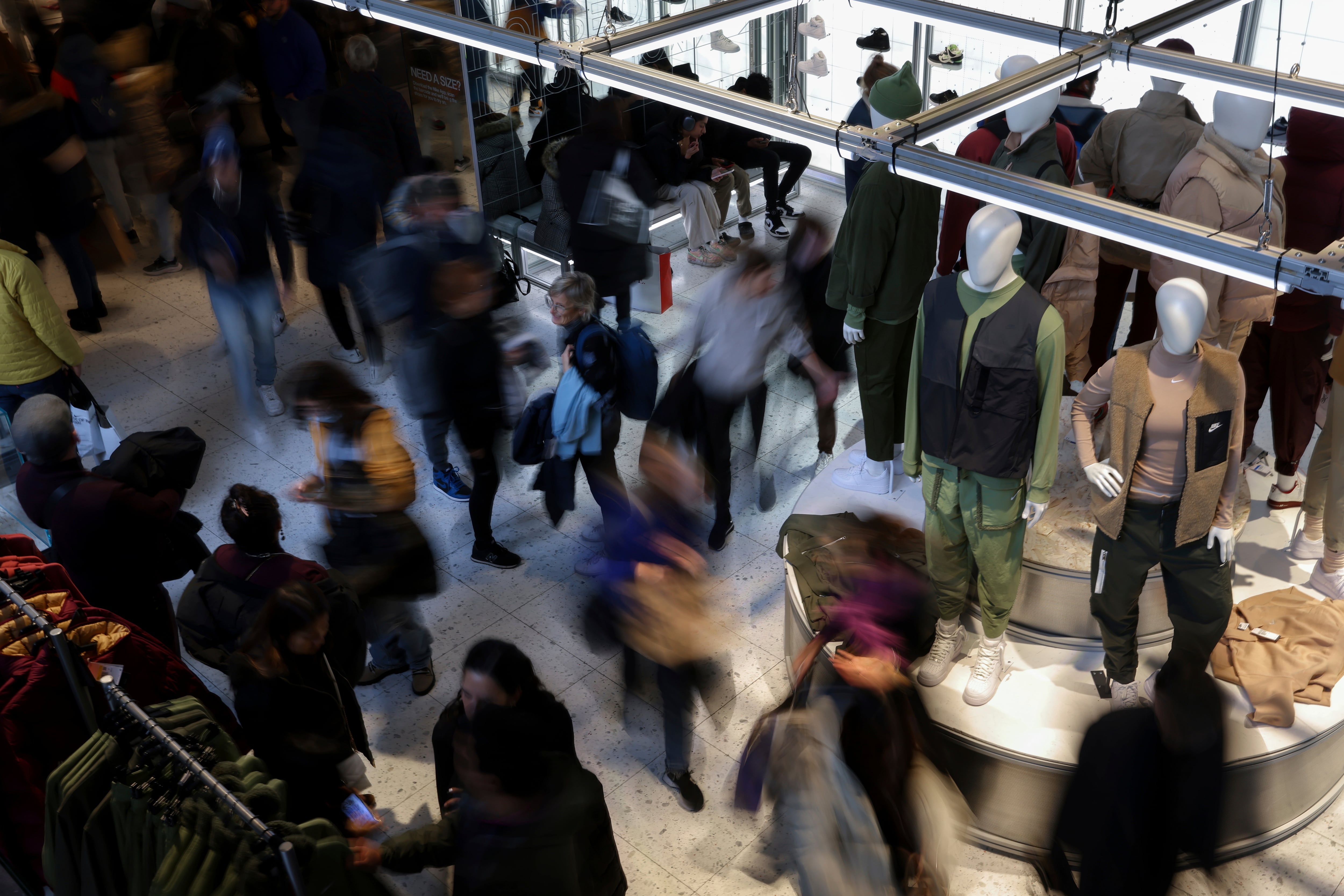
Consumers, who account for about 70% of the total economy, drove the fourth-quarter growth. Their spending expanded at a 2.8% annual rate, for items ranging from clothing, furniture, recreational vehicles and other goods to services like hotels and restaurant meals.
The GDP report also showed that despite the robust pace of growth in the October-December quarter, inflationary measures continued to ease. Consumer prices rose at a 1.7% annual rate, down from 2.6% in the third quarter. And excluding volatile food and energy prices, so-called core inflation came in at a 2% annual rate.
The state of the economy is sure to weigh on people’s minds ahead of the November elections. After an extended period of gloom, Americans are starting to feel somewhat better about inflation and the economy — a trend that could sustain consumer spending, fuel economic growth and potentially affect voters’ decisions. A measure of consumer sentiment by the University of Michigan, for example, has jumped in the past two months by the most since 1991.
There is growing optimism that the Federal Reserve is on track to deliver a rare “soft landing” — raising borrowing rates enough to cool growth, hiring and inflation yet not so much as to send the economy into a tailspin. Inflation touched a four-decade high in 2022 but has since edged steadily lower without the painful layoffs that most economists had thought would be necessary to slow the acceleration of prices.
The economy has repeatedly defied predictions that the Fed's aggressive interest rate hikes would trigger a recession. Far from collapsing last year, the economy accelerated — 2.5%, up from 1.9% in 2022.
“We continue to forecast an ongoing expansion in economic activity over coming quarters,″ said Rubeela Farooqi, chief U.S. economist at High Frequency Economics.
Eventually, she cautioned, higher borrowing rates may dampen consumer spending and GDP. But she added that "there could be some upside to economic growth as the Fed starts to cut rates this year and financial and credit conditions ease.″
The economy’s outlook had looked far bleaker a year ago. As recently as April 2023, an economic model published by the Conference Board, a business group, had pegged the likelihood of a U.S. recession over the next 12 months at close to 99%.
Even as inflation in the United States has slowed significantly, overall prices remain nearly 17% above where they were before the pandemic erupted three years ago, which has exasperated many Americans. That fact will likely raise a pivotal question for the nation’s voters, many of whom are still feeling the lingering financial and psychological effects of the worst bout of inflation in four decades. Which will carry more weight in the presidential election: The sharp drop in inflation or the fact that most prices are well above where they were three years ago?
The Fed began raising its benchmark rate in March 2022 in response to the resurgence in inflation that accompanied the economy’s recovery from the pandemic recession. By the time its hikes ended in July last year, the central bank had raised its influential rate from near zero to roughly 5.4%, the highest level since 2001.
As the Fed’s rate hikes worked their way through the economy, year-over-year inflation slowed from 9.1% in June 2022, the fastest rate in four decades, to 3.4% as of last month. That marked a striking improvement but still leaves that inflation measure above the Fed’s 2% target.
The progress so far has come at surprisingly little economic cost. Employers have added a healthy 225,000 jobs a month over the past year. And unemployment has remained below 4% for 23 straight months, the longest such streak since the 1960s.
The once red-hot job market has cooled somewhat, easing pressure on companies to raise pay to keep or attract employees and then pass on their higher labor costs to their customers through price hikes.
It’s happened in perhaps the least painful way: Employers are generally posting fewer job openings rather than laying off workers. That is partly because many companies are reluctant to risk losing workers after having been caught flat-footed when the economy roared back from the brief but brutal 2020 pandemic recession.
Another reason for the economy’s sturdiness is that consumers emerged from the pandemic in surprisingly good financial shape, partly because tens of millions of households had received government stimulus checks. As a result, many consumers have managed to keep spending even in the face of rising prices and high interest rates.
Some economists have suggested that the economy will weaken in the coming months as pandemic savings are exhausted, credit card use nears its limits and higher borrowing rates curtail spending. Still, the government reported last week that consumers stepped up their spending at retailers in December, an upbeat end to the holiday shopping season.
Joe Brusuelas, chief economist at the tax and consulting firm RSM, said he thinks consumer spending is even stronger than the retail sales report indicated. Brusuelas suggested that the government data “did not adequately capture’’ increased holiday splurging on travel and other services.