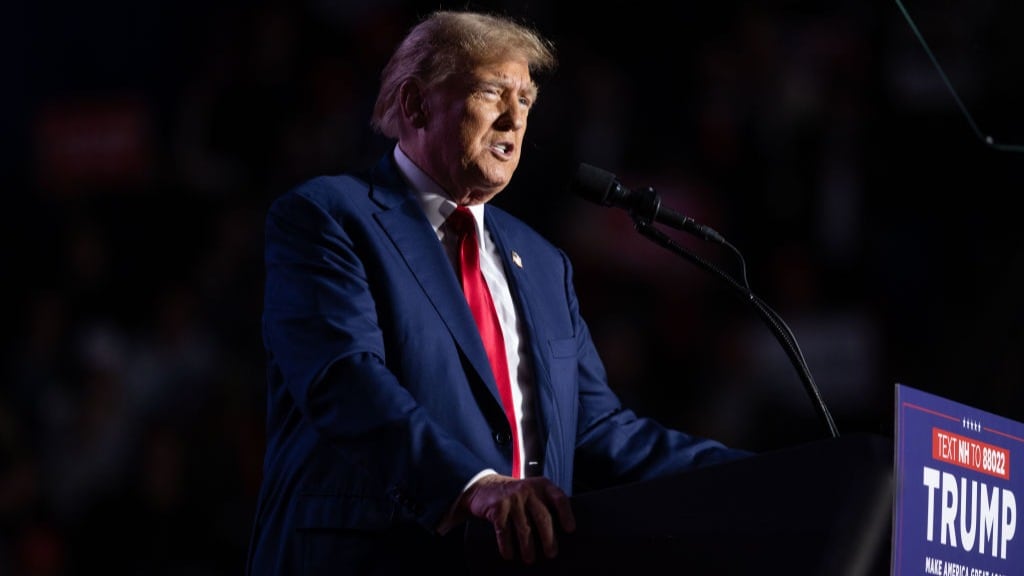
The Supreme Court on Monday unanimously restored Donald Trump to 2024 presidential primary ballots, rejecting state attempts to ban the Republican former president over the Capitol riot.
The justices ruled a day before the Super Tuesday primaries that states cannot invoke a post-Civil War constitutional provision to keep presidential candidates from appearing on ballots. That power resides with Congress, the court wrote in an unsigned opinion.
Trump posted on his social media network shortly after the decision was released: “BIG WIN FOR AMERICA!!!”
The case marked the first time in a generation, since Bush v. Gore in 2000, that the court had ruled so directly on a matter affecting a presidential election. But it almost certainly will not be the last as Trump fights four separate criminal actions against him, and has another Supreme Court date in April.
The outcome ends efforts in Colorado, Illinois, Maine and elsewhere to kick Trump, the front-runner for his party’s nomination, off the ballot because of his attempts to undo his loss in the 2020 election to Democrat Joe Biden, culminating in the Jan. 6, 2021, attack on the Capitol.
Colorado Secretary of State Jena Griswold expressed disappointment in the court's decision as she acknowledged that "Donald Trump is an eligible candidate on Colorado’s 2024 Presidential Primary.”
Trump’s case was the first at the Supreme Court dealing with a provision of the 14th Amendment that was adopted after the Civil War to prevent former officeholders who “engaged in insurrection” from holding office again.
Colorado’s Supreme Court, in a first-of-its-kind ruling, had decided that the provision, Section 3, could be applied to Trump, who that court found incited the Capitol attack. No court before had applied Section 3 to a presidential candidate.
The justices sidestepped the politically fraught issue of insurrection in their opinions Monday.
The court held that states may bar candidates from state office. “But States have no power under the Constitution to enforce Section 3 with respect to federal offices, especially the Presidency,” the court wrote.
While all nine justices agreed that Trump should be on the ballot, there was sharp disagreement from the three liberal members of the court and a milder disagreement from conservative Justice Amy Coney Barrett that their colleagues went too far in determining what Congress must do to disqualify someone from federal office.
Justices Sonia Sotomayor, Elena Kagan and Ketanji Brown Jackson said they agreed that allowing the Colorado decision to stand could create a “chaotic state by state patchwork” but said they disagreed with the majority’s finding a disqualification for insurrection can only happen when Congress enacts legislation. “Today, the majority goes beyond the necessities of this case to limit how Section 3 can bar an oathbreaking insurrectionist from becoming President," the three justices wrote in a joint opinion.
It’s unclear whether the ruling leaves open the possibility that Congress could refuse to certify the election of Trump or any other presidential candidate it sees as having violated Section 3.
Derek Muller, a law professor at the University of Notre Dame, said “it seems no,” noting that the liberals complained that the majority ruling forecloses any other ways for Congress to enforce the provision. Rick Hasen, a law professor at the University of California-Los Angeles, wrote that it’s frustratingly unclear what the bounds might be on Congress.
Hasen was among those urging the court to settle the issue so there wasn’t the risk of Congress rejecting Trump under Section 3 when it counts electoral votes on Jan. 6, 2025.
“We may well have a nasty, nasty post-election period in which Congress tries to disqualify Trump but the Supreme Court says Congress exceeded its powers,” he wrote.
Both sides had requested fast work by the court, which heard arguments less than a month ago, on Feb. 8. The justices seemed poised then to rule in Trump's favor.
Trump had been kicked off the ballots in Colorado, Maine and Illinois, but all three rulings were on hold awaiting the Supreme Court’s decision.
The case is the court’s most direct involvement in a presidential election since Bush v. Gore, a decision that effectively handed the 2000 election to Republican George W. Bush. And it’s just one of several cases involving Trump directly or that could affect his chances of becoming president again, including a case scheduled for arguments in late April about whether he can be criminally prosecuted on election interference charges, including his role in the Jan. 6 Capitol attack. Trump has argued that he has absolute immunity from prosecution. The timing of the high court's intervention has raised questions about whether Trump will be tried before the November election.
The arguments in February were the first time the high court had heard a case involving Section 3. The two-sentence provision, intended to keep some Confederates from holding office again, says that those who violate oaths to support the Constitution are barred from various positions including congressional offices or serving as presidential electors. But it does not specifically mention the presidency.
Conservative and liberal justices questioned the case against Trump. Their main concern was whether Congress must act before states can invoke the 14th Amendment. There also were questions about whether the president is covered by the provision.
The lawyers for Republican and independent voters who sued to remove Trump’s name from the Colorado ballot had argued that there is ample evidence that the events of Jan. 6 constituted an insurrection and that it was incited by Trump, who had exhorted a crowd of his supporters at a rally outside the White House to “fight like hell.” They said it would be absurd to apply Section 3 to everything but the presidency or that Trump is somehow exempt. And the provision needs no enabling legislation, they argued.
Following the decision, the president of the liberal-leaning group that represented the voters pointed to the court's silence on whether Trump incited the insurrection. “They were given the opportunity to exonerate Donald Trump and they did not do that,” said Noah Bookbinder of the Citizens for Responsibility and Ethics in Washington.
Trump’s lawyers mounted several arguments for why the amendment can’t be used to keep him off the ballot. They contended the Jan. 6 riot wasn’t an insurrection and, even if it was, Trump did not go to the Capitol or join the rioters. The wording of the amendment also excludes the presidency and candidates running for president, they said. Even if all those arguments failed, they said, Congress must pass legislation to reinvigorate Section 3.
The case was decided by a court that includes three justices appointed by Trump when he was president. They have considered many Trump-related cases in recent years, declining to embrace his bogus claims of fraud in the 2020 election and refusing to shield tax records from Congress and prosecutors in New York.
The 5-4 decision in Bush v. Gore case more than 23 years ago was the last time the court was so deeply involved in presidential politics. Justice Clarence Thomas is the only member of the court who was on the bench then. Thomas has ignored calls by some Democratic lawmakers to step aside from the Trump case because his wife, Ginni, supported Trump’s effort to overturn the 2020 election results and attended the rally that preceded the storming of the Capitol by Trump supporters.