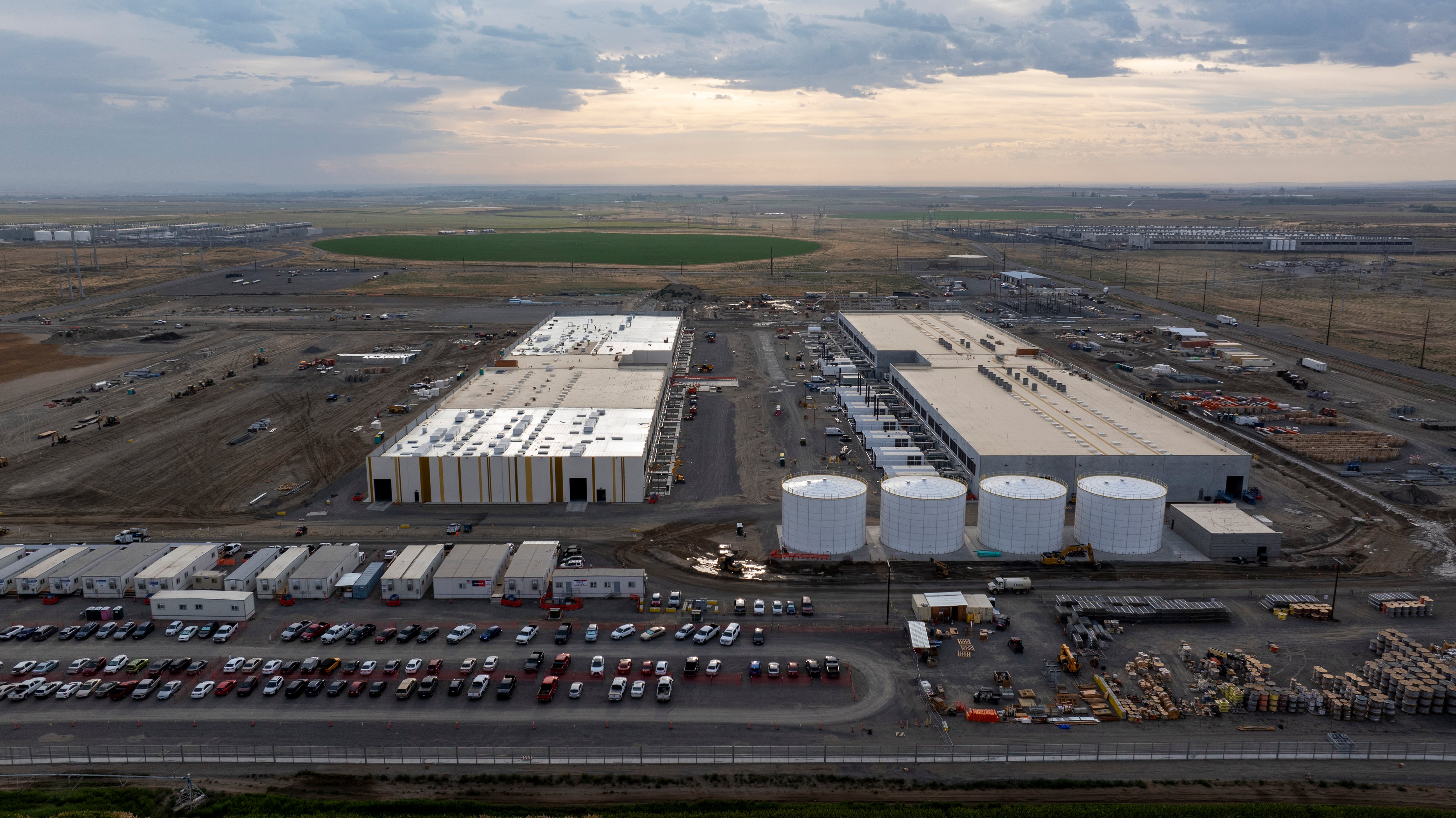
HARRISBURG, Pa. (AP) — The explosive growth of the data centers needed to power America’s fast-rising demand for artificial intelligence and cloud computing platforms has spurred states to dangle incentives in hopes of landing an economic bonanza, but it’s also eliciting pushback from lawmakers and communities.
Activity in state legislatures — and competition for data centers — has been brisk in recent months, amid an intensifying buildout of the energy-hungry data centers and a search for new sites that was ignited by the late 2022 debut of OpenAI’s ChatGPT.
Many states are offering financial incentives worth tens of millions of dollars. In some cases, those incentives are winning approval, but only after a fight or efforts to require data centers to pay for their own electricity or meet energy efficiency standards.
Some state lawmakers have contested the incentives in places where a heavy influx of massive data centers has caused friction with neighboring communities. In large part, the fights revolve around the things that tech companies and data center developers seem to most want: large tracts of land, tax breaks and huge volumes of electricity and water.
And their needs are exploding in size: from dozens of megawatts to hundreds of megawatts and from dozens of acres up to hundreds of acres for large-scale data centers sometimes called a hyperscaler.
While critics say data centers employ relatively few people and pack little long-term job-creation punch, their advocates say they require a huge number of construction jobs to build, spend enormous sums on goods and local vendors and generate strong tax revenues for local governments.
In Pennsylvania, lawmakers are writing legislation to fast-track permitting for data centers. The state is viewed as an up-and-coming data center destination, but there is also a sense that Pennsylvania is missing out on billions of dollars in investment that’s landing in other states.
“Pennsylvania has companies that are interested, we have a labor force that is capable and we have a lot of water and natural gas,” said state Rep. Eric Nelson. “That’s the winning combination. We just have a bureaucratic process that won’t open its doors.”
It’s been a big year for data centers
Kansas approved a new sales tax exemption on goods to build and equip data centers, while Kentucky and Arkansas expanded pre-existing exemptions so that more projects will qualify.
Michigan approved one that carries some protections, including requirements to use municipal utility water and clean energy, meet energy-efficiency measures and ensure that it pays for its own electricity.
Such tax exemptions are now so widespread — about three dozen states have some version of it — that it is viewed as a must-have for a state to compete.
“It’s often a nonstarter if you don’t have them, for at least the hyperscalers,” said Andy Cvengros, who helps lead the data center practice at commercial real estate giant JLL. “It’s just such a massive impact on the overall spend of the data center.”
Zoning, energy fights often frustrate developers
In West Virginia, lawmakers approved a bill to create “microgrid” districts free from local zoning and electric rate regulations where data centers can procure power from standalone power plants.
Gov. Patrick Morrisey, a Republican, called the bill his “landmark policy proposal” for 2025 to put West Virginia “in a class of its own to attract new data centers and information technology companies.”
Utah and Oklahoma passed laws to make it easier for data center developers to procure their own power supply without going through the grid while Mississippi rolled out tens of millions of dollars in incentives last year to land a pair of Amazon data centers.
In South Carolina, Gov. Henry McMaster signed legislation earlier this month that eased regulations to speed up power plant construction to meet demand from data centers, including a massive Facebook facility.
The final bill was fought by some lawmakers who say they worried about data centers using disproportionate amounts of water, taking up large tracts of land and forcing regular ratepayers to finance the cost of new power plants.
“I do not like that we’re making customers pay for two power plants when they only need one,” Senate Majority Leader Shane Massey told colleagues during floor debate.
Still, state Sen. Russell Ott suggested that data centers should be viewed like any other electricity customer because they reflect a society that is “addicted” to electricity and are “filling that need and that desire of what we all want. And we’re all guilty of it. We’re all responsible for it.”
Some lawmakers are hesitant
In data center hotspots, some lawmakers are pushing back.
Lawmakers in Oregon are advancing legislation to order utility regulators to ensure data centers pay the cost of power plants and power lines necessary to serve them.
Georgia lawmakers are debating a similar bill.
In Virginia, the most heavily developed data center zone in the U.S., Gov. Glenn Youngkin vetoed a bill that would have forced more disclosures from data center developers about their site’s noise pollution and water use.
In Texas, which endured a deadly winter blackout in 2021, lawmakers are wrestling with how to protect the state’s electric grid from fast-growing data center demand.
Lawmakers still want to attract data centers, but a bill that would speed up direct hookups between data centers and power plants has provisions that are drawing protests from business groups.
Those provisions would give utility regulators new authority to approve those agreements and order big electric users such as data centers to switch to backup generators in a power emergency.
Walt Baum, the CEO of Powering Texans, which represents competitive power plant owners, warned lawmakers that those provisions might be making data center developers hesitant to do business in Texas.
“You’ve seen a lot of new announcements in other states and over the last several months and not as much here in Texas,” Baum told House members during a May 7 committee hearing. ”I think everybody right now is in a waiting pattern and I worry that we could be losing to other states while that waiting pattern is happening.”
___
Follow Marc Levy on X at https://x.com/timelywriter.