By Alex Veiga
When viewed through a wide lens, renters across the U.S. finally appear to be getting some relief, thanks in part to the biggest apartment construction boom in decades.
Median rent rose just 0.5% in June, year over year, after falling in May for the first time since the pandemic hit the U.S. Some economists project U.S. rents will be down modestly this year after soaring nearly 25% over the past four years.
A closer look, however, shows the trend will likely be little comfort for many U.S. renters who’ve had to put an increasing share of their income toward their monthly payment. Renters in cities such as Cincinnati and Indianapolis are still getting hit with increases of 5% or more. Much of the new construction is located in just a few metro areas, and many of the new units are luxury apartments, which rent for well north of $2,000.
Median U.S. rent has risen to $2,029 this June from $1,629 in June 2019, according to rental listings company Rent, which tracks rents in 50 of the largest U.S. metropolitan areas. Demand for apartments exploded during the pandemic as people who could work remotely sought more space or decided to relocate to another part of the country.
The steep rent increases have left tenants like Melissa Lombana, a high school teacher who lives in the South Florida city of Miramar, with progressively less income to spend on other needs.
The rent on her one-bedroom apartment jumped 13% last year to $1,700. It climbed another 6% to $1,800 this month when she renewed her lease.
“Even the $1,700 was a stretch for me,” said Lombana, 43, who supplements her teaching income with a side job doing educational testing. “In a year, I will not be able to afford living here at all.”
Lombana’s rent is now gobbling up nearly half her monthly income. That puts her in a category referred to as “cost-burdened” by the U.S. Department of Housing and Urban Development, denoting households that pay 30% or more of their income toward rent. Last year, the average rent-to-income ratio per household rose to 30%. This March, it was 29.6%.
Lombana hasn’t had any luck finding a more affordable apartment. While South Florida is one of the metropolitan areas seeing a rise in apartment construction, the units are mostly high-end and not a viable option.
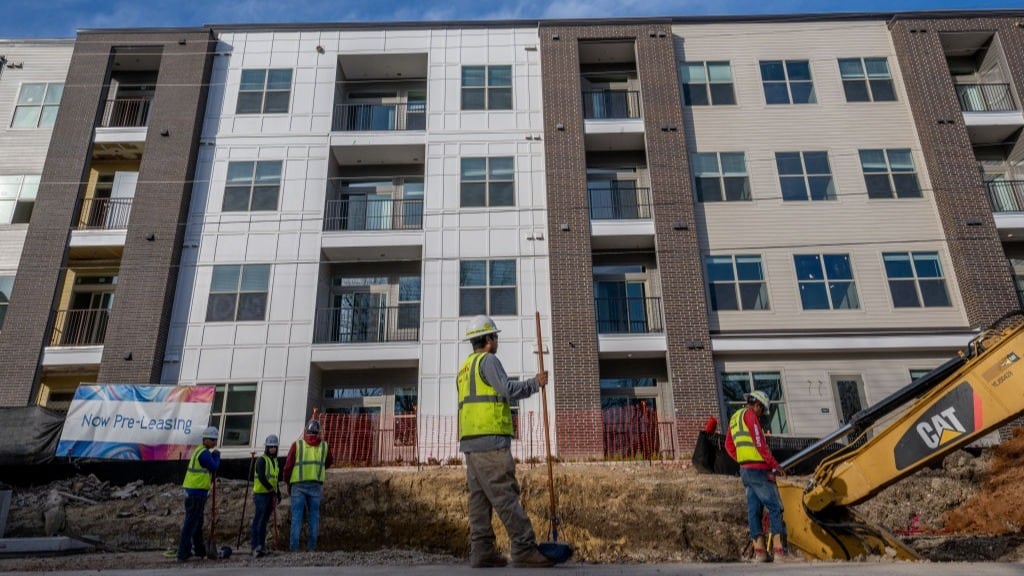
That scenario is playing out across the nation. Developers are rushing to complete projects that were green-lit during the pandemic-era surge in demand for rentals or left in limbo by delays in supplies of fixtures and building materials. Nearly 1.1 million apartments are currently under construction, according to the commercial real estate tracker CoStar, a pace not seen since the 1970s.
Increasing the supply of apartments tends to moderate rent increases over time and can give tenants more options on where to live. But more than 40% of the new rentals to be completed this year will be concentrated in about 10 high job growth metropolitan areas, including Austin, Nashville, Denver, Atlanta and New York, according to Marcus & Millichap. In many areas, the boost to overall inventory will be barely noticeable.
Even within metros where there’ll be a notable increase in available apartments, such as Nashville, most of it will be in the luxury category, where rents average $2,270, nationally. Some 70% of the new rental inventory will be the luxury class, said Jay Lybik, national director of multifamily analytics at CoStar.
That will leave most tenants unlikely to see a big enough reduction in rent to make a difference, industry experts and economists say.
“I think we’re in a period of rent flattening for 12 or 18 months, but it’s certainly not a big rent decline,” said Hessam Nadji, CEO of commercial real estate firm Marcus & Millichap.
“We’re building a multi-decade record number of units,” Nadji said. “It’s going to cause some softening and some pockets of overbuilding, but it’s not going to fundamentally resolve the housing shortage or the affordability problem for renters across the U.S.”
The surge in rents has made it difficult for workers to keep up with inflation despite solid wage gains the past few years and exacerbated a long-term trend. Between 1999 and 2022, U.S. rents soared 135%, while income grew 77%, according to data from Moody’s Analytics.
Realtor.com is forecasting that rents will drop an average of 0.9% this year. But while down nationally, rents are still rising in many markets around the country, especially those where hiring remains robust.
In the New York metro area, the median rent climbed 4.7% in June from a year earlier to $2,899, according to Realtor.com. In the Midwest, rents surged 5.6% in the Cincinnati metro area to $1,188, and 6.9% to $1,350 in the Indianapolis metro area.
The current spike in apartment construction alone isn’t going to be enough to address how costly renting has become for many Americans.
“For the rest of the 2020s rents will continue to grow because millennials are such a big generation and we’re very much in the hole in terms of building housing for that generation,” said Daryl Fairweather, chief economist at Redfin. “It will take many good years of new construction to build adequate housing for millennials.”
The bigger challenge is building more work force housing, because the cost of land, labor and navigating the government approval process incentivize developers to put up luxury apartments buildings.
Expanding the supply of modestly priced rentals would help alleviate the strain from so many new apartments targeting renters with high incomes, “although additional subsidies will be needed to make housing affordable to households with the lowest incomes,” researchers at Harvard University’s Joint Center for Housing Studies wrote in a recent report.
Despite the overall pullback in U.S. rents, Joey Di Girolamo, in Pembroke Pines, Florida, worries that he’ll face more sharp rent increases in coming years.
Last year, the web designer left a two-bedroom, two-bath townhome he rented for $2,200 a month to avoid a $600 a month increase. This year, his rent went up by $200, a nearly 10% jump.
“That blew me away,” said Di Girolamo, 50. “I’m just kind of dreading what it’s going to be like next year, but especially 3 or 4 years from now.”