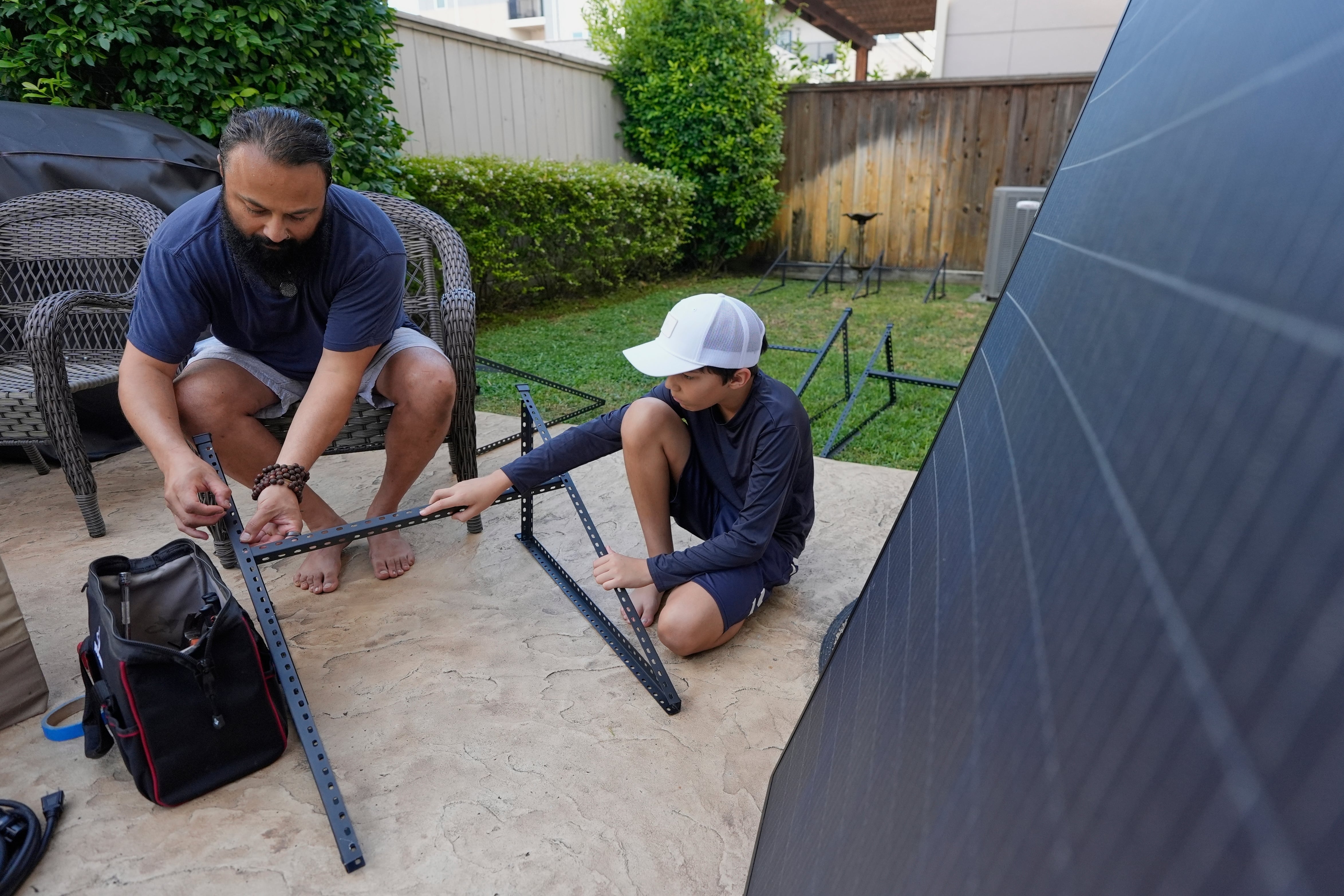
When Terrence Dwyer received a knock on his door and a flyer for a solar panel system small enough to fit on his deck, he was quickly sold. Solar systems that plug into regular wall outlets have been popular in Europe for years and are gaining traction in the U.S. for their affordability and simple installation.
“We thought absolutely, let’s do this right away,” said Dwyer, who lives in Oakland, California.
These small-scale solar systems could become attractive to more homeowners now that President Donald Trump’s sweeping budget-and-policy package will scrap residential rooftop solar tax credits and may shift interest to cheaper alternatives. Even before the GOP bill passed, manufacturers of the smaller systems known as plug-in or balcony solar were seeing increased demand and other positive signs such as a new Utah law streamlining regulations for homeowners to buy and install them. The systems about the size of a door haven’t been as widely adopted in the U.S. as in Europe because of lack of awareness, patchwork utility rules and limited availability.
The $2,000 plug-in solar system installed on Dwyer’s backyard deck in March consists of two 400 watt panels, an inverter, a smart meter and a circuit breaker. It saves him around $35 per month on his power bill because he is consuming less energy from the grid, but he said reducing his carbon footprint was his primary motivation.
“We like the environmental benefits of solar and wanted to engage with solar in some fashion,” Dwyer said.
Had Dwyer opted for rooftop solar, he would have paid $20,000 for the system and $30,000 to upgrade his roof to support the panels.
Installing a plug-in solar system requires some homework. What power companies let customers do with energy-generating equipment varies, which is why prospective purchasers should check their utility’s policies first. Building permits might be required depending on the municipality. Some systems can be self-installed, while others may require an electrician. For example, some kits have meters that must be wired into a home’s circuit breaker.
Removing hurdles for plug-in solar
Dwyer bought his system from Bright Saver, a nonprofit company in California that advocates for plug-in solar. In addition to the type Dwyer bought, the company also offers a smaller model costing $399 that recently sold out in six days.
“The interest and demand have been overwhelming,” said Cora Stryker, a founder of Bright Saver. “It is clear that we are hitting a nerve — many Americans have wanted solar for a long time but have not had an option that is feasible and affordable for them until now.”
Kevin Chou, another founder of Bright Saver, said wider adoption of the systems in the U.S. has been hindered by utility policies that create uncertainty about whether they’re allowed and a lack of state and local policies to make clear what rules apply.
Some utilities contacted by The Associated Press say plug-in solar systems require the same interconnection applications as rooftop panels that send electricity back to the wider network. But Steven Hegedus, an electrical engineering professor at University of Delaware, said he doesn’t understand why a utility would need to require an interconnection agreement for plug-in solar because, unlike rooftop systems, they are designed to prevent energy from flowing to the grid.
Still, if in doubt, a customer should follow their utility’s policy.
During the early days of plug-in solar’s growth, some opposition from utilities is likely since customers are buying less energy, said Robert Cudd, a research analyst at the California Center for Sustainable Communities at the University of California, Los Angeles.
“Utilities really prefer everyone being a predictable and generous consumer of the electricity they sell,” Cudd said.
This year, Utah enacted a novel law supporting plug-in solar by exempting certain small-scale systems from interconnection agreements and establishing safety requirements such as being certified by a nationally recognized testing organization such as Underwriters Laboratories. It appears to be the only state that’s passed legislation supporting plug-in solar, according to the National Conference of State Legislatures.
Republican state Rep. Raymond Ward, who sponsored the legislation, said the smaller systems allow people to better manage where their energy comes from and what they pay.
“Europe has these things. You can go buy them and they work and people want them. There is no reason why we shouldn’t have them here in the United States,” Ward said.
Bright Saver says they are lobbying other states for similar legislation.
Alexis Abramson, dean of the University of Columbia Climate School, also applauded Utah’s move.
“We actually need more localities, more states putting in allowances for this type of equipment,” she said.
Plug-in solar availability and savings potential
Some questions remain about how much customers could save. Severin Borenstein, a professor at the University of California, Berkeley’s Haas School of Business, said the cost of some portable solar systems in the U.S. would make it hard for customers to come out ahead on their utility bills over the time they own them. He estimates the price of a $2,000 system in the U.S. works out to paying about $0.20 a kilowatt-hour over a 25-year period, which only saves people money if they have high utility costs. By comparison, Borenstein said the cost of systems sold in Europe, typically around $600, is equivalent to paying about $0.05 or $0.06 per kilowatt-hour over 25 years.
Baltimore resident Craig Keenan said saving money was only part of why he installed one of the smaller Bright Saver models on his balcony in July.
“I’m interested in renewable energy because the amount of carbon emissions that we produce as a species is very, very unsustainable for our world,” he said.
He said he expects the system will save him about $40 per year on utility bills, so it would take him about 10 years to recoup the cost of the kit.
Keenan, a mechanical engineer, said installation took him 10 to 15 minutes.
“I think anyone can install this,” he said. “It’s not complicated. It doesn’t require a technical degree.”
Other companies selling plug-in solar kits include Texas-based Craftstrom. It has sold about 2,000 systems in the U.S. since 2021, mostly in California, Texas and Florida. The company’s basic kits contain a solar panel that can fit in a backyard or other sunny space, along with equipment to maintain and regulate the flow of energy including an inverter and smart meter.
Kenneth Hutchings, Craftstrom’s chief revenue officer, said their U.S. sales rose this year even before the passage of the GOP tax bill, and he expects demand for plug-in solar to increase further as federal rooftop solar credits expire.
The company advises customers to notify their power company before installation, but it has “never had any pushback from any utility,” said Michael Scherer, one of the founders of Craftstrom.
China-based EcoFlow plans to begin selling plug-in solar systems in Utah and expand to other states if supportive legislation is passed, said Ryan Oliver, a company spokesperson.
“This is an example of where technology is sort of ahead of the regulators,” Oliver said, adding: “As this rolls out to more of a nationwide product, we expect it will become more mainstream as people understand it better.”
___
Associated Press video journalist Mingson Lau in Baltimore contributed to this report.
___
The Associated Press’ climate and environmental coverage receives financial support from multiple private foundations. AP is solely responsible for all content. Find AP’s standards for working with philanthropies, a list of supporters and funded coverage areas at AP.org.