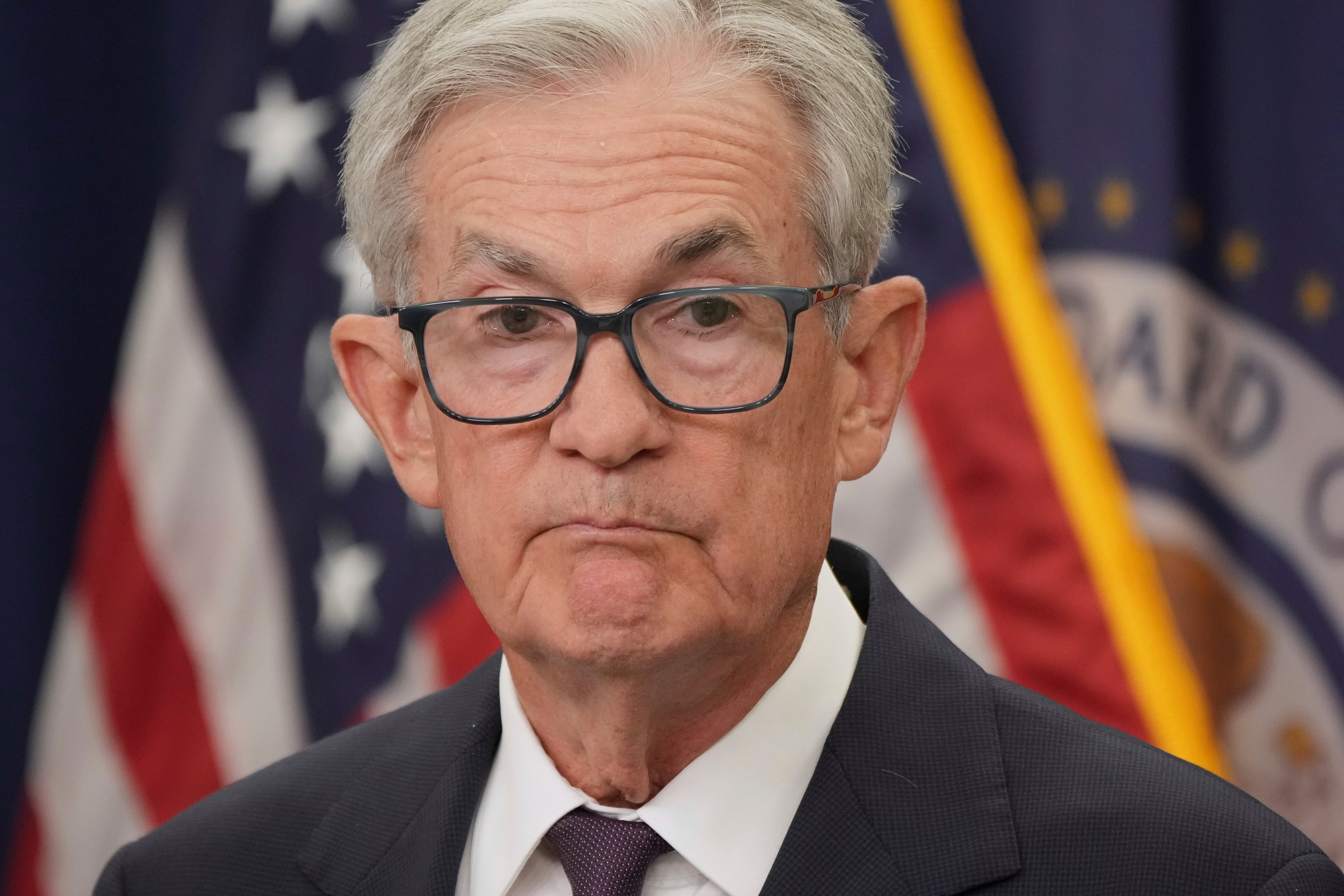
WASHINGTON (AP) — A sharp slowdown in hiring poses a growing risk to the U.S. economy, Federal Reserve Chair Jerome Powell said Tuesday, a sign that the Fed will likely cut its key interest rate twice more this year.
Powell said in a speech in Philadelphia that despite the federal government shutdown cutting off official economic data, “the outlook for employment and inflation does not appear to have changed much since our September meeting,” when the Fed reduced its key rate for the first time this year.
Fed officials at that meeting also forecast that the central bank would reduce its rate twice more this year and once in 2026. Lower rates from the Fed could reduce borrowing costs for mortgages, car loans, and business loans. Powell spoke before a meeting of the National Association of Business Economics.
Powell reiterated a message he first delivered after the September meeting, when he signaled that the Fed is slightly more worried about the job market than its other congressional mandate, which is to keep prices stable. Tariffs have lifted the Fed’s preferred measure of inflation to 2.9%, he said, but outside the duties there aren’t “broader inflationary pressures” that will keep prices high.
“Rising downside risks to employment have shifted our assessment of the balance of risks,” he said.
Economists said Powell’s remarks solidified expectations for further rate cuts, starting at its next meeting Oct. 28-29.
“While there was little doubt the (Fed) was angled to cut rates at its next meeting, today’s remarks were strong confirmation of that expectation,” Michael Feroli, chief U.S. economist at JPMorgan Chase, said in a note to clients.
Powell also said that the central bank may soon stop shrinking its roughly $6.6 trillion balance sheet. The Fed has been allowing roughly $40 billion of Treasuries and mortgage-backed securities to mature each month without replacing them.
“We may approach that point in coming months,” Powell said.
The shift could slightly lower borrowing costs over time. Economists at BMO Capital Markets estimated that the yields on Treasury securities ticked down slightly after Powell’s remarks.
Separately, Powell spent most of his speech defending the Fed’s practice of buying longer-term Treasury bonds and mortgage-backed securities in 2020 and 2021, which were intended to lower longer-term interest rates and support the economy during the pandemic.
Yet those purchases have come under a torrent of criticism from Treasury Secretary Scott Bessent, as well as some of the candidates floated by the Trump administration to replace Powell when his term as Chair ends next May.
Bessent said in an extended critique published earlier this year that the huge purchases of bonds during the pandemic worsened inequality by boosting the stock market, without providing noticeable benefits to the economy.
Other critics have long argued that the Fed kept implementing the purchases for too long, keeping interest rates low even as inflation began to spike in late 2021. The Fed beginning in 2021 stopped the purchases and then sharply boosted borrowing costs to combat inflation.
“With the clarity of hindsight, we could have—and perhaps should have—stopped asset purchases sooner,” Powell said. “Our real-time decisions were intended to serve as insurance against downside risk.”
Yet Powell said that moving earlier would not have prevented the COVID-era inflation spike: “Stopping sooner could have made some difference, but not likely enough to fundamentally alter the trajectory of the economy.”
Powell also said the purchases were intended to avoid a breakdown in the market for Treasury securities, which could have sent interest rates much higher.
The Fed chair also addressed a move by a bipartisan group of senators to stop the central bank from paying interest on the cash reserves banks park at the Fed. A measure to prevent the Fed from doing so was defeated in the Senate last week by the lopsided vote of 83-14.
Still, it garnered support from both parties, including Republican senators Rand Paul from Kentucky and Ted Cruz from Texas, as well as Massachusetts Democratic Sen. Elizabeth Warren.
Powell said that without the ability to pay interest on reserves, the Fed “would lose control over rates” and wouldn’t be able to carry out its mission. The Fed lifts the short-term interest rate it controls when it wants to cool borrowing and spending and slow inflation, while it cuts the rate to encourage borrowing, growth, and hiring.