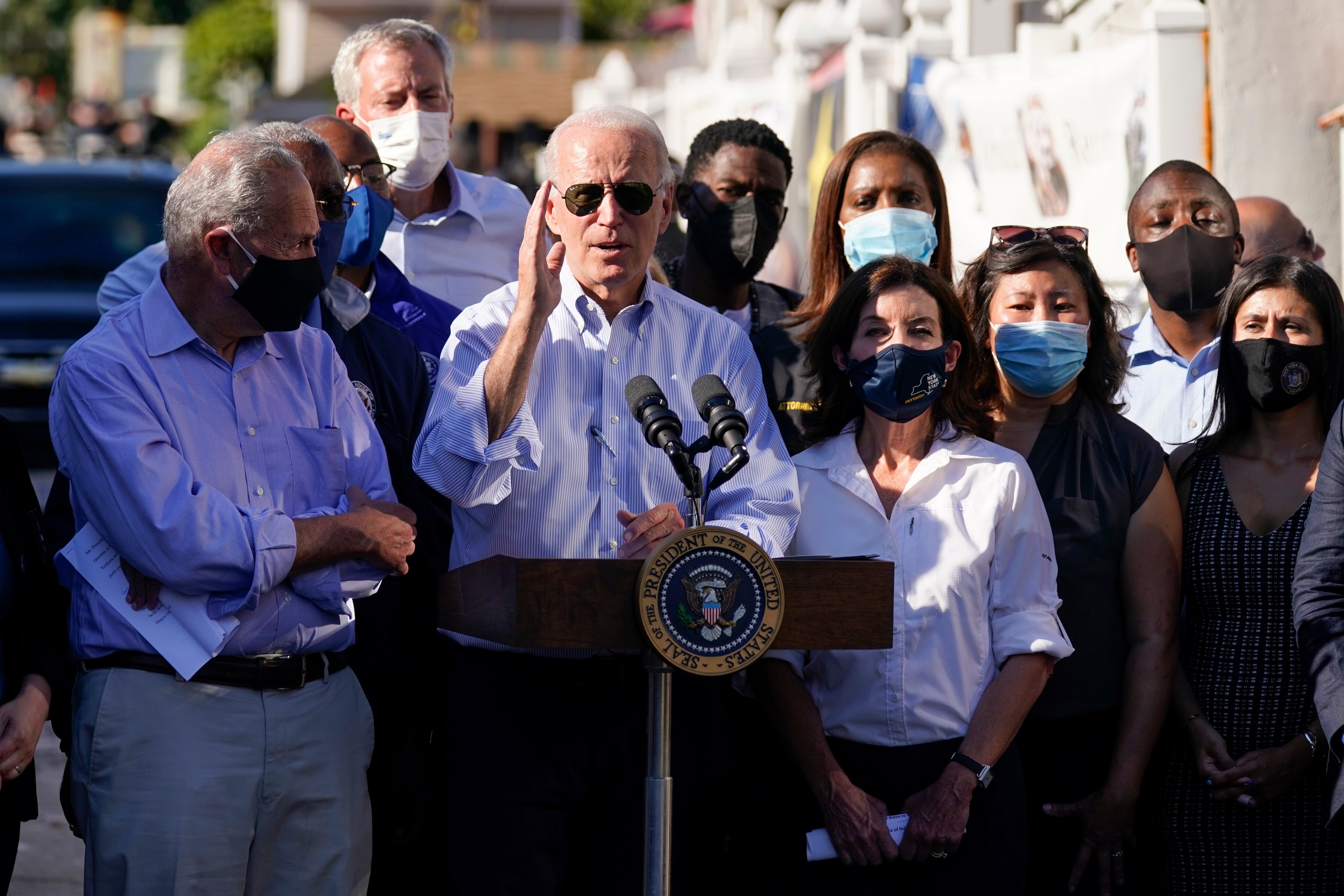
President Joe Biden speaks as he tours a neighborhood impacted by flooding from the remnants of Hurricane Ida, Tuesday, Sept. 7, 2021, in the Queens borough of New York. (AP Photo/Evan Vucci)
WASHINGTON (AP) — Solar energy has the potential to supply up to 40% of the nation’s electricity within 15 years — a 10-fold increase over current solar output, but one that would require massive changes in U.S. policy and billions of dollars in federal investment to modernize the nation's electric grid, a new federal report says.
The report by the Energy Department's Office of Energy Efficiency and Renewable Energy says the United States would need to quadruple its annual solar capacity — and continue to increase it year by year — as it shifts to a renewable-dominant grid in order to address the existential threat posed by climate change.
The report released Wednesday is not intended as a policy statement or administration goal, officials said. Instead, it is "designed to guide and inspire the next decade of solar innovation by helping us answer questions like: How fast does solar need to increase capacity and to what level?'' said Becca Jones-Albertus, director of the Energy Department's solar energy technologies office.
Energy Secretary Jennifer Granholm said in a statement that the study “illuminates the fact that solar, our cheapest and fastest-growing source of clean energy, could produce enough electricity to power all of the homes in the U.S. by 2035 and employ as many as 1.5 million people in the process.”
The report comes as President Joe Biden declared climate change has become “everybody’s crisis” during a visit to neighborhoods flooded by the remnants of Hurricane Ida. Biden warned Tuesday that it's time for America to get serious about the “code red” danger posed by climate change or face increasing loss of life and property.
“We can’t turn it back very much, but we can prevent it from getting worse,” Biden said before touring a New Jersey neighborhood ravaged by severe flooding caused by Ida. “We don’t have any more time.”
The natural disaster has given Biden an opening to push Congress to approve his plan to spend $1 trillion to fortify infrastructure nationwide, including electrical grids, water and sewer systems, to better defend against extreme weather. The legislation has cleared the Senate and awaits a House vote.
The U.S. installed a record 15 gigawatts of solar generating capacity in 2020, and solar now represents about just over 3% of the current electricity supply, the Energy Department said.
The “Solar Futures Study,” prepared by DOE’s National Renewable Energy Laboratory, shows that, by 2035, the United States would need to quadruple its yearly solar capacity additions and provide 1,000 GW of power to a renewable-dominant grid. By 2050, solar energy could provide 1,600 GW on a zero-carbon grid — producing more electricity than consumed in all residential and commercial buildings in the country today, the report said. Decarbonizing the entire energy system could result in as much as 3,000 GW of solar by 2050 due to increased electrification in the transportation, buildings, and industrial sectors, the report said.
To achieve such an increase, the U.S. must install an average of 30 GW of solar capacity per year between now and 2025 — double its current rate — and 60 GW per year from 2025 to 2030, the report said.
Abigail Ross Hopper, president and CEO of the Solar Energy Industries Association, said the study “makes it clear that we will not achieve the levels of decarbonization that we need without significant policy advances.''
The solar group sent a letter to Congress Wednesday from nearly 750 companies spelling out recommended policy changes. "We believe with those policies and a determined private sector, the Biden administration’s goals are definitely achievable,'' Hopper said.
The New York Times and President Donald Trump are fighting again. The news outlet said Wednesday it won't be deterred by Trump's “false and inflammatory language” from writing about the 79-year-old president's health. The Times has done a handful of stories on that topic recently, including an opinion column that said Trump is “starting to give President Joe Biden vibes.” In a Truth Social post, Trump said it might be treasonous for outlets like the Times to do “FAKE” reports about his health and "we should do something about it.” The Republican president already has a pending lawsuit against the newspaper for its past reports on his finances.
OpenAI has appointed Slack CEO Denise Dresser as its first chief of revenue. Dresser will oversee global revenue strategy and help businesses integrate AI into daily operations. OpenAI CEO Sam Altman recently emphasized improving ChatGPT, which now has over 800 million weekly users. Despite its success, OpenAI faces competition from companies like Google and concerns about profitability. The company earns money from premium ChatGPT subscriptions but hasn't ventured into advertising. Altman had recently announced delays in developing new products like AI agents and a personal assistant.
President Donald Trump says he will allow Nvidia to sell its H200 computer chip used in the development of artificial intelligence to “approved customers” in China. Trump said Monday on his social media site that he had informed China’s leader Xi Jinping and “President Xi responded positively!” There had been concerns about allowing advanced computer chips into China as it could help them to compete against the U.S. in building out AI capabilities. But there has also been a desire to develop the AI ecosystem with American companies such as chipmaker Nvidia.
U.S. sports betting is booming as NFL and college football fuel massive activity. BetMGM CEO Adam Greenblatt breaks down trends, growth, and what’s next.
President Donald Trump says a deal struck by Netflix last week to buy Warner Bros. Discovery “could be a problem” because of the size of the combined market share. The Republican president says he will be involved in the decision about whether federal regulators should approve the deal. Trump commented Sunday when he was asked about the deal as he walked the red carpet at the Kennedy Center Honors. The $72 billion deal would bring together two of the biggest players in television and film and potentially reshape the entertainment industry.
Disney's changes to a program for disabled visitors are facing challenges in federal court and through a shareholder proposal. The Disability Access Service program, which allows disabled visitors to skip long lines, was overhauled last year. Disney now mostly limits the program to those with developmental disabilities like autism who have difficulty waiting in lines. The changes have sparked criticism from some disability advocates. A shareholder proposal submitted by disability advocates calls for an independent review of Disney's disability policies. Disney plans to block this proposal, claiming it's misleading. It's the latest struggle by Disney to accommodate disabled visitors while stopping past abuses by some theme park guests.
With a merger this big, creators, studios, and theaters all face uncertain futures. Here’s what experts are worried about and what good could come from it.
With disengagement rising and hybrid work shifting, 'Everybody Matters' author Bob Chapman explains why treating people well could define the future of work.