BARI, Italy (AP) — Pope Francis challenged leaders of the world’s wealthy democracies on Frida y to keep human dignity foremost in developing and using artificial intelligence, warning that such powerful technology risks turning human relations themselves into mere algorithms.
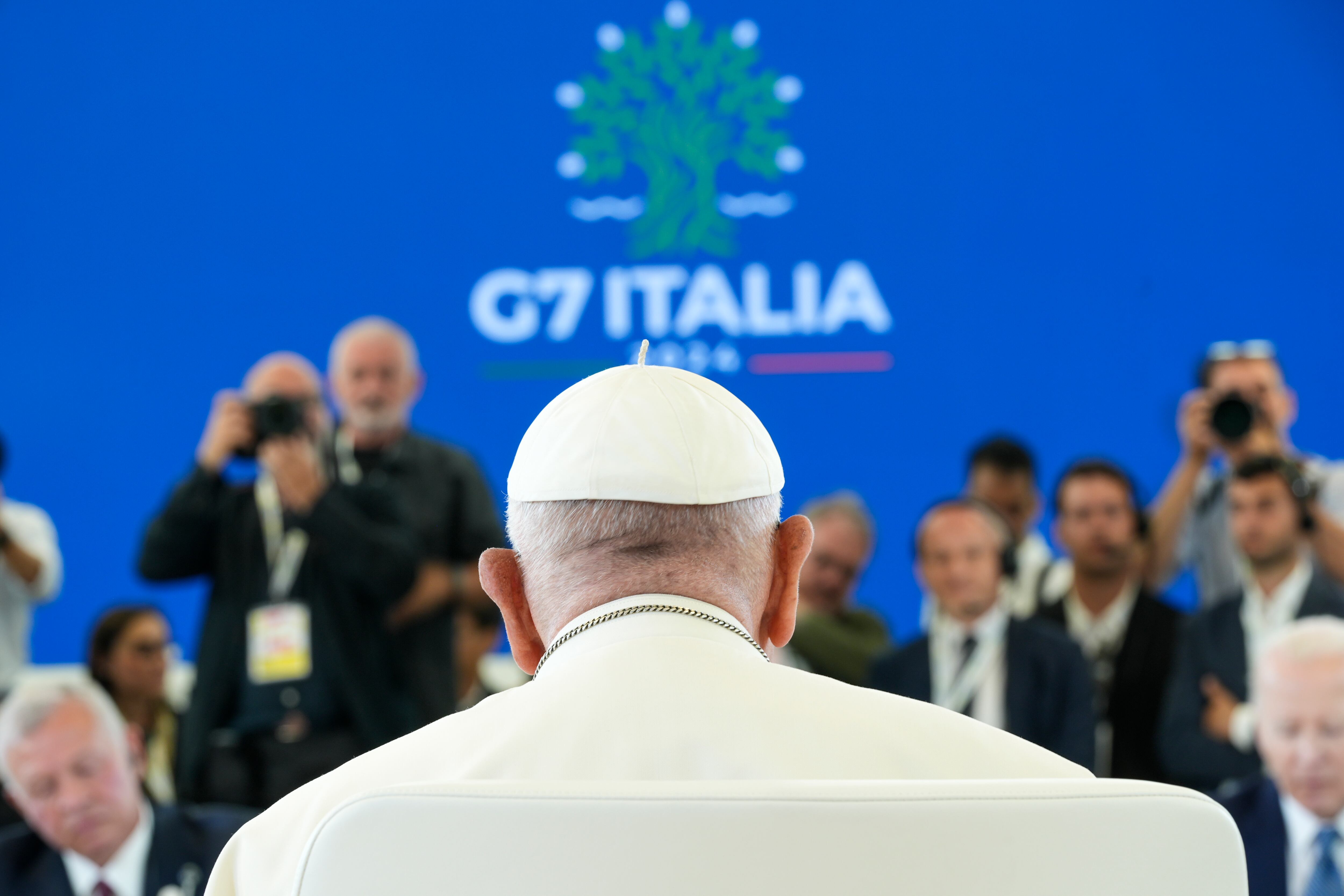
Francis brought his moral authority to bear on the Group of Seven, invited by host Italy to address a special session at their annual summit on the perils and promises of AI. In doing so, he became the first pope to attend the G7, offering an ethical take on an issue that is increasingly on the agenda of international summits, government policy and corporate boards alike.
Francis said politicians must take the lead in making sure AI remains human-centric, so that decisions about when to use weapons or even less-lethal tools always remain made by humans and not machines.
“We would condemn humanity to a future without hope if we took away people’s ability to make decisions about themselves and their lives, by dooming them to depend on the choices of machines,” he said. “We need to ensure and safeguard a space for proper human control over the choices made by artificial intelligence programs: Human dignity itself depends on it.”
The G7 final statement largely reflected his concerns.
The leaders vowed to better coordinate the governance and regulatory frameworks surrounding AI to keep it “human-centered.” At the same time, they acknowledged the potential impacts on the labor markets of machines taking the place of human workers and on the justice system of algorithms predicting recidivism.
“We will pursue an inclusive, human-centered, digital transformation that underpins economic growth and sustainable development, maximizes benefits, and manages risks, in line with our shared democratic values and respect for human rights,” they said.
By attending the summit, Francis joined a chorus of countries and global bodies pushing for stronger guardrails on AI following the boom in generative AI kickstarted by OpenAI’s ChatGPT chatbot.
The Argentine pope used his annual peace message this year to call for an international treaty to ensure AI is developed and used ethically. In it, he argued that a technology lacking human values of compassion, mercy, morality and forgiveness is too perilous to develop unchecked.
He didn't repeat that call explicitly in his speech Friday, but he made clear the onus is on politicians to lead on the issue. He also urged them to ultimately ban the use of lethal autonomous weapons, colloquially known as “killer robots.”
“No machine should ever choose to take the life of a human being,” he said.
On the weapons issue, the G7 leaders said they recognized the impact of AI in the military domain “and the need for a framework for responsible development and use.” They encouraged states to make sure “military use of AI is responsible, complies with applicable international law, particularly international humanitarian law, and enhances international security.”
Italian Premier Giorgia Meloni had invited Francis and announced his participation, knowing the potential impact of his star power and moral authority on the G7. Those seated at the table seemed duly awed, and the boisterous buzz in the room went absolutely quiet when Francis arrived.
“The pope is, well, a very special kind of a celebrity,” said John Kirton, a political scientist at the University of Toronto who directs the G7 Research Group think tank.
Kirton recalled the last summit that had this kind of star power, that then translated into action, was the 2005 meeting in Gleneagles, Scotland. There, world leaders decided to wipe out the $40 billion of the debts owed by 18 of the world’s poorest countries to the World Bank and the International Monetary Fund.
That summit was preceded by a Live 8 concert in London that featured Sting, The Who and a reformed Pink Floyd and drew over a million people in a show of solidarity against hunger and poverty in Africa.
“Gleneagles actually hit a home run and for some it’s one of the most successful summits,” Kirton said.
No such popular pressure was being applied to G7 leaders in the Italian region of Puglia, but Francis knew he could wield his own moral authority to renew his demands for safeguards for AI and highlight the threats to peace and society it poses if human ethics are left to the side.
“To speak of technology is to speak of what it means to be human and thus of our singular status as beings who possess both freedom and responsibility,” he said. “This means speaking about ethics.”
Generative AI technology has dazzled the world with its capabilities to produce humanlike-responses, but it’s also sparked fears about AI safety and led to a jumble of global efforts to rein it in.
Some worry about catastrophic but far off risks to humanity because of its potential for creating new bioweapons and supercharging disinformation. Others fret about its effect on everyday life, through algorithmic bias that results in discrimination or AI systems that eliminate jobs.
In his peace message, Francis echoed those concerns and raised others. He said AI must keep foremost concerns about guaranteeing fundamental human rights, promoting peace and guarding against disinformation, discrimination and distortion.
On the regulation front, Francis was in some ways preaching to the converted as the G7 members have been at the forefront of the debate on AI oversight.
Japan, which held the G7’s rotating presidency last year, launched its Hiroshima AI process to draw up international guiding principles and a code of conduct for AI developers. Adding to those efforts, Prime Minister Fumio Kishida last month unveiled a framework for global regulation of generative AI, which are systems that can quickly churn out new text, images, video, audio in response to prompts and commands.
The European Union was one of the first movers with its wide-ranging AI Act that’s set to take effect over the next two years and could act as a global model. The act targets any AI product or service offered in the bloc’s 27 nations, with restrictions based on the level of risk they pose.
In the United States, President Joe Biden issued an executive order on AI safeguards and called for legislation to strengthen it, while some states like California and Colorado have been trying to pass their own AI bills, with mixed results.
Britain kickstarted a global dialogue on reining in AI’s most extreme dangers with a summit last fall. At a followup meeting in Seoul, companies pledged to develop the technology safely. France is set to host another meeting in the series early next year. The United Nations has also weighed in with its first resolution on AI.
___
Chan reported from London.