SEOUL, South Korea (AP) — North Korea stayed silent Wednesday about the detention of an American soldier who sprinted across the Koreas’ heavily fortified border as members of his tour group looked on in shock. Some observers said heightened tensions between the two countries make it unlikely that he will return any time soon.
Pvt. Travis King bolted into North Korea while on a tour of the Demilitarized Zone on Tuesday, a day after he was supposed to go back to a base in the U.S. He was released from a South Korean prison July 10 after serving time for assault and was scheduled to return to Fort Bliss, Texas.
King, who was imprisoned for 47 days, faced discharge from the Army because of his conviction in a foreign country, according to a U.S. official who spoke on condition of anonymity because of the sensitivity of the matter.
King is the first known American held in North Korea in nearly five years, and his detention comes at a time of elevated animosity. On Wednesday, North Korea test-fired two ballistic missiles into the sea in an apparent protest of the deployment of a U.S. nuclear-armed submarine in South Korea for the first time in decades.
“It’s likely that North Korea will use the soldier for propaganda purposes in the short term and then as a bargaining chip,” said Yang Moo-jin, president of the University of North Korean Studies in South Korea.
King, a 23-year-old cavalry scout with the 1st Armored Division, was supposed to leave Monday for Texas. He was escorted as far as customs but left the airport before boarding his plane.
It wasn’t clear how he spent the hours until joining the tour in the border village of Panmunjom and running across the border Tuesday afternoon. The Army realized he was missing when he did not get off the flight in Texas as expected. Military officials released his name and limited information after King’s family was notified.
One woman who was on the tour with King said she initially thought his dash was some kind of stunt — and that she and others in the group couldn't believe what happened.
King’s stint in prison was the result of an altercation last year.
In February, a court fined him 5 million won ($3,950) after he was convicted of assaulting an unidentified person and damaging a police vehicle in Seoul last October, according to a transcript of the verdict obtained by The Associated Press.
The ruling said King had also been accused of punching a 23-year-old man at a Seoul nightclub, though the court dismissed that charge because the victim didn’t want King to be punished.
King’s maternal grandfather, Carl Gates, said his grandson joined the Army roughly three years ago because he “wanted to do better for himself.” He was drawn to service because he has a brother who is a police officer and a cousin in the Navy, Gates said.
Gates said he hoped his grandson could be brought home to get help.
“I think right now he might have a problem or something. I can’t see him doing that intentionally if he was in his right mind,” Gates said.
White House press secretary Karine Jean-Pierre said the administration was working to figure out where King was being held, his condition and his reason for crossing into North Korea. She said administration officials would seek his safe return to his family.
The American-led U.N. Command said Tuesday that the U.S. soldier was believed to be in North Korean custody.
It wasn’t known whether or how the U.S. and North Korea would communicate. The two countries have no diplomatic relations and are still officially at war because the Korean War ended with an armistice, not a peace treaty.
In the past, Sweden, which has an embassy in Pyongyang, provided consular services for other Americans detained in North Korea. But Swedish diplomatic staff reportedly haven’t returned to North Korea since the country imposed a COVID-19 lockdown in early 2020 and ordered all foreigners to leave.
Some observers said North Korea and the U.S. could still talk via Panmunjom or the North Korean mission at the U.N. in New York.
It's rare for Americans or South Koreans to defect to North Korea, but more than 30,000 North Koreans have fled to South Korea to escape political oppression and economic difficulties since the end of the 1950-53 Korean War.
Tae Yongho, a former minister at the North Korean Embassy in London, said North Korea is likely pleased to have “an opportunity to get the U.S. to lose its face” because King’s crossing happened on the same day the U.S. submarine arrived in South Korea.
Tae, now a South Korean lawmaker, said North Korea was unlikely to return King easily because he is a soldier from a nation technically at war with North Korea, and he voluntarily went to the North.
The U.S. still stations about 28,000 troops in South Korea.
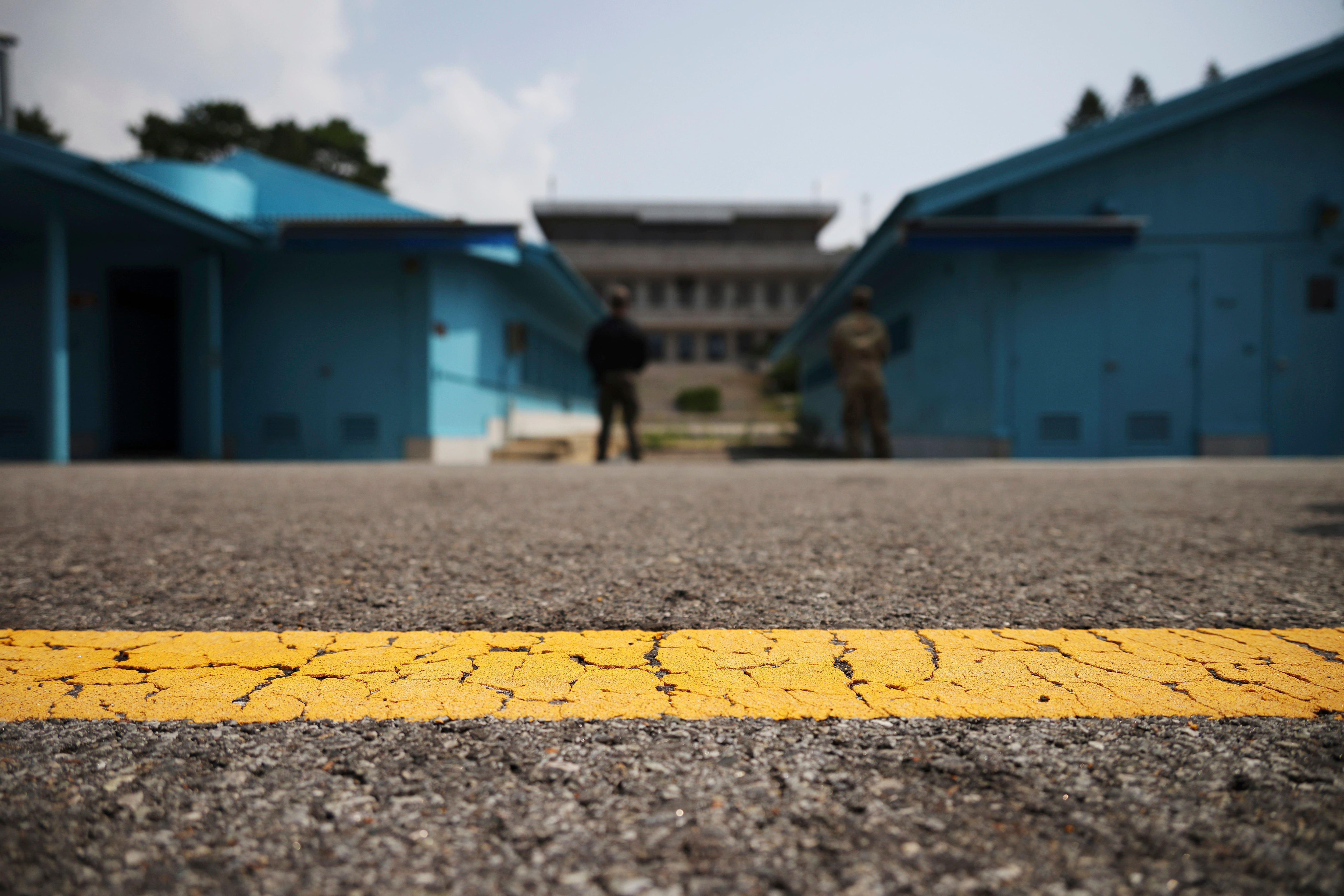
Panmunjom, located inside the 248-kilometer-long (154-mile-long) Demilitarized Zone, has been jointly overseen by the U.N. Command and North Korea since the close of the Korean War.
Bloodshed has occasionally occurred there, but it has also been a venue for diplomacy and tourism, drawing visitors who want to see the Cold War’s last frontier. No civilians live there, but North and South Korean soldiers face off while tourists on both sides snap photographs.
A small number of U.S. soldiers went to North Korea during the Cold War, including Charles Jenkins, who deserted his army post in South Korea in 1965 and fled across the DMZ. He appeared in North Korean propaganda films and married a Japanese nursing student who was abducted from Japan by North Korean agents. Jenkins died in Japan in 2017.
In recent years, some American civilians have been arrested in North Korea on allegations of espionage, subversion and other anti-state acts, but were released after the U.S. sent high-profile missions to secure their freedom. The last releases occurred in 2018.
Those releases stood in striking contrast to the fate of Otto Warmbier, an American university student who died in 2017, days after he was released by North Korea in a coma following 17 months in captivity.