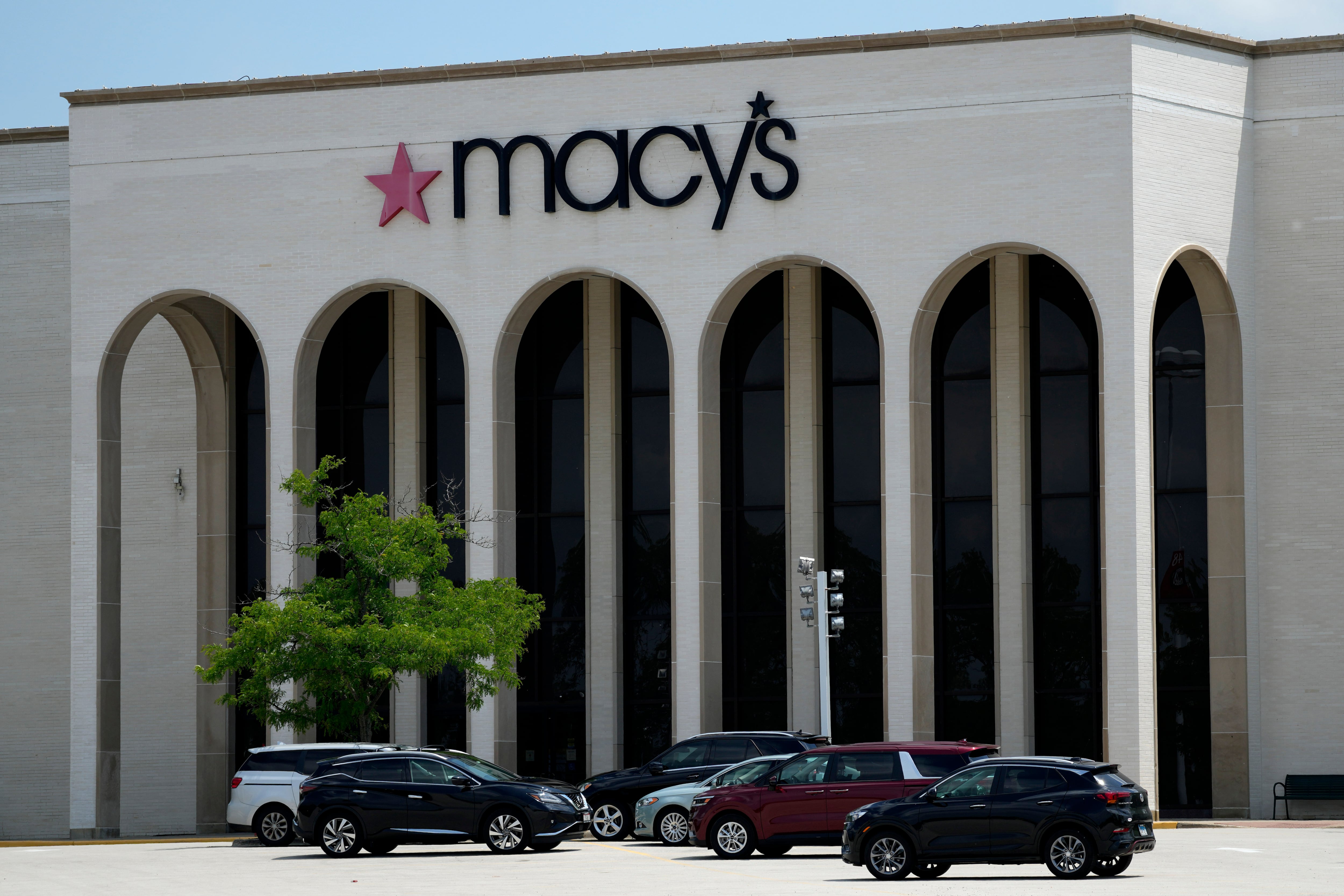
NEW YORK (AP) — Macy’s sales and profit slipped in its first quarter and the department store, citing more cautious customers and the impact that a trade war launched by the U.S., trimmed its profit forecast for 2025.
The New York retailer, however, topped most performance expectations for the first three months of the year and maintained its annual sales forecast.
Yet Macy’s CEO Tony Spring said that after seeing almost no price increases linked to tariffs in the first quarter, some “limited” price increases are appearing now, leading to the more cautious annual profit outlook.
“I think it’s important to understand that we are not just broadly increasing price,” Spring said in a conference call Wednesday. “We’re being incredibly surgical about the situation with tariffs.”
The company is diversifying the origin of its products as well, and will pull items when the math doesn’t work, he said.
About 20% of Macy’s products came from China at the end of its last fiscal year. Private brands sourced approximately 27% from China, down from 32% last year.
“With the recent announcement of these tariffs, we’ve renegotiated orders with suppliers,” Spring said. “We’ve canceled or delayed orders where the value proposition is just not where it needs to be.”
Shares rose 1% Wednesday.
Sales at Macy’s, which also owns upscale Bloomingdale’s and the Bluemercury cosmetics chain, dropped to $4.79 billion, from $5 billion a year earlier. That’s better than the $4.42 billion that analysts polled by FactSet expected.
Comparable sales, which include those online, dipped 2%. There was comparable store sales growth at Bloomingdale’s and Bluemercury.
Neil Saunders, managing director of GlobalData, said it wasn’t a bad quarter for Macy’s, particularly as the retailer closes underperforming locations.
Macy’s said previously that it would close 66 stores, mostly in the first quarter.
“The 2.0% dip in comparable sales is below market growth but is not entirely unexpected,” Saunders wrote. “It is also, barring the robust holiday quarter, a somewhat better performance than Macy’s delivered across most of the last fiscal year.”
For the period ended May 3, Macy’s earned $38 million, or 13 cents per share. That compares with $62 million, or 22 cents per share, a year ago.
Stripping out one time charges, earnings were 16 cents per share, which topped Wall Street’s estimate by a penny.
The company stuck by its 2025 sales forecast which ranged from $21 billion to $21.4 billion. But it now expects full-year adjusted earnings between $1.60 and $2 per share. Its prior forecast was for an adjusted profit of $2.05 to $2.25 per share.
Industry analysts had been projecting full-year sales of $21.03 billion and an adjusted per-share profit of $1.91.
Macy’s and other retailers are wrestling with uncertainty about tariffs which are making it difficult to plan. The same goes for many American consumers who have are growing increasingly uncomfortable about the U.S. economy and watching their spending.
American Eagle Outfitters withdrew its annual financial outlook earlier this month citing “macro uncertainty” and said it would write down $75 million in spring and summer merchandise.
Ross Stores withdrew its forecast last week.
Walmart, the nation’s largest retailer, got a public scolding from President Donald Trump this month after it said that it has already raised prices on some items and would have to do so again this summer. Trump told the retail giant that it should “eat” the additional costs.
Target’s sales fell more than expected in the first quarter and it warned they will continue to flag this year.
Home Depot, too, said that it will eat some of the costs but that some goods heavily impacted by the trade war will no longer be on shelves.
Trump’s threatened 145% import taxes on Chinese goods were reduced to 30% in a deal announced May 12, with some of the higher tariffs on pause for 90 days. Trump on Friday threatened a 50% tax on all imports from the European Union as well as a 25% tariff on smartphones unless they’re made in America.
On Sunday, however, Trump said that the U.S. will delay implementation of a 50% tariff on goods from the EU until July 9 to negotiate.
Spring, Macy’s CEO, said there has been some success with vendors on lowering prices, but the department store is absorbing some costs as well.
“We’re making selective price increase in selective brands, selective categories, because we believe the value equation for the customer is still very relevant,” Spring said. “So some of the impact on our gross margin this year is going to be around the tariffs, but we’re also investing in getting market share because we really do believe as we get into the back half of the year, that price value dimension is going to be very critical.”