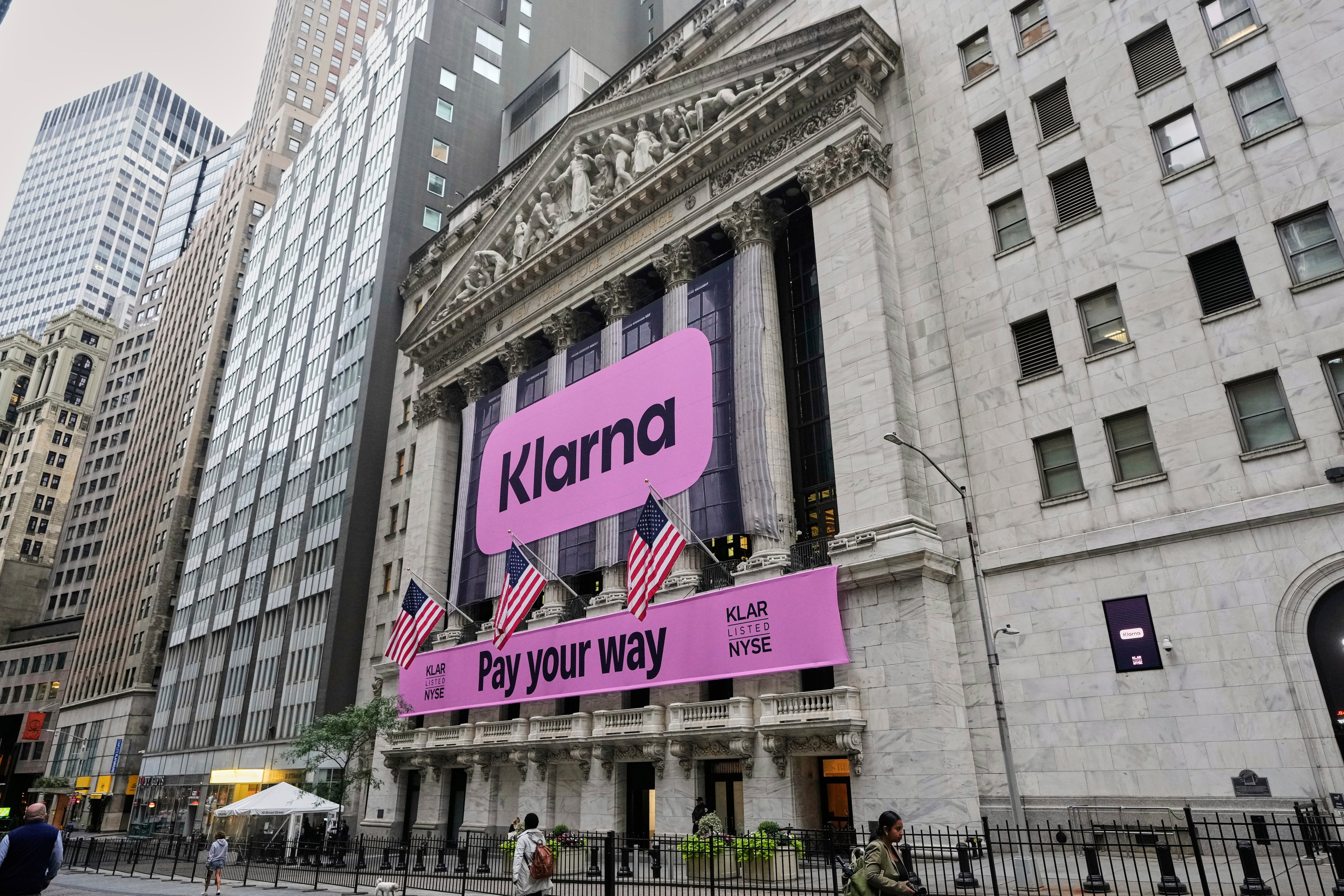
NEW YORK (AP) — Swedish buy now, pay later company Klarna is making its highly anticipated public debut on the New York Stock Exchange Wednesday, the latest in a run of high-profile initial public offerings this year.
The offering priced at $40 Tuesday, above the forecasted range of $35 to $37 a share, valuing the company at more than $15 billion.
The valuation easily makes Klarna one of the biggest IPOs so far in 2025, which has been one of the busier years for companies going public. Other popular IPOs so far this year include the design software company Figma and Circle Internet Group, which issues the USDC stablecoin. Investors are also looking forward to the expected market debuts of the ticket exchange StubHub and the cryptocurrency exchange Gemini, which is majority owned by the Winklevoss twins.
Founded in 2005 as a payments company, Klarna entered the U.S. buy now, pay market in 2015 in partnership with department store operator Macy’s. Since then, Klarna has expanded to hundreds of thousands of merchants and has embedded itself in internet browsers and digital wallets as an alternative to credit cards. The company recently announced a partnership with Wal-Mart.
The company started trading under the symbol “KLAR.” While Klarna was founded in Sweden and is a popular payment service in Europe, company executives said they made the decision to go public in the U.S. as a signal that Klarna’s future growth opportunities lay with the American shopper.
“It’s the largest consumer market in the world, and it’s the biggest credit card market in the world. It’s a tremendous opportunity, from our perspective,” said Sebastian Siemiatkowski, CEO and co-founder, in an interview with The Associated Press.
Over the years and in multiple interviews, Siemiatkowski has made it clear that Klarna is looking to steal away customers from the big credit card companies, and sees credit cards as a high-interest, exploitative product that consumers rarely use correctly.
Klarna’s most popular product is what’s known as a “pay-in-4” plan, where a customer can split a purchase into four payments spread over six weeks. The company also offers a longer-term payment plan where it charges interest. The business model has caught on globally, particularly among consumers who are reluctant to use credit cards. The company said 111 million consumers worldwide have used Klarna for a purchase.
Klarna and other buy now, pay later companies have attracted increased public interest in recent years, as the business model has caught on. State and federal regulators, as well as consumer groups, have expressed some degree of worry that consumers may overextend themselves financially on these buy now, pay later loans just as much as they do with credit cards.
Siemiatkowski says the company is actively monitoring how consumers use their products, and the average balance of Klarna user is less than $100. Because the company issues loans that are six weeks or less, Klarna argues it can more easily adjust its underwriting standard depending on economic conditions.
Ahead of going public, Klarna reported in August that it had second-quarter revenues of $823 million and had an adjusted profit of $29 million. The delinquency rate on Klarna’s “pay-in-4” loans is 0.89% and on its longer-term loans for bigger purchases, the delinquency rate is 2.23%. Those figures are below the average 30-day delinquency rates on a credit card.
Klarna will now be the second-largest buy now, pay later company on U.S. public markets, behind Affirm. Shares of Affirm have surged more than 40% so far this year, valuing the company at around $28 billion, helped by a belief among investors that buy now, pay later companies may take away market share from traditional banks and credit cards.
Klarna’s primary underwriters for the IPO were JPMorgan Chase and Goldman Sachs.