By Lindsay Whitehurst and Seung Min Kim
Justice Sandra Day O’Connor, the Arizona rancher's daughter who became a voice of moderate conservatism as the first woman on the U.S. Supreme Court, was memorialized by President Joe Biden on Tuesday as a pioneer in the legal world who inspired generations of women.
Biden and Chief Justice John Roberts were among those who eulogized O'Connor at Washington National Cathedral. O’Connor retired from the high court in 2006 after more than two decades, and died Dec. 1 at age 93.
The president, a longtime senator who once chaired the Senate Judiciary Committee, began his remarks by recalling her 1981 confirmation hearing — a day that Biden described as momentous because of the history that she would make on the nation's most powerful court.
He called her “a pioneer in her own right” who shattered barriers in both the political and legal worlds, along with the “nation’s consciousness.” He said that 'her principles were deeply held and of the highest order.”
“How she embodied such attributes under such pressure and scrutiny helped empower generations of women in every part of American life, including the court itself — helping to open doors, secure freedoms and prove that a woman can not only do anything a man can do, but many times do it a hell of a lot — a heck of a lot better," the president said.
Biden added: "Excuse my language, Father.”
Roberts, in his eulogy, also highlighted O'Connor's trailblazing career and said her leadership shaped the legal profession, making it clear that justices were both men and women. She had a distinct style during arguments, often jumping in with a question that cut to the heart of a case, he said. That put her most important issues on the table quickly, in line with one of her favorite sayings: “Get it done.”
“She was so successful that the barriers she broke down are almost unthinkable today,” Roberts said, calling her a “strong, influential and iconic jurist.”
Roberts had initially been tapped to replace O'Connor, although during his confirmation process, he was nominated to be chief justice. He recalled how O'Connor, in response to questions from reporters about him, said the only issue with the then-nominee was that he didn't wear a skirt.
“My initial reaction was, of course, everything's negotiable,” Roberts said.
O’Connor was nominated in 1981 by President Ronald Reagan. Largely unknown on the national scene until her appointment, she would come to be referred to by commentators as the nation’s most powerful woman.
O’Connor wielded considerable influence on the nine-member court, generally favoring states in disputes with the federal government and often siding with police when they faced claims of violating people’s rights. Her impact could perhaps best be seen, though, on the court’s rulings on abortion. She twice helped form the majority in decisions that upheld and reaffirmed Roe v. Wade, the decision that said women have a constitutional right to abortion.
Thirty years after that decision, a more conservative court overturned Roe, and the opinion was written by the man who took her place, Justice Samuel Alito.
O’Connor was a top-ranked graduate of Stanford’s law school in 1952, but quickly discovered that most large law firms at the time did not hire women. She nevertheless built a career that included service as a member of the Arizona Legislature and state judge before her appointment to the Supreme Court at age 51.
When she first arrived, there wasn’t even a women’s bathroom anywhere near the courtroom. That was soon rectified, but she remained the court’s only woman until 1993, when Ruth Bader Ginsburg joined the court.
“She loved the law and the Supreme Court,” said Jay O’Connor, one of her three sons, during her memorial service. “She loved our country and our democracy. And most of all, she loved her family.”
She brought a formidable energy to her personal life as well, her son recalled, noting that her way of relaxing after a long day at work was “three rounds of tennis or 18 holes of golf.”
She was a voracious reader and, along with her husband John, a talented dancer — the couple took disco lessons in Arizona in the late 1970s. She also ran a bustling household as her three sons grew up, at times employing the same skills she used to question attorneys in the courtroom.
“She honed those skills grilling her sons about being out late on Saturday night,” he said.
The late justice’s final message to her three sons, Jay O’Connor said, included the guidance: “Our purpose in life is to help others along the way.”
“What a beautiful, powerful and totally Sandra Day O’Connor sentiment,” he said.
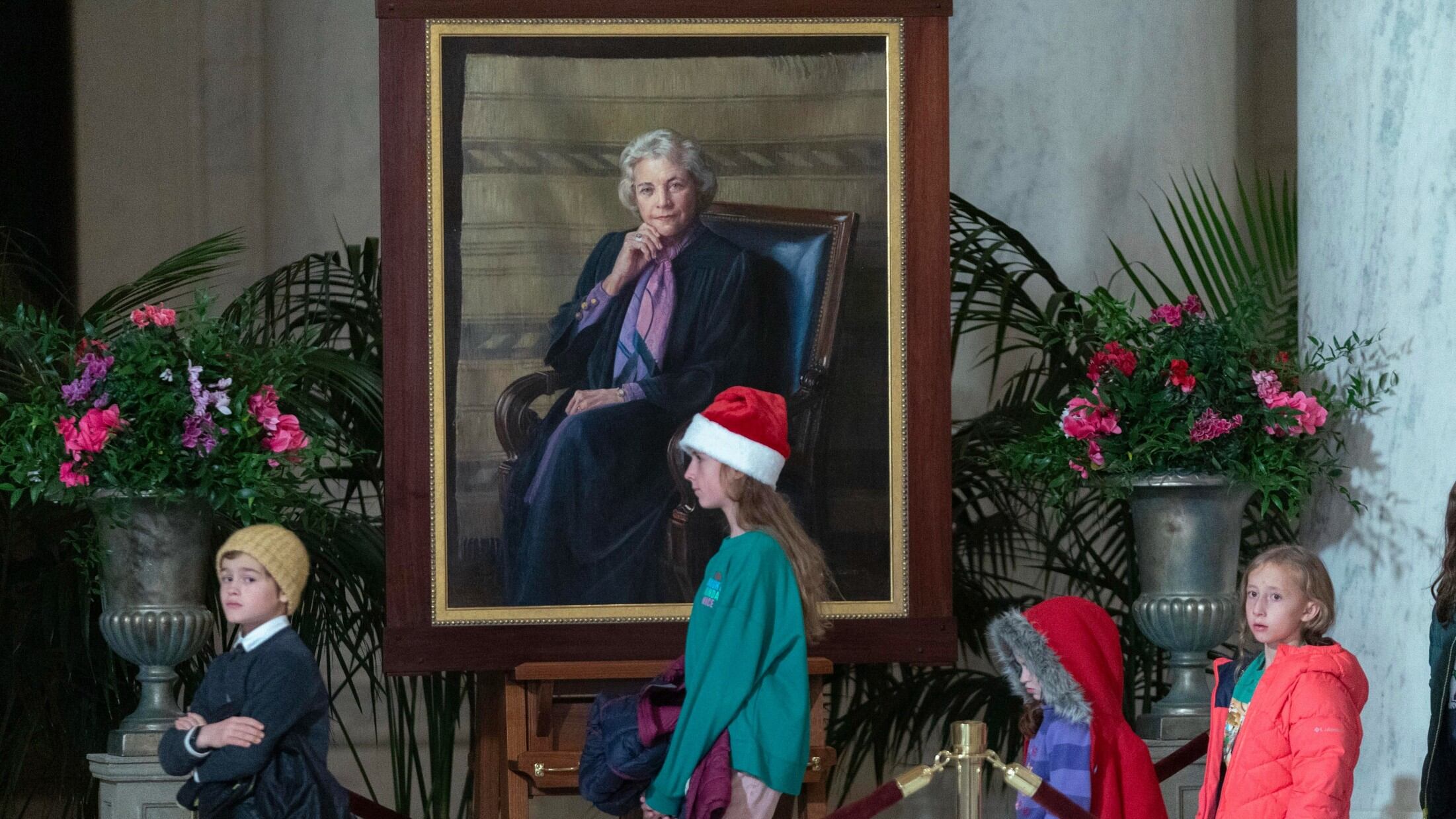
In a speech before her casket lay in repose Monday, Supreme Court Justice Sonia Sotomayor remembered O'Connor as a trailblazer and a “living example that women could take on any challenge, could more than hold their own in any spaces dominated by men and could do so with grace.”
O’Connor retired at age 75, citing her husband’s struggle with Alzheimer’s disease. She later expressed regret that a woman had not been chosen to replace her, but would live to see a record four women serving on the high court.
President Barack Obama awarded O’Connor the Presidential Medal of Freedom, the nation’s highest civilian honor.
She died in Phoenix of complications related to advanced dementia and a respiratory illness. Her survivors include a brother, three sons and grandchildren. The family plans to return her remains to her childhood home, the Lazy B Ranch in Arizona.
The family has asked that donations be made to iCivics, the group she founded to promote civics education.
Associated Press writers Mark Sherman and Chris Megerian contributed to this report.
Updated at 3:50 a.m. ET Dec. 20.