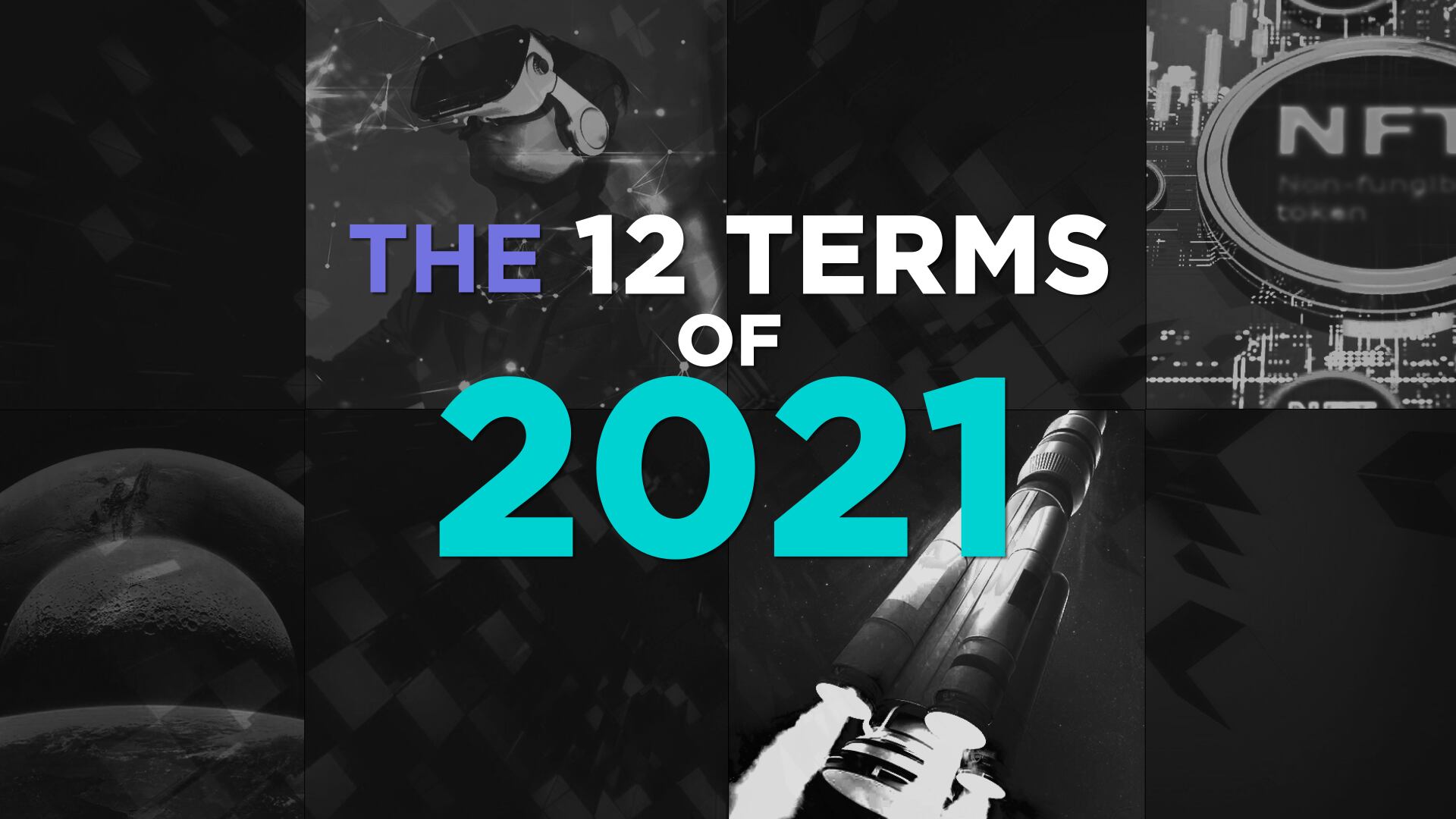
What was everyone talking about his year? In the spirit of the holidays, Cheddar presents the 12 days of the top terms we were saying, screaming, texting, and posting this year. So, we can all remember what there is to celebrate and how far we've all come.
Day 1: "To the Moon"
Definition: (verb) to indicate prices of an asset are predicted to go "through the roof" or "extremely high"
"To the moon" became the three-word rallying cry for cryptoheads this year (not a throwback to The Honeymooners). It means crypto prices are rising dramatically. In April, Tesla and SpaceX founder and well-known crypto fiend Elon Musk tweeted out "Everything to the moon!" which appeared to be a reference to rising Dogecoin prices. The cost of a Dogecoin did, in fact, blast off, going from about 7 cents to 75 cents right after that tweet. Now it's back to trading around 20 cents, where it's been since July.
Day 2: Metaverse
Definition: (noun) a virtual-reality space in which users can interact with a computer-generated environment and other users.
Ready to escape the physical world? Facebook, er, Meta, has got you covered! Mark Zuckerberg, who changed humanity with his social media platform, is ready to take us to the next level. In October the company announced it would change its name to Meta in order to emphasize its new focus on building a virtual world that will give friends a new way to hang out and offer another venue for advertisers to reach potential customers. Investors seem interested, and the price of metaverse-related stocks, like gaming platform Roblox and chipmaker Nvidia, soared on the news.
Day 3: Inflation
Definition: (noun) a general increase in prices and a fall in the purchasing value of money.
Did you try to buy a used car this year? Inflation. Did you try to buy gas for that car this year? Inflation. Did you try to buy literally anything else in the U.S. this year? Inflation. Friday we learned inflation is currently rising at the fastest point since 1982. At first, it was just impacting certain sectors, but by year-end, it was affecting pretty much everything. Wages have been rising, so that could offset some of the costs for some of the workers, but even pay isn't rising that fast. So buckle up because it's going to be at least a few more very expensive months.
Day 4: YOLO trade
Definition: (noun) derived from the acronym ‘You Only Live Once.’ Describes a trade where someone goes all-in on a stock.
Investors were spending, spending, spending this year, which sent the markets to record highs, even as indicators like unemployment and inflation at times gave a poor overview of the country's economic health. But the r/wallstreetbets crowd was shooting their shots with YOLO trades. Basically, a YOLO trade is when you put all of your money into one investment (a stock, a crypto, etc.) and hope for the best because, as the saying goes, you only live once.
Day 5: Infrastructure
Definition: (noun) the basic physical and organizational systems that uphold the structure of the economy.
This was the year bridges and roads finally got some respect. President Joe Biden put a massive amount of political capital behind his push to upgrade the building blocks that literally keep America running. Traditionally, when we think about infrastructure, we think about things like railroads and highways, but the $1.2 billion infrastructure spending bill that finally passed with bipartisan support in November also includes items like clean drinking water, a system of electric vehicle chargers, and high-speed internet. Its sister bill, dubbed Build Back Better, includes social spending on things like child care and early education, home health aides, and a child tax credit. While physical infrastructure is a done deal, BBB is still on the table and facing pushback from both sides of the aisle.
Day 6: SPAC
Definition: (noun) abbreviation for Special Purpose Acquisition Company. Describes companies formed to raise money through initial public offerings (IPO) in order to later acquire or merge with an existing company.
2021 has been SPAC-tacular! Once an unusual way to bring a company to public markets, it now seems to be the method du jour for business leaders looking to cash in with less regulatory friction than the traditional IPO process. Some of the most notable SPACs of the year include Lucid Motors, WeWork, SoFi, Him and Hers Health, Redbox, and BuzzFeed.
Day 7: Transitory
Definition: (adjective) Of brief duration, not permanent.
Today's word took on a whole new meaning this year. "Transitory" was usually paired with "inflation." Prices for everything are soaring, but the Federal Reserve stance for most of the year was that it wasn't a permanent situation. It was just supposed to be temporary as the economy worked its way out of pandemic-era conditions. That recently changed. Fed Chair Jerome Powell confirmed that inflation in the U.S. is no longer considered transitory. To deal with regular ol' booming inflation, the body will be speeding up bond tapering immediately and could start raising interest rates next year.
Day 8: Supply Chain
Definition: (noun) a system of organizations, people, activities, information, and resources involved in supplying a product or service to a consumer.
Before 2021, we all knew what a supply chain was. But I'm not sure that most of us cared until 2021. Toilet paper, refrigerators, cars, holiday gifts — all of it had us freaking out when we needed to buy this stuff. COVID quarantines and regulations caused slowdowns across the world. Because we import so many goods, if a factory had to shut down overseas, it meant our goods were delayed. If a massive cargo ship got stuck and blocked the critical Suez Canal for nearly a week, our goods were delayed. If there weren't enough longshoremen at U.S. ports or enough truck drivers for final delivery, our goods were delayed. Most of us ultimately got what we needed, even if it wasn't the brand we wanted, but scarce resources meant pent-up demand, and with rising demand and waning supply, prices rose too. (See Day 3: Inflation.)
Day 9: NFT
Definition: (noun) The abbreviation of non-fungible token, can be used as a unique and non-interchangeable unit of data stored on a digital ledger.
2021 brought up new objects to buy beyond the physical world. NFTs, in essence, are pieces of art that exist only online. Like traditional art, the value of these pieces lies in market perception — how much buyers think an NFT is worth, because, frankly, we can all right-click and hit save and have our own copies of these works. The world really began to embrace them this year, with artists like Beeple and Grimes setting the stage with multimillion-dollar deals, auction houses making a killing on these works, and corporations using the technology on everything from baseball cards to Power Rangers for revenue and promotion.
Day 10: HODL
Definition: (verb) “hold on for dear life.” It refers to retaining crypto assets that you own for an extended period, even throughout a highly volatile market movement. Stems from a misspelling of the word "hold"
It's been a good year for crypto. The big guys, like Bitcoin and Ethereum, have notched triple-digit percentage hikes, and some of the popular smaller players, like Dogecoin, are up even more. It hasn't always been a smooth ride, though, and investors have, at times, had to hold on for dear life (HODL) to their investments. For instance, Bitcoin hit 60,000 in April…and then plunged down to 30,000 by July — a heart-stopper for sure. But for those who HODL, things got much, much better in early November when it soared back up to a new record high…although it has since fallen off. For those crypto investors who have held onto their holdings this year, surely they're in for more excitement in 2022.
Day 11: The Fundamentals
Definition: (noun). Information related to a business’ profitability, revenue, assets, liabilities, and growth potential
“My investment in GameStop was based on the fundamentals,” Keith Gill told Congress in February. Gill, an aggressive investor in GameStop at the height of the meme stock craze, was asked if he understood what he was buying into when he bet big on the retail chain that had been underperforming for a long time. Some of the meme-stock rushes later in the year seemed to be a case of investors jumping on bizarre bandwagons, but at least with the craze that started it all — GameStop — early investors insist the bet was based on a solid foundation of financial data.
Day 12: Web3
Definition: (noun). Also known as Web 3.0, a version of the Internet where data is decentralized and based on peer-to-peer technologies
New year, new internet? The idea behind Web3 is that it's time for a newer, shinier, less-centralized internet based on blockchain that can offer better user privacy. There aren't many details about how, exactly, this would work, but it's already causing drama in the upper echelons of the tech industry. Jack Dorsey, founder of Twitter and Block (the company formerly known as Square) says venture capital firm Andreessen Horowitz is already involved…which seems to fly in the face of what supporters want to see coalesce because the current internet (Web2) is already run by the richest corporations in the world. Of course, avid blockchain supporter Elon Musk has some thoughts on this: enjoy an old David Letterman interview with Bill Gates to get an idea of where he thinks this could go next.